Question
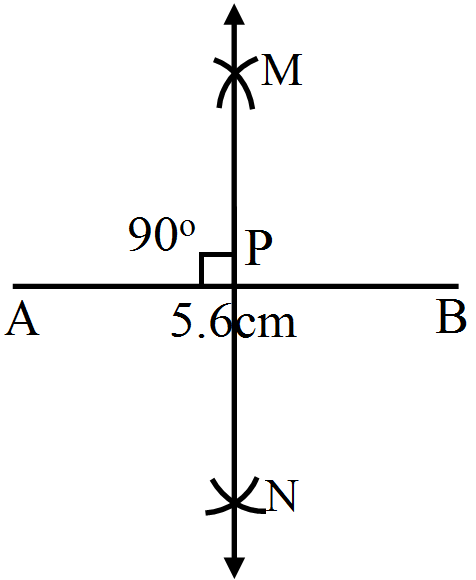
Draw a line segment AB = 5.6cm. Draw the right bisector of AB.
Answer


Steps for construction:
  1. Draw a line segment AB, which is equal to 5.6cm.
  2. With A as the centre and radius more than half of AB, draw arcs, one on each side of AB.
  3. With B as the centre and the same radius as before, draw arcs cutting the perviously drawn arcs at M and N, respectively.
  4. Draw MN, meeting AB at R.

Need a full question paper?

Generate a complete, print-ready paper with questions like this in minutes — across 16+ boards, with answer keys.
Start Generating Free

Similar questions

$7 \frac{1}{8}-6 \frac{1}{10}$
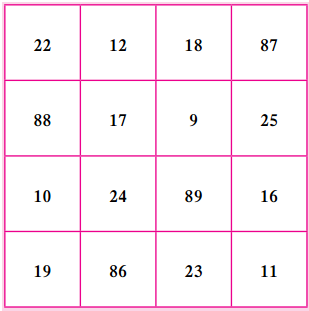
Ramanujan’s Magic square.

Image

  • Add the four numbers in the rows, the columns and along the diagonals of this square.
  • What is the sum?
  • Is it the same every time?
  • What is the peculiarity?
  • Look at the numbers in the first row, 22 – 12 – 1887. Find out why this date is special.

Obtain and read a biography of the great Indian mathematician Srinivasa Ramanujan.

Draw a line segment AB and bisect it. Bisect one of the equal parts to obtain a line segment of length $\frac{1}{2}(\text{AB}).$
Yashwant gives different amounts of time as shown below, to different exercises he does during the week. Draw a bar graph to show the details of his schedule using an appropriate scale.
Type of exercise Running Yogasanas Cycling Mountaineering Badminton
Time 35 minutes 50 minutes 1 hr 10 min 1(1)/(2) hours 45 minutes
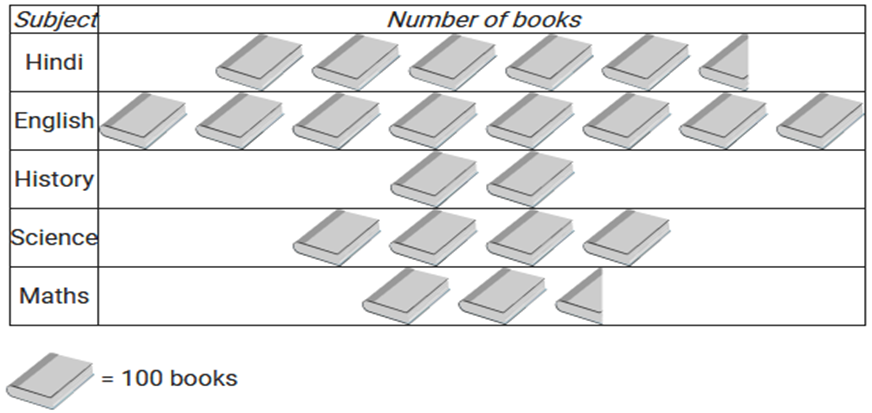
The pictograph shown different subject books which are kept in a library.
  1. How many English books are there in the library?
  2. How many maths books are there?
  3. Which books are maxmimum in number?
  4. Which books are minimum in number?
Following figures relate the weekly wages (in Rs.) of 15 workers in a factory:
300, 250, 200, 250, 200, 150, 350, 200, 250, 200, 150, 300, 150, 200, 250
Prepare a frequency table
  1. What is the range in wages (in Rs.)?
  2. How many Workers are getting Rs. 350?
  3. How many of workers are getting the minimum wages?
Carry out the following Divisions:
i. $\frac{2}{3} \div \frac{1}{4}$
ii. $\frac{5}{9} \div \frac{3}{2}$
iii. $\frac{3}{7} \div \frac{5}{11}$
iv. $\frac{11}{12} \div \frac{4}{7}$
Solve the following problems:
i. On the playground, if the children are made to stand for drill either 20 to a row or 25 to a row, all rows are complete and no child is left out. What is the lowest possible number of children in that school?

ii. Veena has some beads. She wants to make necklaces with an equal number of beads in each. If She makes necklaces of 16 or 24 or 40 beads, there is no bead left over. What is the least number of beads with her?

iii. An equal number of laddoos have been placed in 3 different boxes. The laddoos in the first box were distributed among 20 children equally, the laddoos in the second box among 24 children and those in the third box among 12 children. Not a single laddoo was left over. What was the minimum number of laddoos in the three boxes altogether?

iv. We observed the traffic lights at three different squares on the same big road. They turn green every 60 seconds, 120 seconds and 24 seconds. When the signals are switched on at 8 o’clock in the morning, all the lights were green. How long after that will all three signals turn green simultaneously again?

v. Given the fractions $\frac{13}{45}$ and $\frac{22}{75}$ Write their equivalent fractions with same denominators and add the fractions.

Find the largest number which divides 630 and 940 leaving remainders 6 and 4 respectively.
If we want to show the fractions $\frac{3}{10}, \frac{9}{20}, \frac{19}{40}$ on the number line, how big should the unit be?