Questions

5 Mark Question

Take a timed test

30 questions · self-marked practice — reveal the answer and mark yourself.

Question 15 Marks
Use a pair of compasses and construct the following angles:
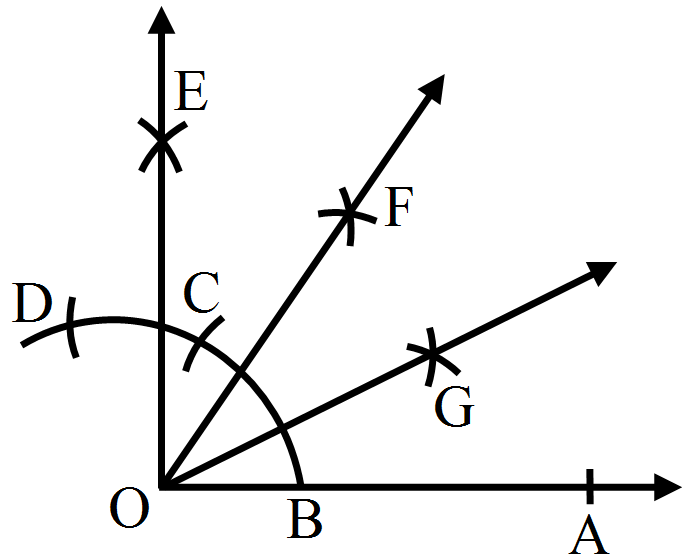
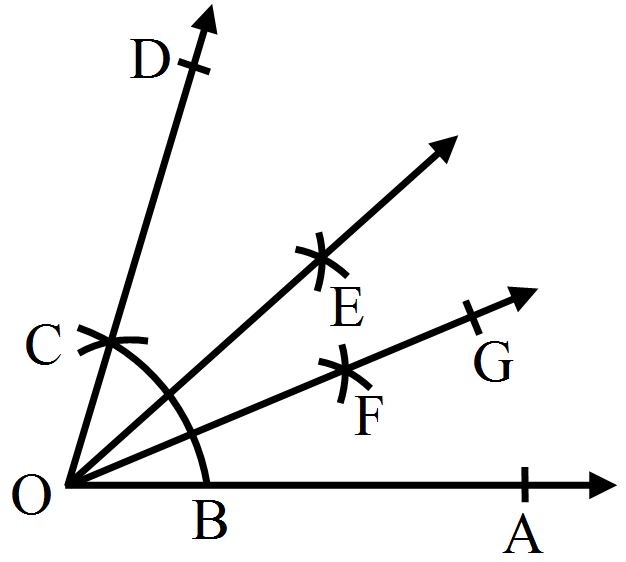
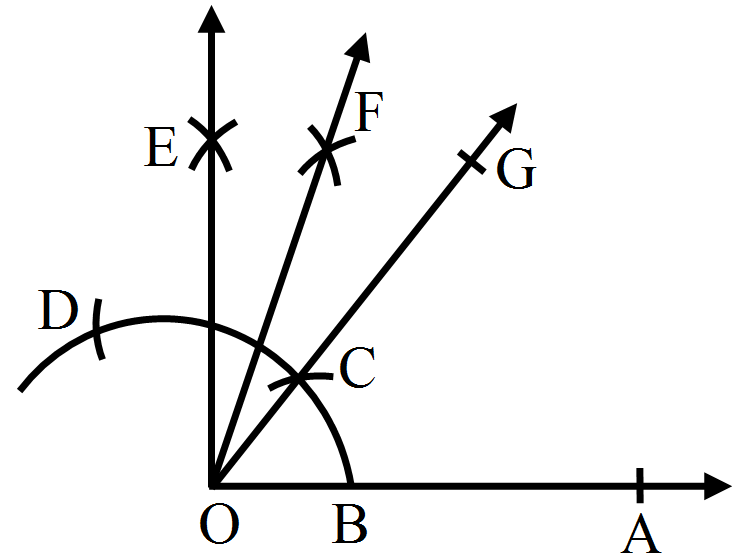
$22\frac{1}{2}^\circ$
Answer

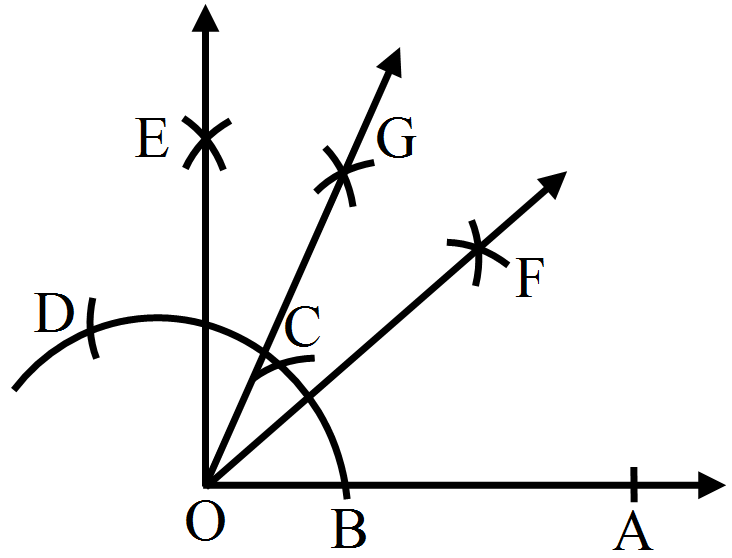
Steps of Construction:
  1. Draw a ray OA.
  2. With O as centre and any suitable radius draw an arc above OA, cutting it at B.
  3. With B as centre and same radius cut the previous arc at C and then with C as centre and same radius cut the arc at D.
  4. With C as centre and radius more than half CD draw an arc.
  5. With D as centre and same radius draw another arc to cut the previous arc at E.
  6. Join OE. Then ∠AOE = 90°.
  7. Draw the bisector OF of $\angle\text{AOE}.$
  8. Draw the bisector OG of $\angle\text{AOF}.$
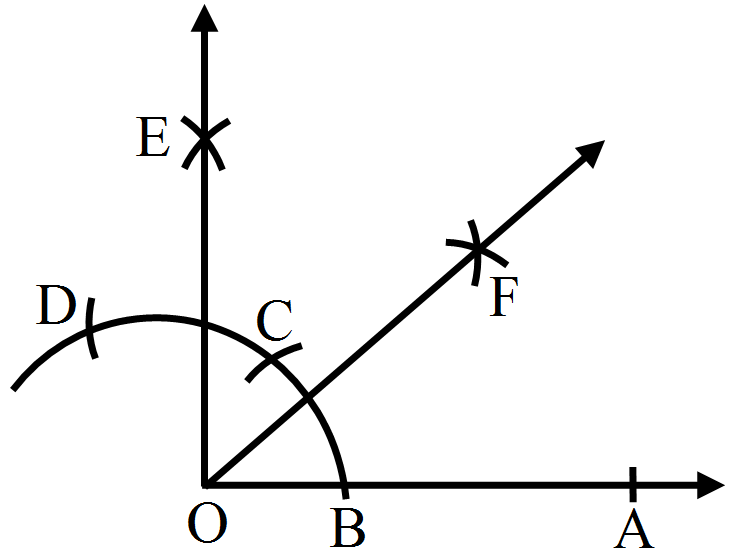
Then, $\angle\text{AOG}=22\frac{1}{2}^\circ$ is the required angle.
View full question & answer
Question 25 Marks
Use a pair of compasses and construct the following angles:
45°
Answer

Steps of Construction:
  1. Draw a ray OA.
  2. With O as centre and any su itable radius draw an arc above OA to cut it at B.
  3. With B as centre and same radius cut the previous arc at C and then with C as centre and same radius cut the arc at D.
  4. With C as centre and radius more than half CD, draw an arc.
  5. With D as centre and same radius draw another arc to cut the previous arc at E.
  6. Join OE. Then $\angle\text{AOE}=90^\circ.$
  7. Draw the bisector OF of angle $\angle\text{AOE}.$
Then, $\angle\text{AOF}=45^\circ$ is the required angle.
View full question & answer
Question 35 Marks
Use a pair of compasses and construct the following angles:
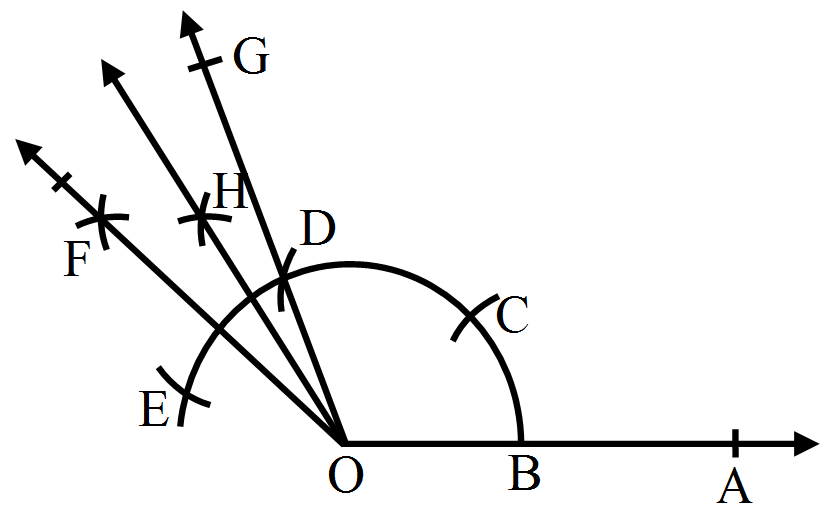
135°
Answer

Steps of Construction:
  1. Draw a ray OA.
  2. With O as centre and any suitable radius draw an arc above OA, cutting it at B.
  3. With B as centre and same radius as before draw another arc to cut the previous arc at C. With C as centre and same radius draw the arc to cut it at D. Again with D as centre and same radius cut the arc at E.
  4. Join OD and produce it to G. Then $\angle\text{AOG}=120^\circ.$
  5. With D as centre and radius more than half DE draw an arc.
  6. With E as centre and same radius draw another arc to cut the previous arc at F Join OF.
  7. Draw the bisector OH of $\angle\text{GOF}.$
Then, $\angle\text{AOH}=135^\circ$ is the required angle.
View full question & answer
Question 45 Marks
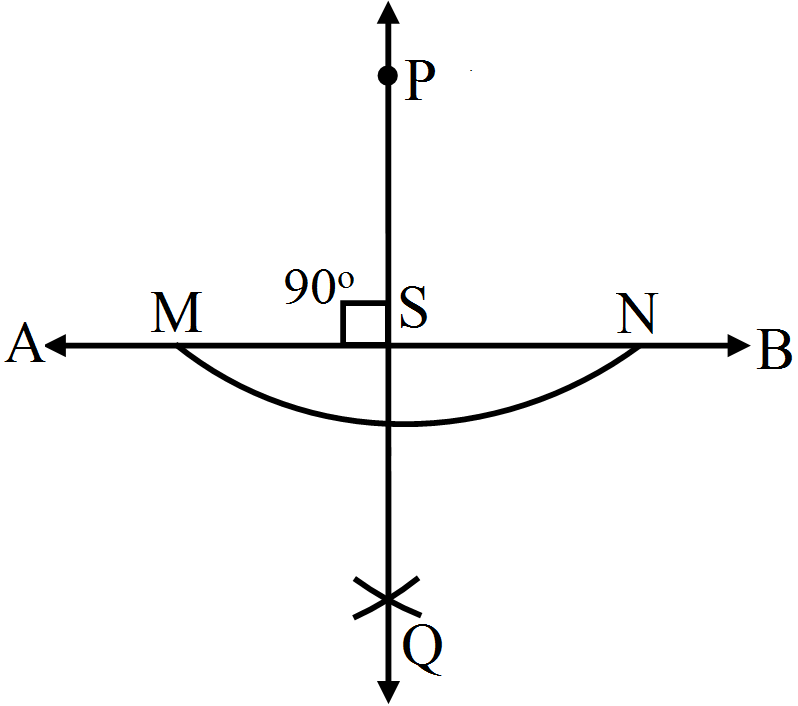
Draw a line AB. Take a point P outside it. Deaw a line passing through P and perpendicular to AB.
Answer

Steps for construction:
  1. Draw a line AB.
  2. Take a point P outside AB.
  3. With P as the centre and a convenient radius, draw an arc intersecting AB at M and N, respectively.
  4. With M as the centre and radius more than half of MN, draw an arc.
  5. With N as the centre and the same radius, draw an arc cutting the previously drawn arc at Q.
  6. Draw PQ meeting AB at S.
PQ is the required line that passes through P and is perpendicular to AB.
View full question & answer
Question 55 Marks
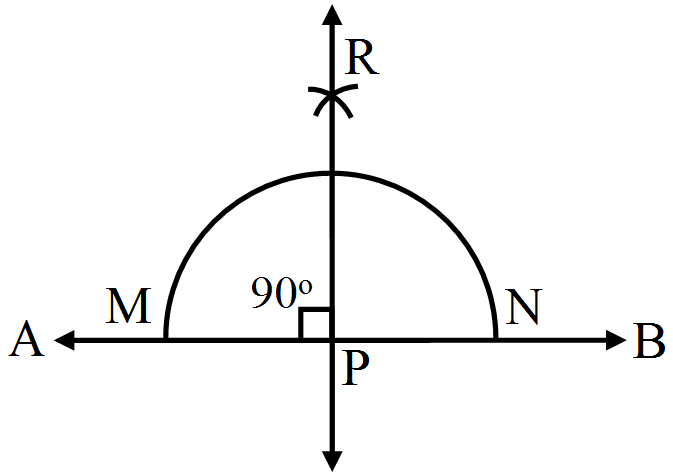
Draw a line AB. Take a point P on it. Draw a line passing through P and perpendicular to AB.
Answer

Steps for construction:
  1. Draw a line AB.
  2. Take a point P on line AB.
  3. With P as the centre, draw an arc of any radius, which intersects line AB at M and N, respectively.
  4. With M as the centre and radius more than half of MN, draw an arc.
  5. With N as the centre and the same radius as in step (4), draw an arc that cuts the previously drawn arc at R.
  6. Draw PR. PR is the required line, which is perpendicular to AB.
View full question & answer
Question 65 Marks
Use a pair of compasses and construct the following angles:
15°
Answer

Steps of Construction:
  1. Draw a ray OA.
  2. With O as centre and any suitable radius draw an arc above OA, cutting it at B.
  3. With B as centre and same radius as before draw another arc to cut the previous arc at C. Join OC and prouce it to D.
  4. Draw the bisector OE of $\angle\text{AQD}.$ Then $\angle\text{AOE}=30^\circ.$
  5. Draw the bisector OF of $\angle\text{AOE}.$
Then, $\angle\text{AOF}=15^\circ$ is the required angle.
View full question & answer
Question 75 Marks
Use a pair of compasses and construct the following angles:
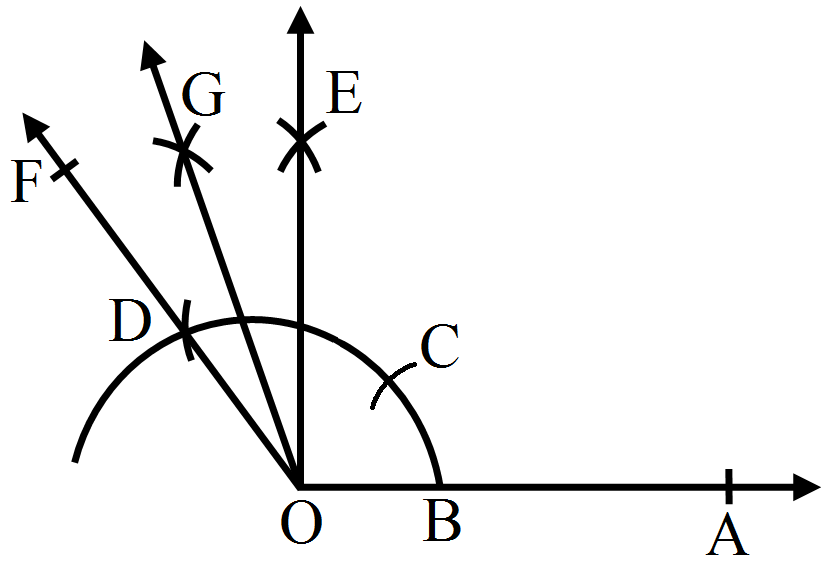
105°
Answer

Steps of Construction:
  1. Draw a ray OA.
  2. With O as centre and any suitable radius draw an arc cutting OA at B.
  3. With B as centre and same radius cut the previous arc at C and then with C as centre and same radius cut the arc at D.
  4. With C as centre and radius more than half CD draw an arc.
  5. With D as centre and same radius draw another arc to cut the previous arc at E.
  6. Join OE. Also join OD and produce it to F.
  7. Draw the bisector OG of $\angle\text{EOF}.$
Thus, $\angle\text{AOG}=105^\circ$ is the required angle.
View full question & answer
Question 85 Marks
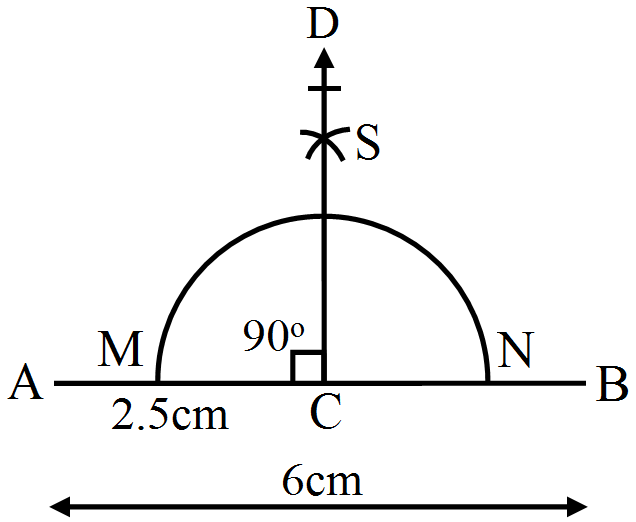
Draw a line segment AB = 6cm. Take a point C on AB such that AC = 2.5cm. Draw CD perpendicular to AB.
Answer

Steps of constructions:
  1. Draw a line segment AB, which is equal to 6cm.
  2. Take a point C on AB such that AC is equal to 2.5cm.
  3. With C as the centre, draw an arc cutting AB at M and N.
  4. With M as the centre and radius more than half of MN, draw an arc.
  5. With N as the centre and the same radius as before, draw another arc cutting the perviously drawn arc at S.
  6. Draw SC and produce it to D.
View full question & answer
Question 95 Marks
Use a pair of compasses and construct the following angles:
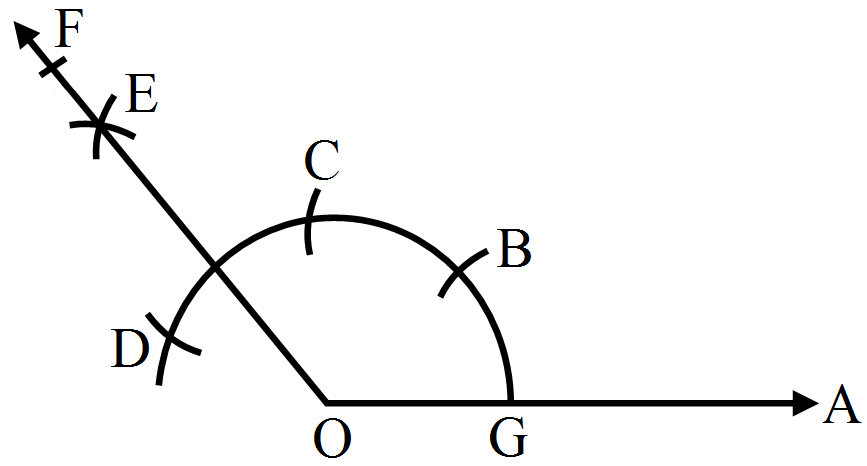
150°
Answer

Steps of Construction:
  1. Draw a ray OA.
  2. With O as centre and any suitable radius draw an arc cutting OA at G.
  3. With G as centre and same radius cut the arc at B and then B as centre and same radius cut the arc at C. Again, with C as centre and same radius cut the arc at D.
  4. With C as centre and radius more than half CD draw an arc.
  5. With D as centre and same radius draw another arc to cut the previous arc at E.
  6. Join OE and produce it to F.
Then, $\angle\text{AOF}=150^\circ.$
View full question & answer
Question 105 Marks
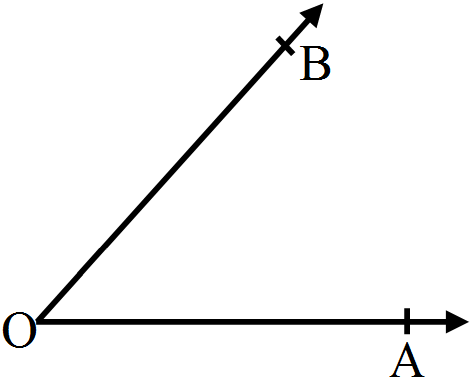
Draw an angle equal to $\triangle\text{AOB},$ given in the adjoining figure.
Answer

Here $\angle\text{AOB}$ is given.
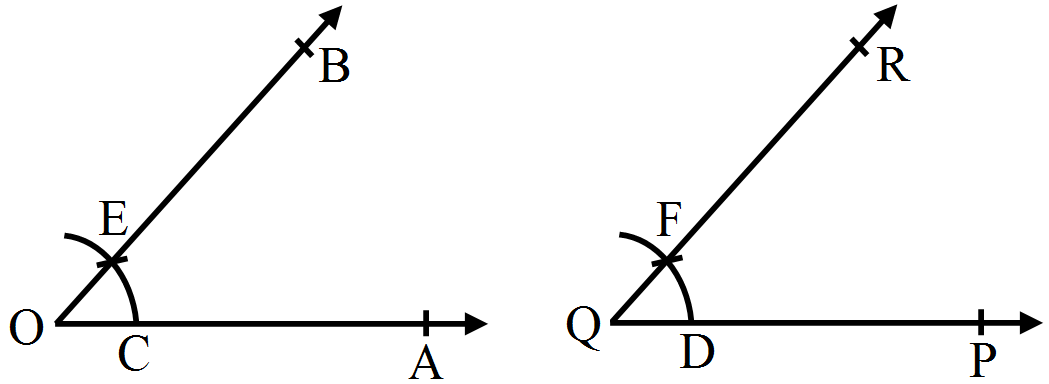
Steps for construction:
  1. Draw a ray QP.
  2. With O as the centre and any suitable radius, draw an arc cutting OA and OB at C and E, respectively.
  3. With Q as the centre and the same radius as in step (2), draw an arc cutting QP at D.
  4. With D as the centre and radius equal to CE, cut the arc through D at F.
  5. Draw QF and produce it to point R.
$\therefore\ \angle\text{PQR}=\angle\text{AOB}$
View full question & answer
Question 115 Marks
Construct an angle of 120° and bisect it.
Answer

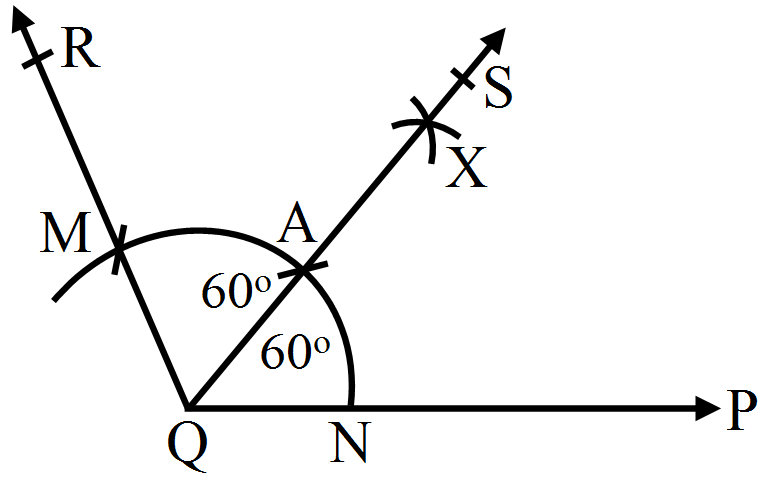
Steps of construction:
  1. Draw a ray QP.
  2. With Q as the centre and any convenient radius, draw an arc cutting QP at N.
  3. With N as the centre and the same radius, cut the arc at A. Again, with A as the centre and the same radius, cut the arc at M.
  4. Draw QM and produce it to R.
$\angle\text{PQR is 120}^\circ.$
  1. With M as the centre and radius more than half of MN, draw an arc.
  2. With N as the centre and the same radius mentioned in step (5), draw another arc, cutting the previously drawn arc at point X.
  3. Draw QX and produce it to point S.
Ray QS is a bisector of $\angle\text{PQR}.$ Ray QS is a bisector of $\angle\text{PQR}.$
View full question & answer
Question 125 Marks
Use a pair of compasses and construct the following angles:
75°
Answer

Steps of Construction:
  1. Draw a ray OA.
  2. With O as centre and any suitable radius draw an arc cutting OA at B.
  3. With B as centre and same radius* cut the previous arc at C and then with C as centre cut the arc at D.
  4. With C as centre and radius more than half CD draw an arc.
  5. With D as centre and same radius draw another arc to cut the previous arc at E.
  6. Join OE. Also join OC and produce it to G.
  7. Draw the bisector OF of $\angle\text{EOG}.$
Then, $\angle\text{AOF}=75^\circ$ is the required angle.
View full question & answer
Question 135 Marks
Use a pair of compasses and construct the following angles:
$67\frac{1}{2}^\circ$
Answer

Steps of Construction:
  1. Draw a ray OA.
  2. With O as centre and any suitable radius draw an arc above OA to cut it B.
  3. With B as centre and same radius cut the previous arc at C and then with C as centre and same radius cut the arc at D.
  4. With C as centre and radius more than half CD draw an arc.
  5. With D as centre and same radius draw another arc to cut the previous arc at E.
  6. Join OE. Then $\angle\text{AOE}=90^\circ.$
  7. Draw the bisector OF of $\angle\text{AOE}.$
  8. Draw the bisector OG of $\angle\text{EOF}.$
Then, $\angle\text{AOG}=67\frac{1}{2}^\circ$ is the required angle.
View full question & answer
Question 145 Marks
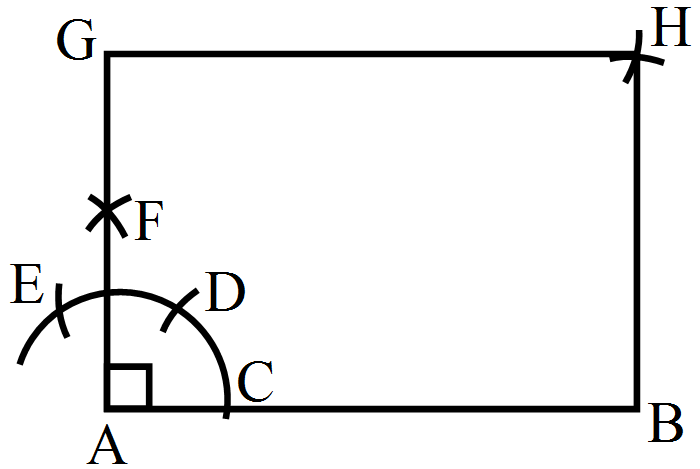
Draw a rectangle whose two adjacent sides are 5cm and 3.5cm. Make use of a pair of compasses and a ruler only.
Answer

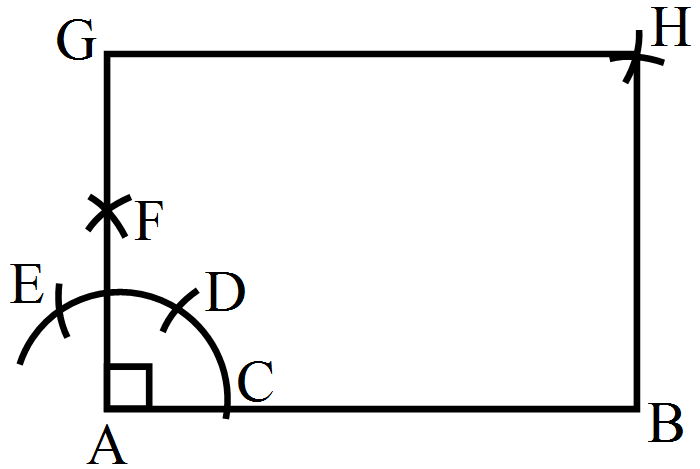
Steps of Construction:
  1. Draw a line-segment AB = 5cm with the help of a rular.
  2. With Aas centre and suitable radius draw an arc cutting AB at C.
  3. With C as centre and same radius cut the previous arc at D and then with D as centre and same radius cut the arc at E.
  4. With D as centre and radius more than half DE draw an arc.
  5. With E as centre and same radius draw another arc to cut the previous arc at F.
  6. Join AF and produce it to G such that AG = 3.5cm. Then $\angle\text{BAG}=90^\circ.$
  7. With G as centre and radius equal to AB draw an arc. With B as centre and radius equal to AG draw another arc to cut the previous arc at H.
  8. Join GH and BH. Then, AB HG is the required rectangle.
View full question & answer
Question 155 Marks
Draw $\angle\text{ABC}$ os measure 60° such that AB = 4.5cm and BC = 5cm and BC = 5cm. Through C draw a line parallel to AB and through B draw a line parallel to AC. Intersecting each other at D. Measure BD and CD.
Answer

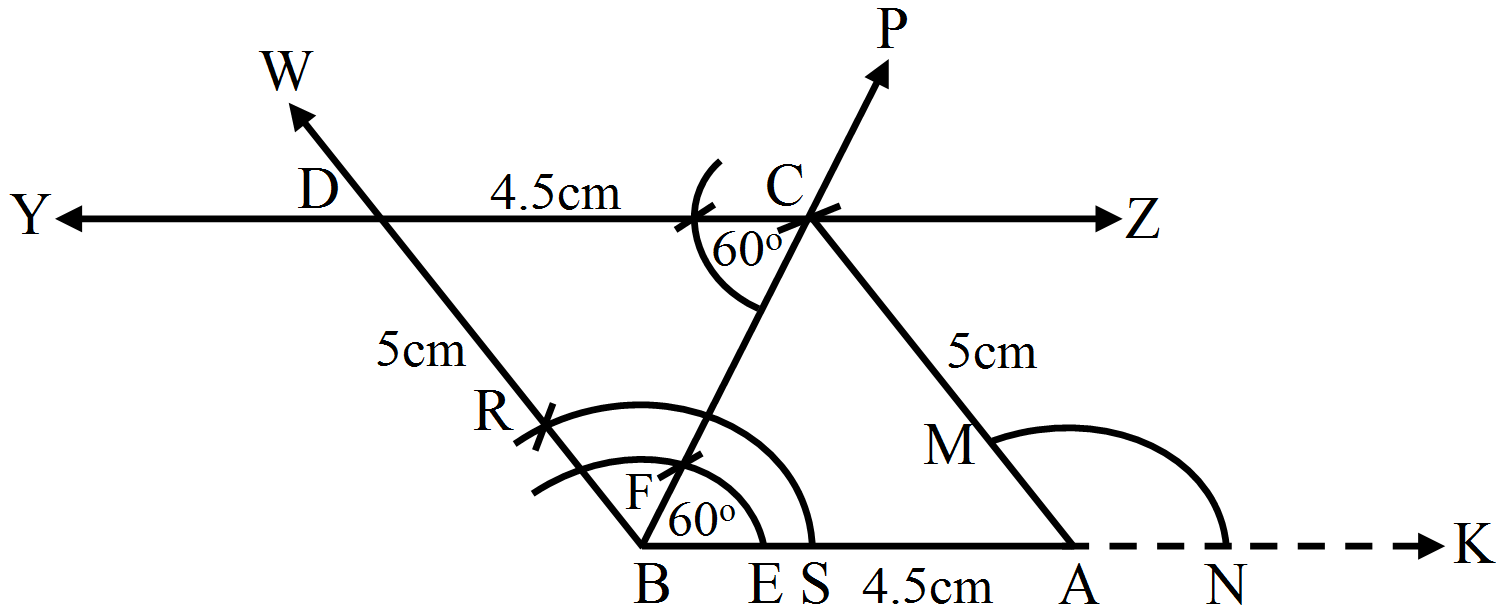
Steps for construction:
  1. Draw a line BX and take a point A, such that AB is equal to 4.5cm.
  2. Draw $\angle\text{ABP}=60^\circ$ with the help of protractor.
  3. With A as the centre and a radius of 5cm, draw an arc cutting PB at C.
  4. Draw AC.
  5. Now, draw $\angle\text{BCY}=60^\circ$
  6. Then, draw $\angle\text{ABW},$ such that $\angle\text{ABW}$ is equal to $\angle\text{CAX},$ which cut the ray CY at D.
  7. Draw BD.
When we measure BD and CD.
We have,
BD = 5cm and CD = 4.5cm.
View full question & answer
Question 165 Marks
Draw a reactangle whose two adjacent sides are 5.4cm and 3.5cm.
Answer

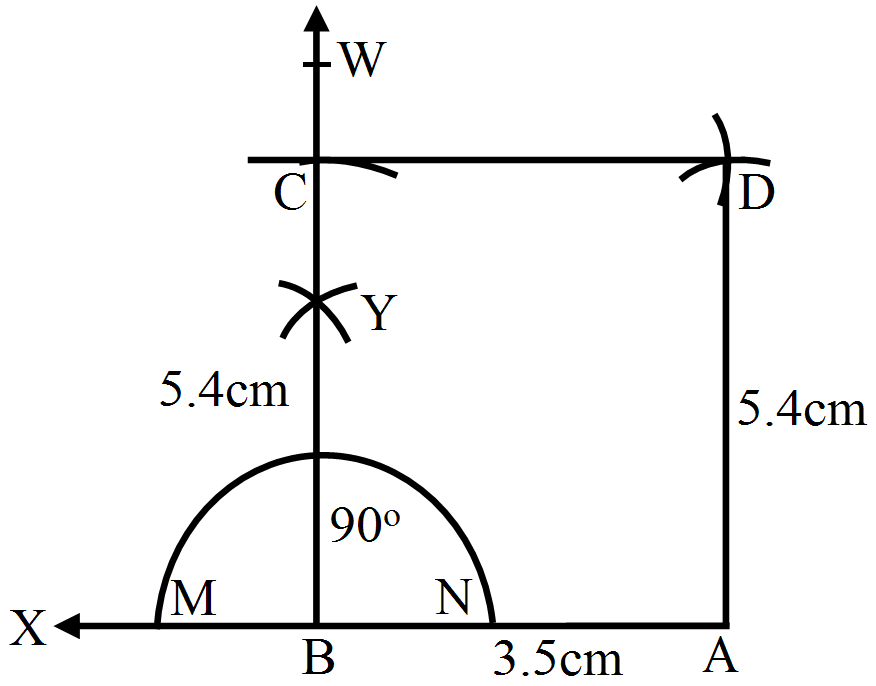
Steps of construction:
  1. Draw a ray AX.
  2. With A as the centre, cut the ray XA at B, such that AB is equal to 3.5cm.
  3. With B as the centre and with any convenient radius, draw an arc cutting AX at M and N.
  4. With N as the centre and with radius more than half of MN, draw an arc.
  5. With M as the centre and with the radius same as before, draw another arc to cut the previous arc at Y.
  6. Draw BY and produced it to W.
  7. With B as the centre and a radius of 5.4cm, cut ray BW at point C.
  8. With C as the centre and a radius 3.5cm, draw an arc on the right side of BC.
  9. With A as the centre and a radius 5.4cm, draw an arc cutting the previous arc at D.
  10. Join CD and AD.
ABCD is the required rectangle.
View full question & answer
Question 175 Marks
Draw an angle of 45°, using a pair of compasses.
Answer

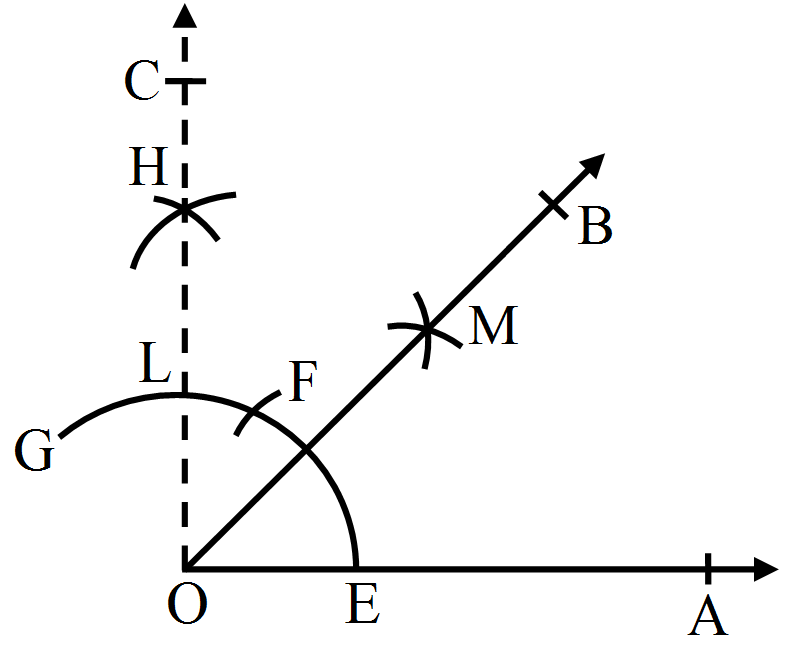
Steps of constructions:
  1. Draw a ray OA.
  2. With centre O and a suitable radius draw an arc meeting OA at E.
  3. With centre E and with same radius, cut the first arc firstly at F and then from F with same radius cut act at G.
  4. With centres F and G, with suitable radius, draw arcs intersecting each other at H.
  5. Join OH intersecting the first arc at L and produce it to C.
  6. With centre E and L and with suitable radius draw arcs intersecting each other at M.
  7. Join OM and produce it to B.
Then, $\angle\text{AOB}=45^\circ$
View full question & answer
Question 185 Marks
Draw a square, each of whose sides is 5cm. Use a pair of compasses and a ruler in your constribuction.
Answer

Steps of Construction:
  1. With the help of a ruler draw a line segment AB = 5cm.
  2. With A as centre and any suitable radius draw an arc cutting AB at C.
  3. With C as centre and same radius cut the previous arc at D and then with D as centre and same radius cut the arc at E.
  4. With D as centre and radius more than half DE draw an arc.
  5. With E as centre and same radius draw another arc to cut the previous arc at F.
  6. Join AF and produce it to G such that AG = 5cm.
  7. With G as centre and radius equal to AB draw an arc. With B as centre and same radius draw another arc to cut the previous arc at H.
  8. Join GH and BH.
Then, ABHG is the required square.
View full question & answer
Question 195 Marks
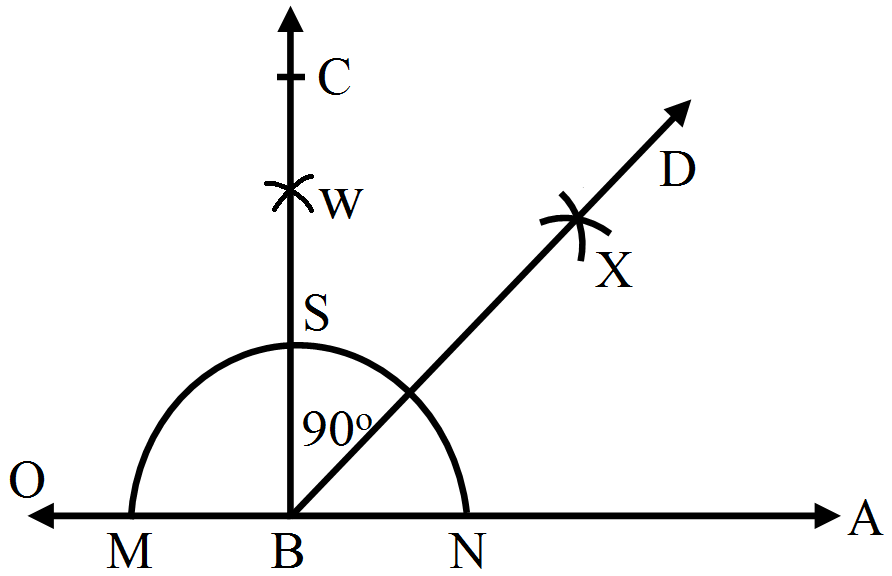
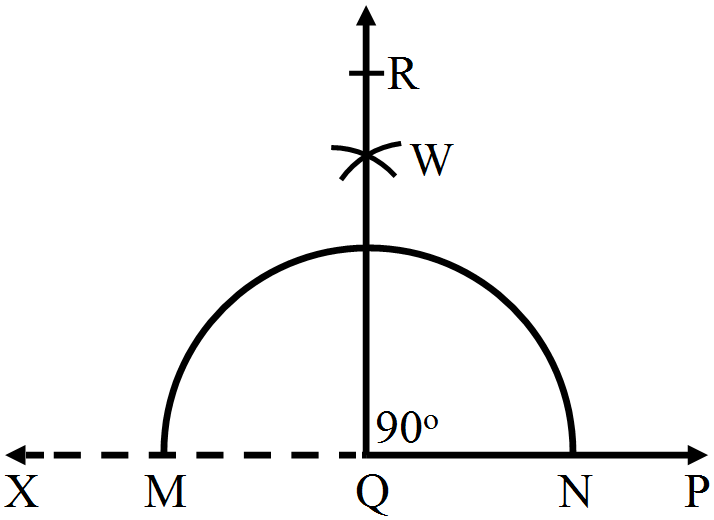
Construct an angle of 90° and bisect it.
Answer

Construction steps:
  1. Draw a line OA.
  2. Take a point B on OA. With B as the centre and any convenient radius, draw an arc cutting OA at M and N.
  3. With N as the centre and radius more than half of MN, draw an arc.
  4. With M as the centre and the same radius as before, draw another arc to cut the previous arc at W.
  5. Draw WB, meeting the arc at S. Produce it to C.
$\angle\text{ABC}$ is the required angle of 90° $\angle\text{ABC}$ is the required angle of 90°.
  1. With S as the centre and radius more than half of SN, draw an arc.
  2. With N as centre and the same radius as in step (6), draw another arc, cutting the previously drawn arc at point X.
  3. Draw BX and produce it to point D. Ray BD is the angle bisctor of $\angle\text{ABC}.$ Ray BD is the angle bisctor of $\angle\text{ABC}.$ Ray BD is the angl bisctor of $\angle\text{ABC}.$ Ray BD is the angle bisctor of $\angle\text{ABC}.$
View full question & answer
Question 205 Marks
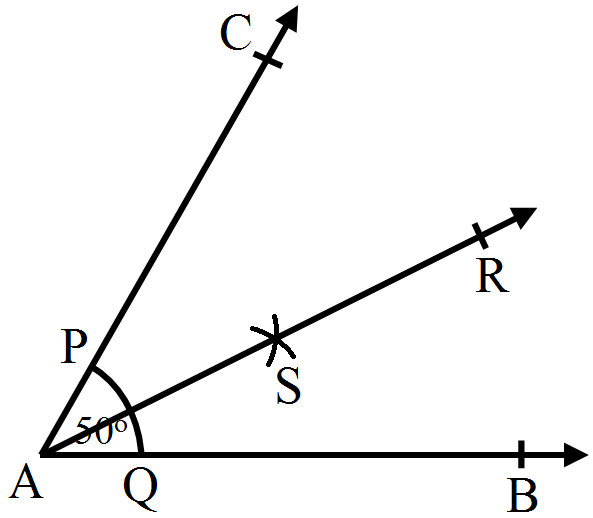
Draw an angle of 50° with the help of protractor. Draw a ray bisecting this angle.
Answer

Steps for construction:
  1. Draw $\angle\text{BAC}=50^\circ$ with the help of protractor.
  2. With A as the centre and any convenient radius, draw an arc cutting AB and AC at Q and P, respectively.
  3. With P as the centre and radius more than half of PQ, draw an arc.
  4. With Q as the centre and the same radius as before, draw another arc cutting the previously drawn arc at a point S.
  5. Draw SA and produce it to point R.
Then, ray AR bisects $\angle\text{BAC}.$
View full question & answer
Question 215 Marks
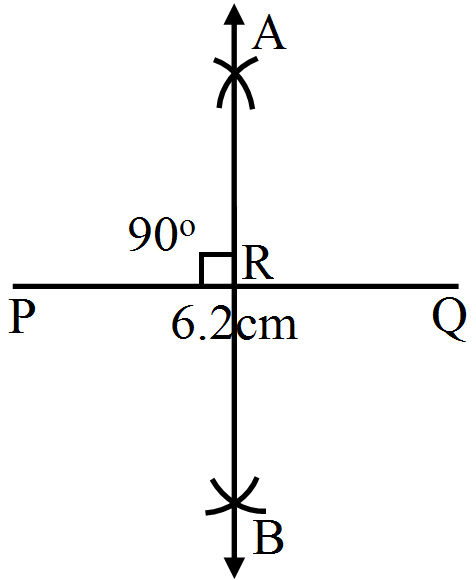
Draw a line segment PQ = 6.2cm. Draw the perpendicular bisector of PQ.
Answer

Steps for construction:
  1. Draw a line segment PQ, which is equal 6.2cm.
  2. With P as the centre and radius more than half of PQ, draw arcs, one on each side of PQ.
  3. With Q as the centre and the same radius as before, draw arcs cutting the perviously drawn arcs at A and B, respectively.
  4. Draw AB, meeting PQ at R.
View full question & answer
Question 225 Marks
Using a pair of compasses construct the following angles:
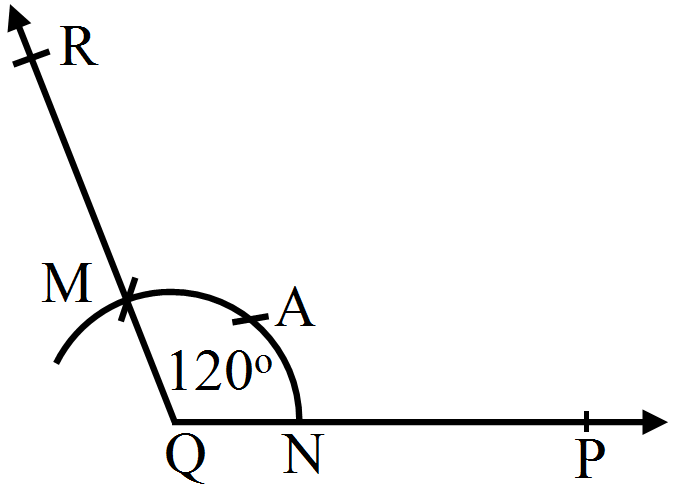
120°
Answer

Steps for construction:
  1. Draw a ray QP.
  2. With Q as the centre and any convenient radius, draw an arc cutting QP at N.
  3. With N as the centre and the same radius, cut the arc at A. Again, with A as the centre and the same radius, cut the arc at M.
  4. Draw QM and produce it to R.
$\angle\text{PQR}$ is the required angle of 120°.
View full question & answer
Question 235 Marks
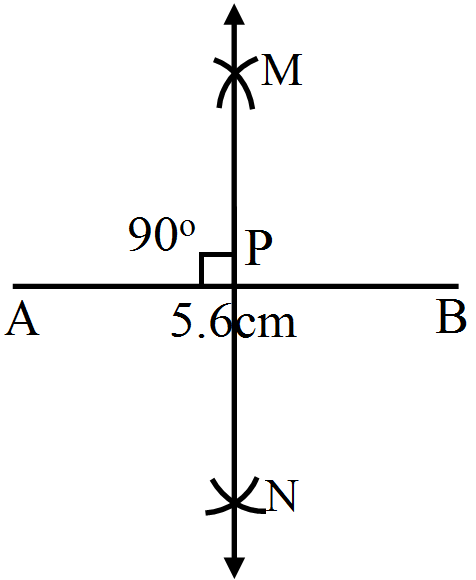
Draw a line segment AB = 5.6cm. Draw the right bisector of AB.
Answer

Steps for construction:
  1. Draw a line segment AB, which is equal to 5.6cm.
  2. With A as the centre and radius more than half of AB, draw arcs, one on each side of AB.
  3. With B as the centre and the same radius as before, draw arcs cutting the perviously drawn arcs at M and N, respectively.
  4. Draw MN, meeting AB at R.
View full question & answer
Question 245 Marks
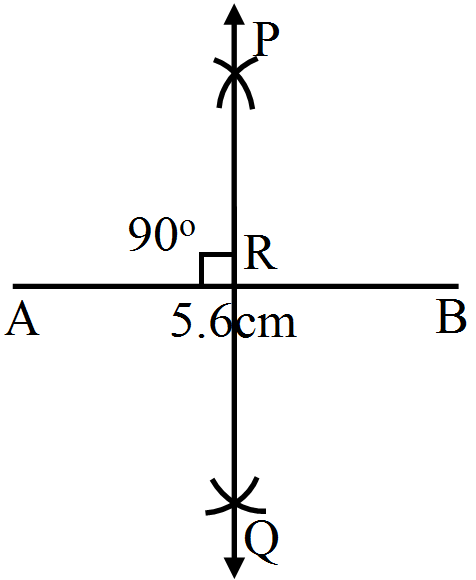
Draw a line segment AB = 5.6cm. Draw the perpendicular bisector of AB.
Answer

Steps for construction:
  1. Draw a line segment AB = 5.6cm.
  2. With A as the centre and radius more than half of AB, draw arcs, one on each side of AB.
  3. With B as the centre and the same radius as before, draw arcs cutting the perviously drawn arcs at P and Q, respectively.
  4. Draw PQ, meeting AB at R.
View full question & answer
Question 255 Marks
Using a pair of compasses construct the following angles:
90°
Answer

Steps for construction:
  1. Draw a line PX.
  2. Take a point Q on AC. With Q as the centre and any convenient radius, draw an arc cutting AX at M and N.
  3. With N as the centre and radius more than half of MN, draw an arc.
  4. With M as the centre and the same radius as before, draw another arc to cut the previous arc at W.
  5. Draw QW produce it to R.
$\angle\text{PQR}$ is required angle of 90°.
View full question & answer
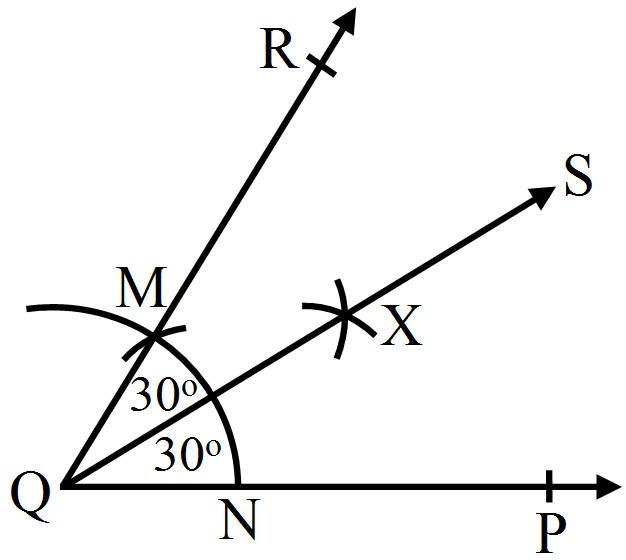
Question 265 Marks
Draw an angle of 60°, using a pair of compasses. Bisect it to make an angle of 30°.
Answer
  1. Draw a ray QP.
  2. Wth Q as the centre and any convenient radius,draw an arc cutting QP at N.
  3. With N as the centre and radius same as before, draw another arc to cut the previous arc at M.
  4. Draw QM and produce it to R.
$\angle\text{PQR}$ is an angle of 60°. $\angle\text{PQR}$ is an angle of 60°.
  1. With M as the centre and radius more than half of MN, draw an arc.
  2. With N as the centre and radius same as in step (5), draw another arc, cutting the previously drawn arc at point X.
  3. Draw QX and produce it to point S.
Ray QS is the bisector of $\angle\text{PQR}.$
View full question & answer
Question 275 Marks
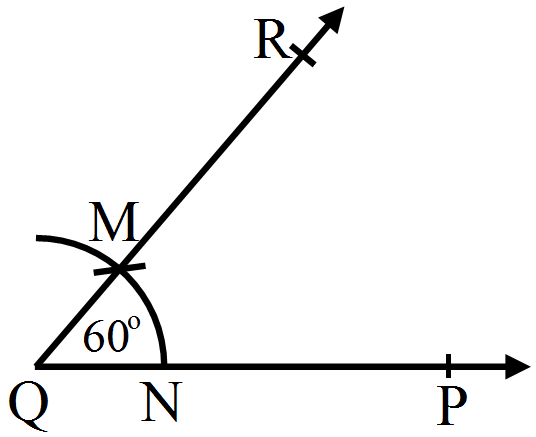
Using a pair of compasses construct the following angles:
60°
Answer

Steps of construction:
  1. Draw a ray QP.
  2. With Q as the centre and any convenient radius, draw an arc cutting QP at N.
  3. With N as the centre and the same radius as before, draw another arc to cut the previous arc at M.
  4. Draw QM and produce it to R.
$\angle\text{PQR}$ is the required angle of 60°.
View full question & answer
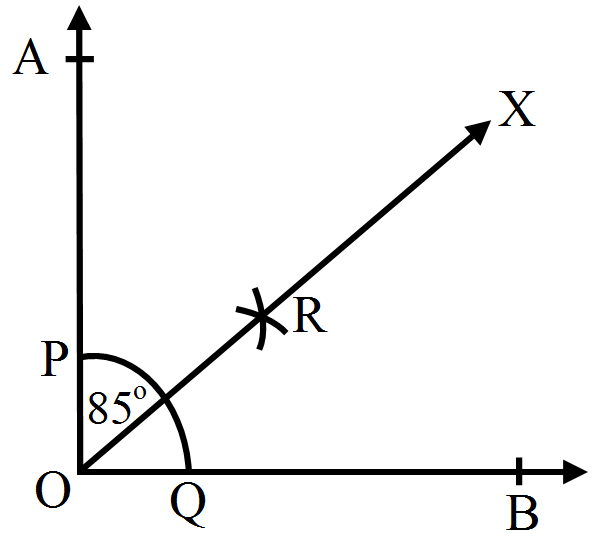
Question 285 Marks
Construct $\angle\text{AOB}=85^\circ$ with the help of a protractor. Draw a ray OX bisecting $\angle\text{AOB}.$
Answer

Steps for construction:
  1. Draw $\angle\text{AOB}=85^\circ$ with the help of a protractor.
  2. With O as the centre and any convenient radius, draw an arc cutting OA and OB at P and Q, respectively.
  3. With P as the centre and radius more than half of PQ, draw an arc.
  4. With Q as the centre and the same radius as before, draw another arc cutting the previously drawn arc at a point R.
  5. Draw RO and produce it to point X.
Then, ray OX bisects $\angle\text{AOB}.$
View full question & answer
Question 295 Marks
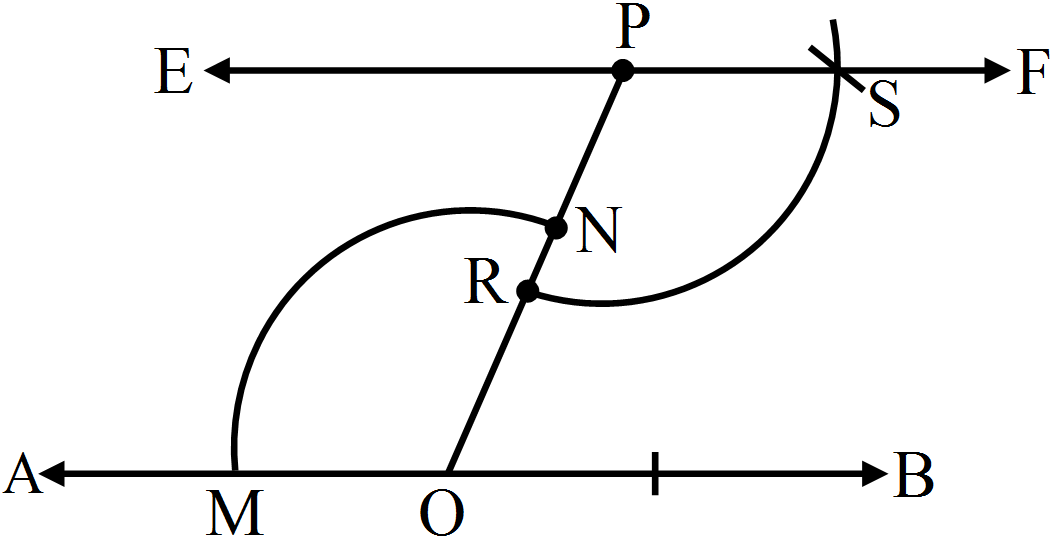
Draw a line AB. Take a point P outside it. Draw a line passing through P and parallel to AB.
Answer

Steps for construction:
  1. Draw a line AB.
  2. Take a point P outside AB and another point O on AB.
  3. Draw PO.
  4. Draw $\angle\text{FPO}$ such that $\angle\text{FPO}$ is equal to AOP.
  5. Extend FP to E.
Then, the line EF passes through the point P and EF || AB.
View full question & answer
Question 305 Marks
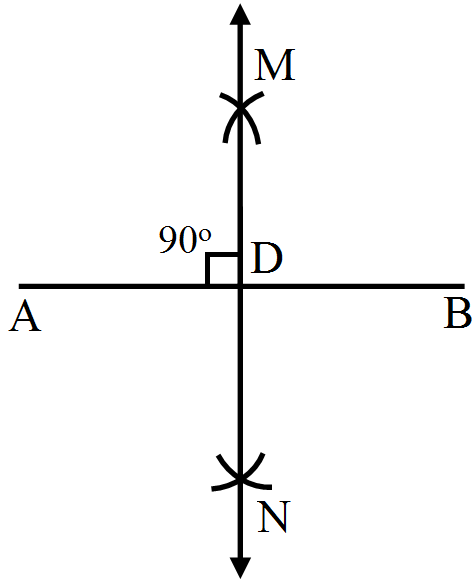
Draw the perpendicular bisector of a given line segment AB of length 6cm.
Answer

Steps for construction:
  1. Draw a line segment AB, which is equal to 6 cm.
  2. With A as the centre and radius more than half of AB, draw arcs, one on each side of AB.
  3. With B as the centre and radius same as before, draw arcs, cutting the perviously drawn arcs at M and N, respectively.
  4. Draw MN meeting AB at D.
MN is the required perpendicular bisector of AB.
View full question & answer