Question
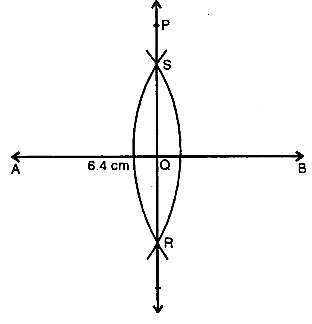
Draw a line segment of length 6.4 cm. Draw its perpendicular bisector.
Answer

Steps of Construction:
(i) Draw a line segment $A B=6.4 cm$.
(ii) With centres $A$ and $B$ and with some suitable radius, draw arcs intersecting each other at $S$ and $R$.
(iii) Join $S R$ intersecting $A B$ at $Q$. Then $P Q R$ is the perpendicular bisector of line segment $A B$

Need a full question paper?

Generate a complete, print-ready paper with questions like this in minutes — across 16+ boards, with answer keys.

Start Generating Free

Similar questions

The marks (out of 10) obtained by 35 students of a class are given in the following table :
Find the mean and the median.
Marks obtained 71102864593
Number of students 7020196451
Using empirical formula, calculate its mode.
The ratio between the areas of two circles is 16 : 9. Find the ratio between their :
(i) radius
(ii) diameters
(iii) circumference
The cost price of an article is Rs. 1,200 and selling price is times of its cost price. Find:
(i) selling price of the article
(ii) profit or loss as a percent.
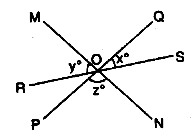
In the given figure, lines $P Q, M N$, and RS intersect at $O$. If $x: y=$ $1: 2$ and $z=90^{\circ}$, find $\angle R O M$ and $\angle P O R$.
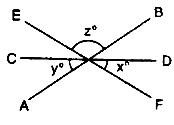
$A B, C D$ and $E F$ are three lines intersecting at the same point.
(i) Find $x$, if $y=45^{\circ}$ and $z=90^{\circ}$.
(ii) Find $a$, if $x=3 a, y=5 x$ and $r=6 x$.
If a boy works for six consecutive days for 8 hours, $7 \frac{1}{2}$ hours, $8 \frac{1}{4}$ hours, $6 \frac{1}{4}$ hours $+6 \frac{3}{4}$ hrs and 7 hours respectively. How much money will he earn at the rate of Rs. 36 per hour?
Oranges are bought at 100 for ?80 and all of them are sold at ₹80 for ₹100. Find the loss or gain as percent in this transaction.
Evaluate: $-\frac{11}{18}+\frac{-3}{9}+\frac{2}{-3}$
Evaluate: $\left(\frac{7}{8} \times \frac{24}{21}\right)+\left(\frac{-5}{9} \times \frac{6}{-25}\right)$
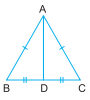
In the adjoining figure, $\triangle A B C$ is an isosceles triangle in which $A B=A C$ and $A D$ is the bisector of $\angle A$.
Prove that :
(i) $\triangle ADB \equiv \triangle ADC$
(ii) $\angle B =\angle C$
(iii) $BD = DC$
(iv) $AD \perp BC$
Image