Questions

[4 marks sum]

🎯

Test yourself on this topic

35 questions · timed · auto-graded

Question 14 Marks
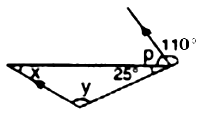
Find $x, y$ and $p$ is the given figure
Answer
In the figure,
∵ Lines are parallel
∴ y = 110° .........(corresponding angles)
But 25° + p + 110° = 180° .........(angles on a line)
⇒ p + 135° = 180°
⇒ p = 180°− 135° = 45°
⇒ x + y + 25° = 180° ......(sum of angles of a triangle)
⇒ x + 110° + 25° = 180°
⇒ x + 135° = 180°
⇒ x = 180°− 135° = 45°
Hence x = 45°, y = 110° and p = 45°
View full question & answer
Question 24 Marks
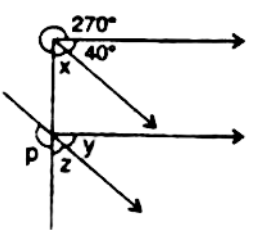
Find $x, y$ and $p$ is the given figure
Image
Answer
In the figure,
∵ Lines are parallel
∴ x = z .........(corresponding angles)
y = 40° ..........(corresponding angles)
But x + 40° + 270° = 360° .......(angles at a point)
⇒ x + 310° = 360°
⇒ x = 360°− 310° = 50°
∴ z = x = 50°
But p + z = 180° .......(linear pair)
⇒ p+ 50° = 180°
⇒ p = 180°− 50° = 130°
Hence x = 50°, y = 40°, z = 50° and p = 130°
View full question & answer
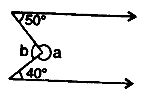
Question 34 Marks
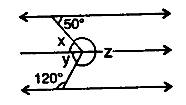
In the given figure, the directed lines are parallel to each other. Find the unknown angles.
Answer
From 0, draw a line parallel to the given parallel lines
∴ ∠1 = 50° .......(alternate angles)
∠2 = 40°
∴ b = ∠1 + ∠2 = 50° + 40° = 90°
But a + b = 360° ........(angles at a point)
∴ a + 90° = 360°
⇒ a = 360°− 90° = 270°
Hence a = 270°, b = 90°
View full question & answer
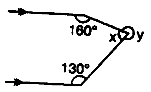
Question 44 Marks
In the given figure, the directed lines are parallel to each other. Find the unknown angles.
Answer
From 0, draw a line parallel to the given parallel lines
∴ Lines are parallel
∴ ∠1 = 160° and ∠2 = 130° .......(alternate angles)
∴ y = ∠1 + ∠2 = 160° + 130° = 290°
But x + y = 360° ........(angles at a point)
⇒ 290° + x = 360°
⇒ x = 360°− 290° = 70°
Hence x = 70°, y = 290°
View full question & answer
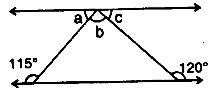
Question 54 Marks
In the given figure, the directed lines are parallel to each other. Find the unknown angles.

Answer
∵ Lines are parallel
∠a = ∠1 and ∠c = ∠2 .........(alternate angles)
But ∠1 + 115° = 180° .........(linear pair)
∴ ∠1 = 180°− 115° = 65°
Similarly ∠2 + 120° = 180°
∴ ∠2 = 180°− 120° = 60°
∴ ∠a = ∠1 = 65°, ∠c = ∠2 = 60°
But a + c + c = 180° ............(angles on a line)
⇒ 65° + b + 60° = 180°
⇒ b + 125° = 180°
⇒ b = 180°− 125° = 55°
Hence a = 65°, b = 55°, c =60°
View full question & answer
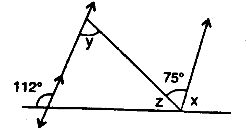
Question 64 Marks
In the given figure, the directed lines are parallel to each other. Find the unknown angles.
Answer
∵ Lines are parallel
∴ y = 75° ........(alternate angles)
∠1 + 112° = 180° .............(linear pair)
∠1 = 180°− 112° = 68°
∠1 = x ..........(corresponding angles)
∴ x = 68°
But x + 75 + z = 180° ......(angles on a line)
⇒ 68° + 75° + z = 180°
⇒ z = 143° = 180°
⇒ z = 180°− 143° = 37°
Hence x = 68°, y = 75°, z = 37°
View full question & answer
Question 74 Marks
In the given figure, the directed lines are parallel to each other. Find the unknown angles.

Answer
∵ Lines are parallel
∴ x = 50° ...........(alternate angles)
and y + 120° = 180° .......(co-interior angles)
∴ y = 180°− 120° = 60°
But x + y + z = 360° .........(angles at a point)
⇒ 50° + 60° + x = 360°
⇒ 110° + z = 360°
⇒ z = 360°− 110° = 250°
Hence x = 50°, y = 60°, z = 250°
View full question & answer
Question 84 Marks
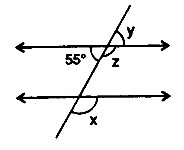
In the given figure, the directed lines are parallel to each other. Find the unknown angles.

Answer
∵ Lines are parallel
∴ x = z ......(corresponding angles)
But z + y = 180° .........(linear pair)
But y = 55° ........(vertically opposite angles)
∴ z + 55° = 180°
⇒ z = 180°− 55°
⇒ z = 125°
But x = z
∴ x = 125°
Hence x = 125°, y = 55°, z = 125°
View full question & answer
Question 94 Marks
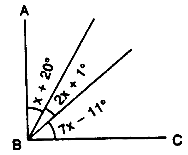
In the given figure, $A B$ is perpendicular to $B C$ at $B$. Find:
(i) the value of $x$.
(ii) the complement of angle $x$.
Answer
(i) In the given figure,
$ A B+B C \text { at } B \text {. } $
$ \therefore \angle \mathrm{ABC}=90^{\circ} $
$ \Rightarrow \mathrm{x}+20^{\circ}+2 \mathrm{x}+1^{\circ}+7 \mathrm{x}-11^{\circ}=90^{\circ} $
$ \Rightarrow 10 \mathrm{x}+10^{\circ}=90^{\circ} $
$ \Rightarrow 10 \mathrm{x}=90^{\circ}-10^{\circ}=80^{\circ} $
$ \Rightarrow x=\frac{80^{\circ}}{10}=8^{\circ} $
Hence $x=8^{\circ}$
(ii) Complement of angle $x=90^{\circ}-x$
$ =90^{\circ}-8^{\circ}=82^{\circ} $
View full question & answer
Question 104 Marks
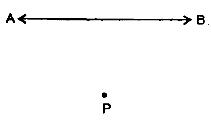
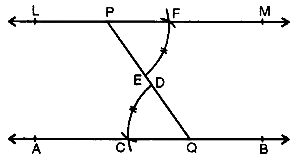
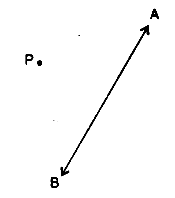
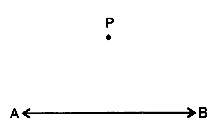
In the case, given below, draw a line through point $P$ and parallel to $A B:$
Answer
Steps of construction:
(i) From P draw a line segment meeting at $A B$
(ii) With centre $Q$ and some suitable radius draw an arc $C D$.
(iii) With centre $P$ and the same radius draw another arc meeting $P Q$ at $E$.

(iv) With centre $E$ and radius equal to $C D$, cut this arc at $F$

(v) Join PF and produce it to both sides to $L$ and $M$. Then line $L M$ is parallel to given line $A B$.
View full question & answer
Question 114 Marks
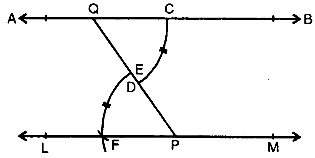
In the case, given below, draw a line through point $P$ and parallel to $A B:$
Answer
Steps of construction:
(i) From P draw a line segment meeting at $A B$
(ii) With centre $Q$ and some suitable radius draw an arc $C D$.
(iii) With centre $P$ and the same radius draw another arc meeting $P Q$ at $E$.


(iv) With centre $E$ and radius equal to $C D$, cut this arc at $F$


(v) Join PF and produce it to both sides to $L$ and $M$. Then line $L M$ is parallel to given line $A B$.
View full question & answer
Question 124 Marks
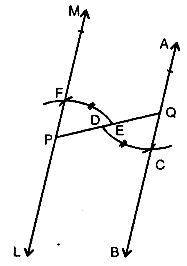
In the case, given below, draw a line through point $P$ and parallel to $A B:$
Answer
Steps of construction:
(i) From $P$ draw a line segment meeting at $A B$
(ii) With centre $Q$ and some suitable radius draw an arc $C D$.
(iii) With centre $P$ and the same radius draw another arc meeting $P Q$ at $E$.

(iv) With centre $E$ and radius equal to $C D$, cut this arc at $F$

(v) Join PF and produce it to both sides to $L$ and $M$. Then line $LM$ is parallel to given line $A B$.
View full question & answer
Question 134 Marks
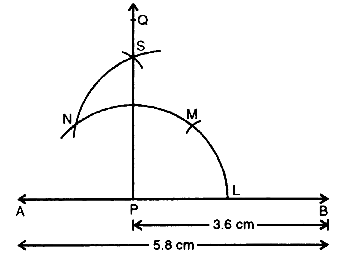
Draw a line segment AB = 5.8 cm. Mark a point P in AB such that PB = 3.6 cm. At P, draw a perpendicular to AB.
Answer
Steps of Construction:
(i) Draw a line segment $A B=5.8 cm$.
(ii) Mark a point $P$ in $A B$ such that $P B=3.6 cm$.
(iii) With centre $P$ and some suitable radius draw an arc meeting $AB$ in $L$.
(iv) With centre $L$ and same radius cut arcs $L M$ and then as $N$.
(v) Bisect arc $MN$ at $S$.
(vi) Join PS and produce it to $Q$. Then $P Q$ is perpendicular to $A B$ at $P$.
View full question & answer
Question 144 Marks
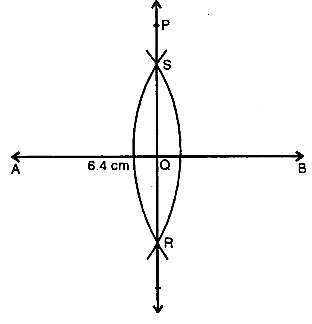
Draw a line segment of length 6.4 cm. Draw its perpendicular bisector.
Answer
Steps of Construction:
(i) Draw a line segment $A B=6.4 cm$.
(ii) With centres $A$ and $B$ and with some suitable radius, draw arcs intersecting each other at $S$ and $R$.
(iii) Join $S R$ intersecting $A B$ at $Q$. Then $P Q R$ is the perpendicular bisector of line segment $A B$
View full question & answer
Question 154 Marks
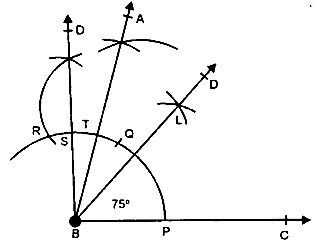
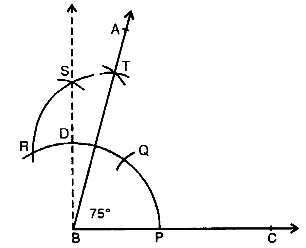
Construct an angle of 75° and then bisect it.
Answer
Steps of Construction:
(i) Draw a line segment $BC$.
(ii) At $B$, draw an angle $A B C$ equal to $75^{\circ}$.

(iii) With centres $P$ and $T$, draw arcs intersecting each other at $L$.
(iv) Join $B L$ and produce it to $D$. Then $B D$ bisects $\angle A B C$.
View full question & answer
Question 164 Marks
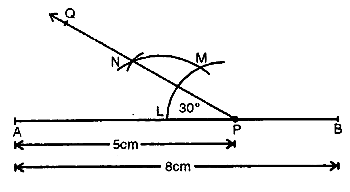
Draw a line segment AB = 8 cm. Mark a point P in AB so that AP = 5 cm. At P, construct angle APQ = 30°.
Answer
Steps of Construction:
(i) Draw a line segment $A B=8 cm$.
(ii) Mark a point $P$ in $A B$ such that $A P=5 cm$.
(iii) With centre $P$ and some suitable radius, draw an arc meeting $A B$ in L.
(iv) With centre $L$ and same radius cut arc LM.
(v) Bisect arc LM at $N$.
(vi) Join $PN$ and produce it to $Q$.
Then $\angle A P Q=30^{\circ}$
View full question & answer
Question 174 Marks
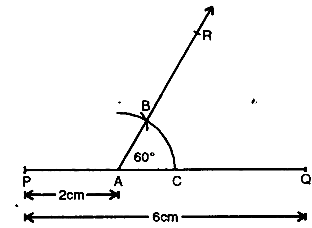
Draw a line segment PQ = 6 cm. Mark a point A in PQ so that AP = 2 cm. At point A, construct angle QAR = 60°.
Answer
Steps of Construction:
(i) Draw a line segment $P Q=6 cm$.

(ii) Mark a point $A$ on $P Q$ so that $A P=2 cm$.
(iii) With centre $A$ and some suitable radius draw an arc meeting $A Q$ at $C$.
(iv) With centre $C$ and with the same radius, cut $\operatorname{arc} C B$.
(v) Join $A B$ and produce it to $R$.
Then $\angle QAR =60^{\circ}$
View full question & answer
Question 184 Marks
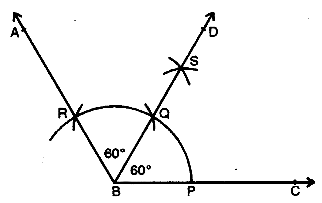
Draw ∠ABC = 120°. Bisect the angle using ruler and compasses only. Measure each 1 angle so obtained and check whether the angles obtained on bisecting ∠ABC are equal or not.
Answer
Steps of Construction:
(i) Draw a line segment $BC$.
(ii) With centre $B$ and some suitable radius, draw an arc meeting $B C$ at $P$.

(iii) With centre $P$ and with the same radius, cut arcs $P Q$ and $Q R$.
(iv) Join $B R$ and produce it to $A$.
Then $\angle A B C=120^{\circ}$
(v) With centres $P$ and $R$, draw two arcs intersecting each other at $S$.
(vi) Join $B S$ and produce it to $D$. $B D$ is the bisector of $\angle A B C$.
On measuring each angle, it is of $60^{\circ}$ each. Yes, both angles are equal in measure.
View full question & answer
Question 194 Marks
Using ruler and compasses, construct the following angle:
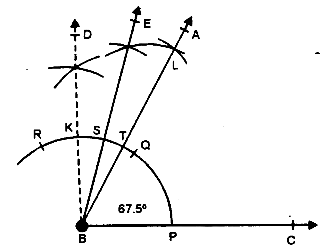
67.5°
Answer
Steps of Construction:
(i) Draw a line segment $BC$.
(ii) With centre $B$ and some suitable radius, draw an arc meeting $B C$ at $P$.
(iii) With centre $P$ and with the same radius, cut $\operatorname{arcs} P Q$ and then $Q R$.
(iv) Bisect arc QR at $K$ and again bisect arc $Q K$ at $S$.
(v) Bisect again arc SQ at T.
(vi) Join $B T$ and produce it to $A$.
Then $\angle ABC =67 \frac{1}{2}^{\circ}$ or $67.5^{\circ}$
View full question & answer
Question 204 Marks
Using ruler and compasses, construct the following angle:
37.5°
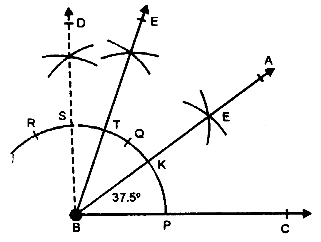
Answer
Steps of Construction:
(i) Draw a line segment $B C$.
(ii) With centre $B$ and some suitable radius, draw an arc meeting $B C$ at $P$.
(iii) With centre $P$ and same radius cut off $\operatorname{arcs} P Q$ and $Q R$.
(iv) Now bisect arc QR at $S$ and again bisect arc QS at T.
(v) Bisect arc PT at K.
(vi) Join $B K$ and produce it to $A$.
Then, $\angle A B C=37 \frac{1}{2}^{\circ}$ or 37.5 .
View full question & answer
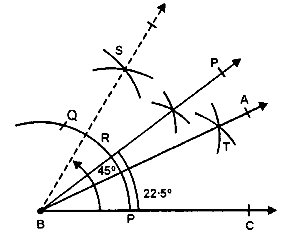
Question 214 Marks
Using ruler and compasses, construct the following angle:
22.5°
View full question & answer
Question 224 Marks
Using ruler and compasses, construct the following angle:
165°
Answer
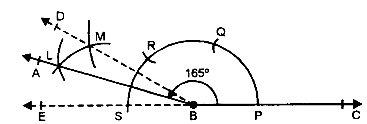
Steps of Construction:
(i) Draw a line segment $B C$.
(ii) With centre $B$ and some suitable radius draw an arc meeting $B C$ at $P$.
(iii) With centre $P$ and same radius cut off arcs $P Q, Q R$ and then RS.

(iv) Join SB.
(v) With centres R and S, draw two arcs intersecting each other at M.
(vi) With centre $T$ and $S$ draw two arcs intersecting each other at L.
(vii) Join BL and produce it to $A$. Then $\angle A B C=165^{\circ}$
View full question & answer
Question 234 Marks
Using ruler and compasses, construct the following angle:
180°
Answer
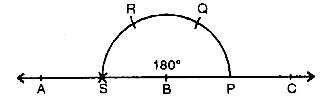
Steps of Construction :
(i) Draw a line segment $B C$.
(ii) With centre $B$ and some suitable radius draw arc meeting $B C$ at $P$.
(iii) With centre $P$ and with same radius cut of $\operatorname{arcs} P Q, Q R$ and then RS.
(iv) Join $B S$ and produce it to $A$.
Then $\angle A B C=180^{\circ}$.
View full question & answer
Question 244 Marks
Using ruler and compasses, construct the following angle:
75°
Answer
Steps of Construction :
(i) Draw a line segment BC.
(ii) With centre $B$ and a suitable radius draw an arc and cut off $P Q$, then $Q R$ of the same radius.
(iii) With centre Q and R, draw two arcs intersecting each other at S.
(iv) Join SB.
(v) With centre Q and D draw two arcs intersecting each other at T.
(vi) Join $B T$ and produce it to $A$.
Then $\angle A B C=75^{\circ}$.
View full question & answer
Question 254 Marks
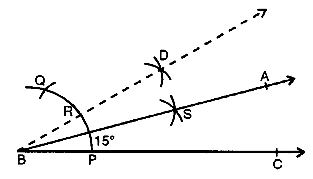
Using ruler and compasses, construct the following angle:
15°
Answer
Steps of Construction:
(i) Draw a line segment $B C$.
(ii) With centre $B$ and a suitable radius draw an arc meeting $B C$ at
P.
(iii) With centre $P$ and with the same radius cut off the arc at $Q$.
(iv) Taking $P$ and $Q$ as curves, draw two arcs intersecting each other at $D$ and join $B D$.
(v) With centre $P$ and $R$, draw two more arcs intersecting each other at $S$.
(vi) Join BS and produce it to $A$.
Then $\angle A B C=15^{\circ}$.
View full question & answer
Question 264 Marks
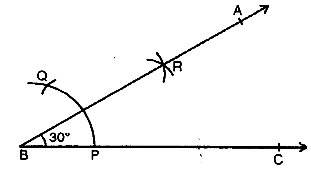
Using ruler and compasses, construct the following angle:
30°
Answer
Steps of Construction:
(i) Draw a line segment $B C$.
(ii) With centre $B$ and a suitable radius draw an arc meeting $B C$ at
P.
(iii) With centre $P$ and with the same radius cut off the arc at $Q$.
(iv) Now with centre P and Q draw two arcs intersecting each other at $R$.
(v) Join $B R$ and produce it to $A$, forming $\angle A B C=30^{\circ}$
View full question & answer
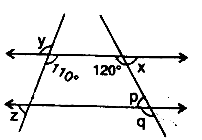
Question 274 Marks
In the given figure, the directed lines are parallel to each other. Find the unknown angles.
Answer
∵ Lines are parallel
∴ x = p
and p + 120° = 180° ........(alternate angles)
⇒ p = 180°− 120° = 60°
∴ x = 60°
q = 120° ........(corresponding angles)
y = 110° .........(vertically opposite angles)
and ∠1 + 110° = 180° .......(co-interior angles)
∴ ∠1 = 180°− 110° = 70°
But z = ∠1 .........(vertically opposite angles)
∴ ∠z = 70°
Hence x = 60°, y = 110°, z = 70°, p = 60°. q = 120°
View full question & answer
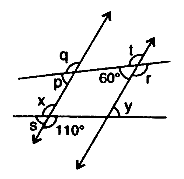
Question 284 Marks
In the given figure, the directed lines are parallel to each other. Find the unknown angles.
Answer
∵ Lines are parallel
∴ q = t and p = 60° ..........(corresponding angles)
But t + 60° = 180° ........(linear pair)
⇒ t = 180°− 60° = 120°
t = r ........(vertically opposite angles)
∴ r = 120°
q = t = 120°
x = 110° .......(vertically opposite angles)
x + s = 180° .......(linear pair)
⇒ 110° + s = 180°
⇒ s = 180°− 110° = 70°
s = ∠1 ............(corresponding angles)
∴ ∠1 = 70°
y = ∠1 = 70° ........(vertically opposite angles)
Hence x = 110°, y = 70°, p = 60°, q = 120°, r = 120°, s = 70°, t = 120°
View full question & answer
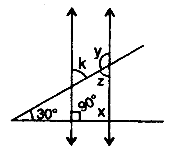
Question 294 Marks
In the given figure, the directed lines are parallel to each other. Find the unknown angles.

Answer
∵ Lines are parallel
∴ x + 90° = 180° ...........(co-interior angles)
⇒ x = 180°− 90° = 90°
⇒ ∠2 = x
⇒ ∠2 = 90°
But ∠1 + ∠2 + 30° = 180° ..........(sum of angles of a triangle)
⇒ ∠1 + 90° + 30° = 180°
⇒ ∠1 + 120° = 180°
⇒ ∠1 = 180°− 120° = 60°
But ∠1 = k ..........(vertically oposite angle)
∴ k = 60°
But ∠1 = z ......(alternate angles)
∴ z = 60°
But k + y = 180° .........(co-interior angles)
⇒ 60° + y = 180°
⇒ y = 180°− 60° = 120°
Hence x = 90°, y = 120°, 
z = 60°, k = 60°
View full question & answer
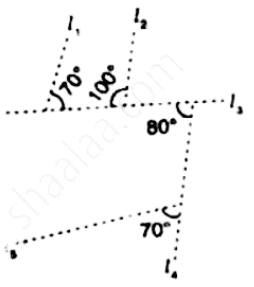
Question 304 Marks
Which pair of the dotted line, segments, in the following figure, are parallel. Give reason:
Image
Answer
∠1 + 100°= 180°
⇒∠1 = 180°− 100°= 80° .........(linear pair)
Lines l1 and l2 will be parallel If ∠1 = 70°
⇒ 80° = 70° which is not true
∴ l1 and 12 are not parallel Again, A, l3 and l5 will be parallel
If 80° = 70° ..........(corresponding angle)
Which is not true.
∴ l3 and l5 are not parallel
But ∠1 = 80° ........(alternate angles)
⇒ 80° = 80°
Which is true
∴ l2 and l4 are parallel
View full question & answer
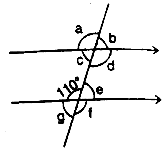
Question 314 Marks
In the given figure, find the measure of the unknown angles:
Answer
a = d ....(vertically opposite angles)
d = f ......(corresponding angles)
f = 110° .......(vertically opposite angles)
∴ a = d = f = 110°
e + 110° = 180° ......(co-interior angles)
∴ e = 180°− 110° = 70°
b = c .......(vertically opposite angles)
b = e .........(corresponding angles)
e = g ........(vertically opposite angles)
∴ b = c = e = g = 70° ”
Hence a = 110°, b = 70°, e = 70°, d = 110°, e = 70°, f= 110° and g = 70°
View full question & answer
Question 324 Marks
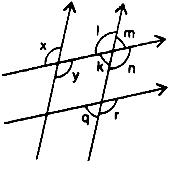
In the given figure, the arrows indicate parallel lines. State which angles are equal. Give a reason.
Answer
In the figure,
x = y ......(vertically opposite angles)
y= l .........(alternate angles)
x = I .......(corresponding angles)
1 = n .......(vertically opposite angles)
n = r .......(corresponding angles)
∴ x = y = l = n = r
Again m = k ......(vertically opposite angles)
k = q ........(corresponding angles)
∴ m = k = q
View full question & answer
Question 334 Marks
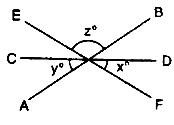
$A B, C D$ and $E F$ are three lines intersecting at the same point.
(i) Find $x$, if $y=45^{\circ}$ and $z=90^{\circ}$.
(ii) Find $a$, if $x=3 a, y=5 x$ and $r=6 x$.
Answer
$A B, C D$ and $E F$ are intersecting each other at $O$.
and $\angle D O F=x^{\circ}, \angle A O C=y^{\circ}$
and $\angle B O E=z^{\circ}$
But $\angle D O B=\angle A O C=y^{\circ}$....(Vertically opposite angles)
Similarly, $\angle \mathrm{COE}=\angle \mathrm{DOF}=\mathrm{x}^{\circ}$
and $\angle A O F=\angle B O E=z^{\circ}$
$\therefore C D$ is a straight line
$\therefore \angle C O E+\angle B O E+\angle D O E=180^{\circ}$
$\Rightarrow \mathrm{x}^{\circ}+\mathrm{z}^{\circ}+\mathrm{y}^{\circ}=180^{\circ}$
$\Rightarrow \mathrm{x}^{\circ}+\mathrm{y}^{\circ}+\mathrm{z}^{\circ}=180^{\circ}$
(i) If $y=45^{\circ}$, and $z=90^{\circ}$, then
$ \Rightarrow \mathrm{x}^{\circ}+45^{\circ}+90^{\circ}=180^{\circ} $
$ \Rightarrow \mathrm{x}^{\circ}+135^{\circ}=180^{\circ} $
$ \therefore x^{\circ}=180^{\circ}-135^{\circ}=45^{\circ} $
$ \begin{aligned} & \text { (ii) If } x=3 a, y=5 x, z=6 x, \\ & \text { then } x+y+z=180^{\circ} \\ & \Rightarrow x+5 x+6 x=180^{\circ} \\ & \Rightarrow 12 x=180^{\circ} \\ & \Rightarrow x=\frac{180^{\circ}}{12}=15^{\circ} \\ & \text { But } x=3 a \\ & \therefore 3 a=15^{\circ} \\ & \Rightarrow a=\frac{15^{\circ}}{3}=5^{\circ} \end{aligned} $
Hence $a=5^{\circ}$
View full question & answer
Question 344 Marks
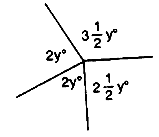
Find each angle shown in the diagram.
Answer
In the figure,
$3 \frac{1}{2} y ^{\circ}+2 y ^{\circ}+2 y ^{\circ}+2 \frac{1}{2} y ^{\circ}=360^{\circ}
....($Angles at a point$)$
$\Rightarrow \frac{7}{2} y^{\circ}+2 y^{\circ}+2 y^{\circ}+\frac{5}{2} y^{\circ}=360^{\circ}$
$\Rightarrow \frac{7}{2} y^{\circ}+\frac{5}{2} y^{\circ}+4 y^{\circ}=360^{\circ}$
$\Rightarrow \frac{12}{2} y^{\circ}+4 y^{\circ}=360^{\circ}$
$\Rightarrow 6 y^{\circ}+4 y^{\circ}=360^{\circ}$
$\Rightarrow 10 y^{\circ}=360^{\circ}$
$\Rightarrow y=\frac{360^{\circ}}{10}=36^{\circ}$
$ \therefore \angle \mathrm{AOB}=3 \frac{1}{2} \mathrm{y}^{\circ}=\frac{7}{2} \mathrm{y}^{\circ}=\frac{7}{2} \times 36^{\circ}$
$ =126^{\circ}$
$ \angle \mathrm{BOC}=2 \mathrm{y}^{\circ}=2 \times 36^{\circ}=72^{\circ}$
$ \angle \mathrm{COD}=2 \mathrm{y}^{\circ}=72^{\circ}$
$ \angle \mathrm{DOA}=2 \frac{1}{2} \mathrm{y}^{\circ}=\frac{5}{2} \mathrm{y}^{\circ}$
$ =\frac{5}{2} \times 36^{\circ}=90^{\circ} $
View full question & answer
Question 354 Marks
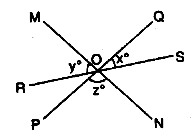
In the given figure, lines $P Q, M N$, and RS intersect at $O$. If $x: y=$ $1: 2$ and $z=90^{\circ}$, find $\angle R O M$ and $\angle P O R$.
Answer
In the figure, lines $P Q, M N$ and $R s$ are intersecting each other at $O$
$ x: y=1: 2, z=90^{\circ} $
$\angle \mathrm{MOQ}=\angle \mathrm{PON}=\mathrm{z} \ldots \ldots$. (Vertically opposite angles)
Now, RS is a straight line
$ \therefore \mathrm{x}+\mathrm{z}+\mathrm{y}=180^{\circ} $
$ \Rightarrow \mathrm{x}+\mathrm{y}+90^{\circ}=180^{\circ} . $....$ \left(\because z=90^{\circ}\right) $
$ \Rightarrow \mathrm{x}+\mathrm{y}=180^{\circ}-90^{\circ}=90^{\circ} $
But $x: y=1: 2$
Let $\mathrm{x}=\mathrm{a}$ then $\mathrm{y}=2 \mathrm{a}$
$ \therefore \mathrm{a}+2 \mathrm{a}=90^{\circ} $
$ \Rightarrow 3 \mathrm{a}=90^{\circ} $
$ \Rightarrow \mathrm{a}=\frac{90^{\circ}}{3}=30^{\circ} $
$\therefore \mathrm{x}=30^{\circ}$ and $\mathrm{y}=2 \mathrm{a}=2 \times 30^{\circ}=60^{\circ}$
Now, $\angle \mathrm{ROM}=\mathrm{y}=60^{\circ}$
$ \text { and } \angle \mathrm{POR}=\angle \mathrm{SOQ} $.......(Vertically opposite angles)
$ =x=30^{\circ} $
View full question & answer
[4 marks sum] - MATHS STD 7 Questions - Vidyadip