Question
Draw a line segment of length $6\ cm.$ Construct its perpendicular bisector. Measure the two parts of theline segment.

Answer

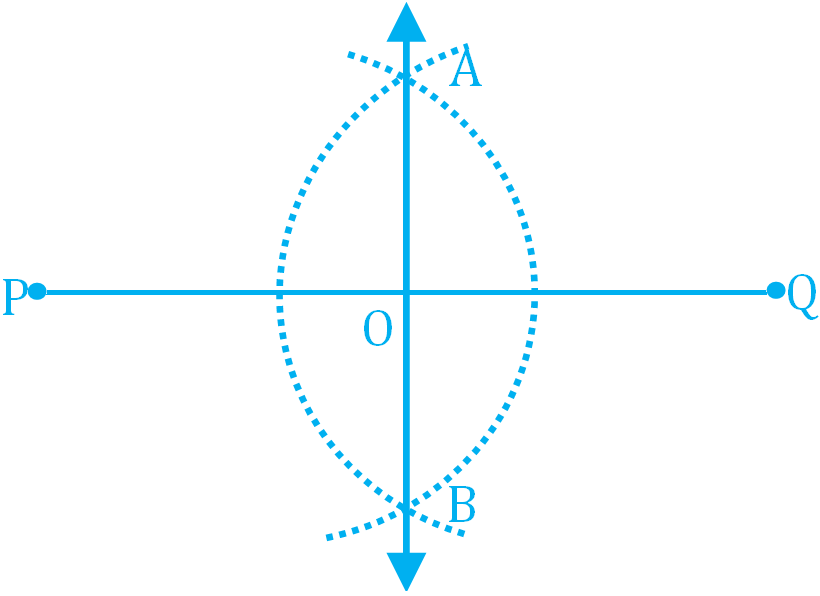
Steps of construction are as follows:
Step I: Draw a line segment $PQ = 6\ cm.$​​​​​​​

Step II: With $P$ as centre and a convenient radius $($more than $\frac12 PQ),$ draw an arc.
Step III: With $O$ as centre and same radius, draw another arc, such that it intersects the previous arc at $A$ and $B.$​​​​​​​

Step IV: Join $A$ and $B.$
Thus, $AB$ is perpendicular bisector of $PQ$ i.e. $\text{OP} = \text{OQ} =\frac12\times\text{PQ} =\frac12\times 6=3 \text{cm}.$

Need a full question paper?

Generate a complete, print-ready paper with questions like this in minutes — across 16+ boards, with answer keys.

Start Generating Free

Similar questions

The following table shows the area of the land on which different crops were grown.
Crop Area of land (in million hectares)
Rice $50$
Wheat $30$
Pulses $20$
Sugarcane $25$
Cotton $15$
Prepare a pictograph by choosing a suitable symbol to represent $10$ million hectares.
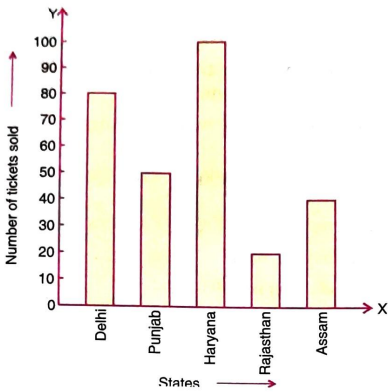
Read the bar graph shown in Fig. and answer the following questions:
(i) What is the information given by the bar graph?
(ii) How many tickets of Assam State Lottery were sold by the agent?
(iii) Of which state, were the maximum number of tickets sold?
(iv) State whether true or false.
The maximum number of tickets sold is three times the minimum number of tickets sold.
(v) Of which state were the minimum number of tickets sold?
Image
Nandini's house is $\frac9{10} \ km$ from her school. She walked some distance and then took a bus for $\frac12 \ km$ to reach the shcool. How far did she walk?
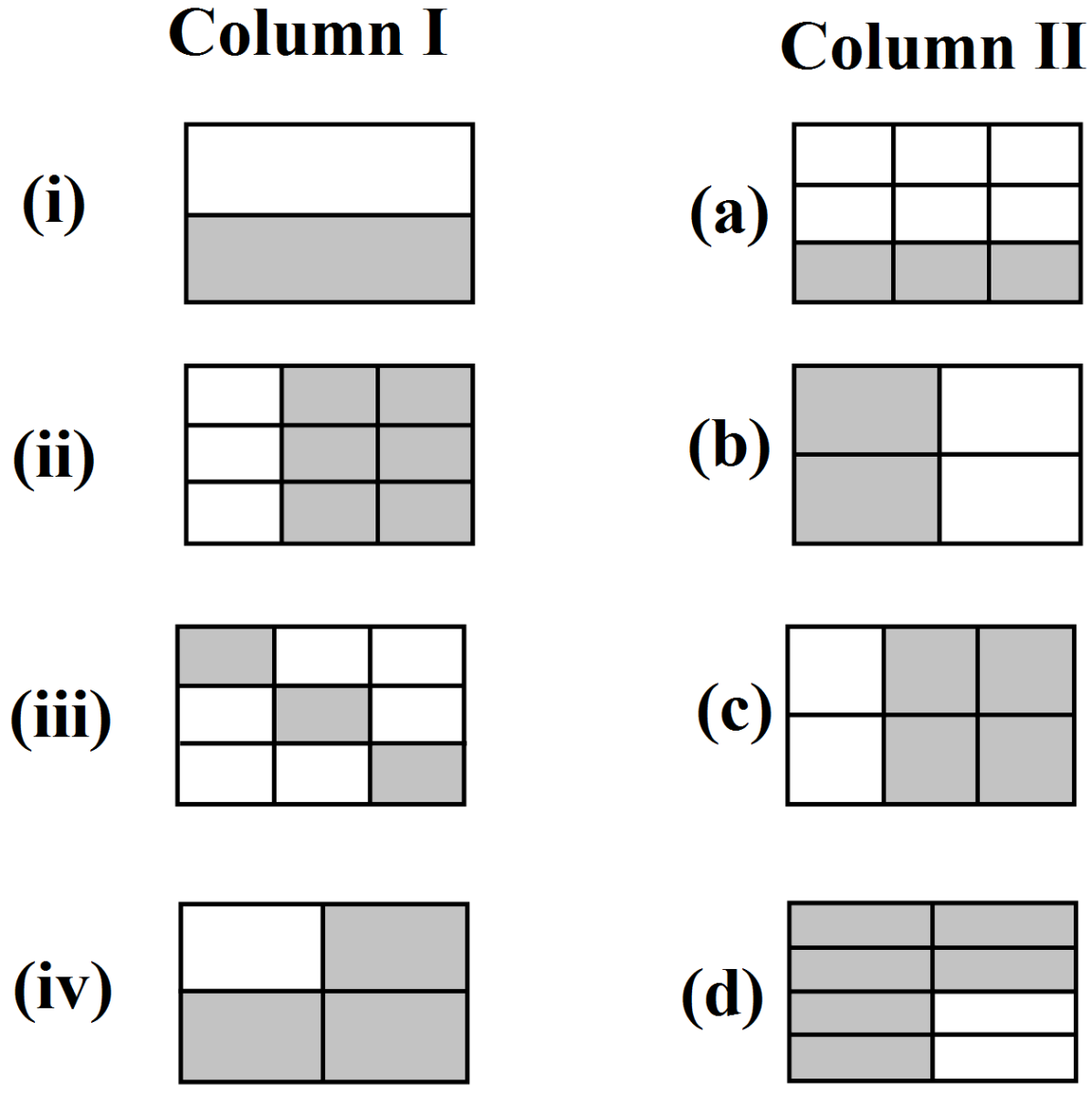
Write the fractions and match fractions in Column $ I$ with the aquivalent fractions in Column $II.$
Use a pair of compasses and construct the following angles: $75^\circ $
Show that each of the following is meaningless. Give reason in each case.
$i.\ VC$
$ii.\ IL$
$iii.\ VVII$
$iv.\ IXX$
Draw a line segment of length $6.5\ cm$ and divide it into four equal parts, using ruler and compasses.
The weights of new born babies (in kg) in a hospital on a particular day are as follows:
2.3, 2.2, 2.1, 2.7, 2.6, 3.0, 2.5, 2.9, 2.8, 3.1, 2.5, 2.8, 2.7, 2.9,
(i) Rearrange the weights in descending order.
(ii) Determine the highest weight.
(iii) Determine the lowest weight.
(iv) Determine the range.
(v) How many babies were born on that day?
(vi) How many babies weigh below 2.5 kg?
(vii) How many babies weigh more than 2.8 kg?
(viii) How many babies weigh 2.8 kg?
Using a protractor, draw $\angle\text{BAC}$ of measure $45^\circ .$ Take a point $P$ in the interior of $\angle\text{BAC}.$ From $P$ draw line segments $PM$ and $PN$ such that $\text{PM}\perp\text{AB}$ and $\text{PN}\perp\text{AC},$ Measure $\angle\text{MPN}.$
Draw a line segment of length 10 cm and bisect it. Further bisect one of the equal parts and measure its length.