Questions

5 Marks Questions

Take a timed test

22 questions · self-marked practice — reveal the answer and mark yourself.

Question 15 Marks
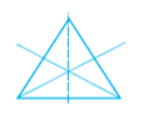
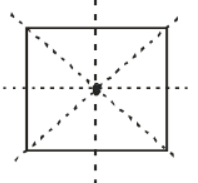
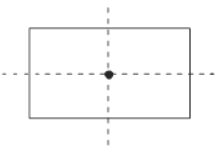
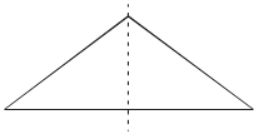
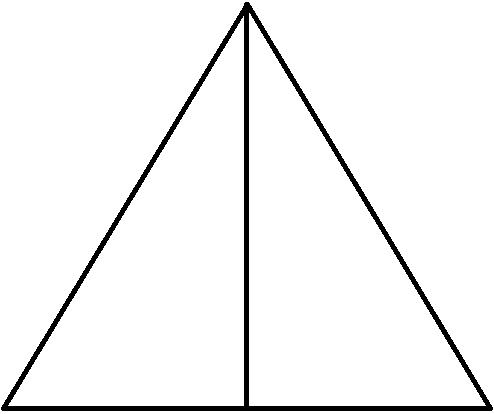
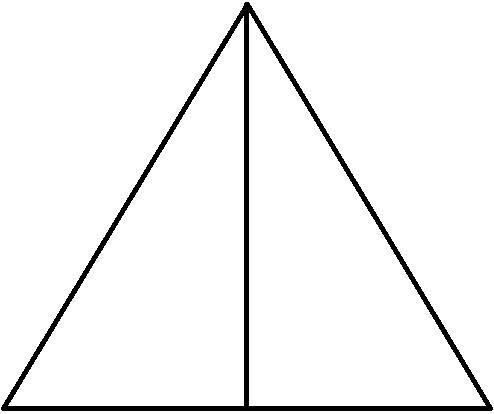
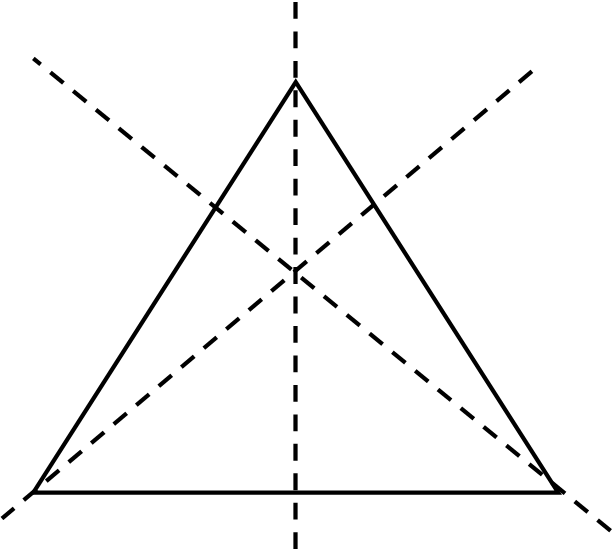
Complete the following table.
Shape Rough figure Number of lines of symmetry
Equilateral Triangle  
Square    
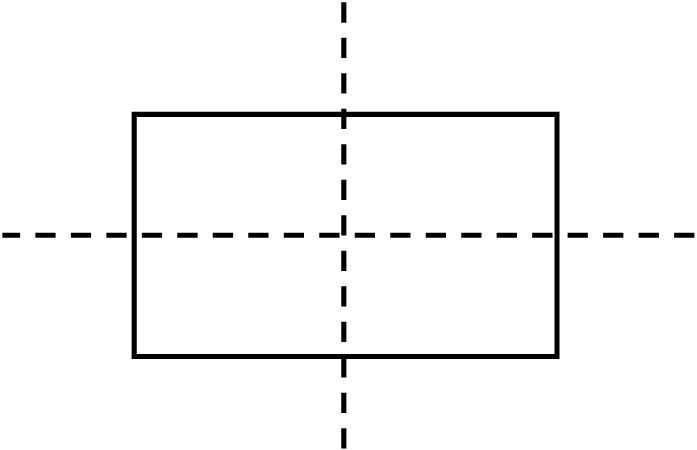
Rectangle    
Isosceles Triangle    
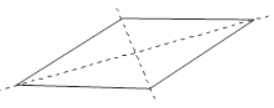
Rhombus    
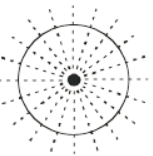
Circle    
Answer
The above table can be completed as follows:
Shape Rough figure of the shape Number of lines of symmetry in it
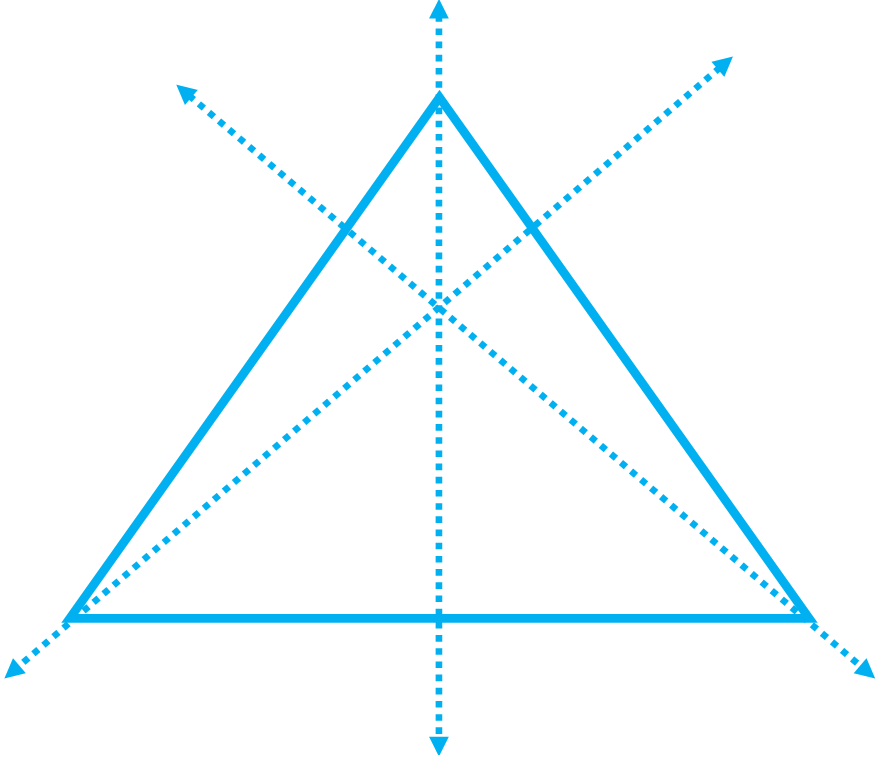
Equilateral Triangle $3$
Square $4$
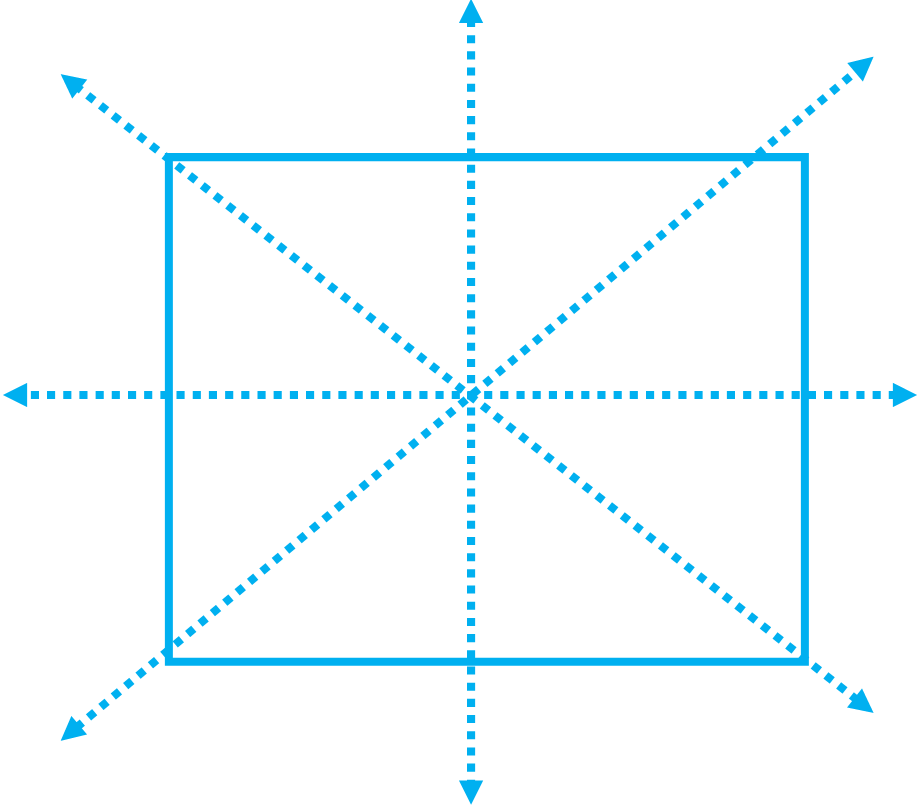
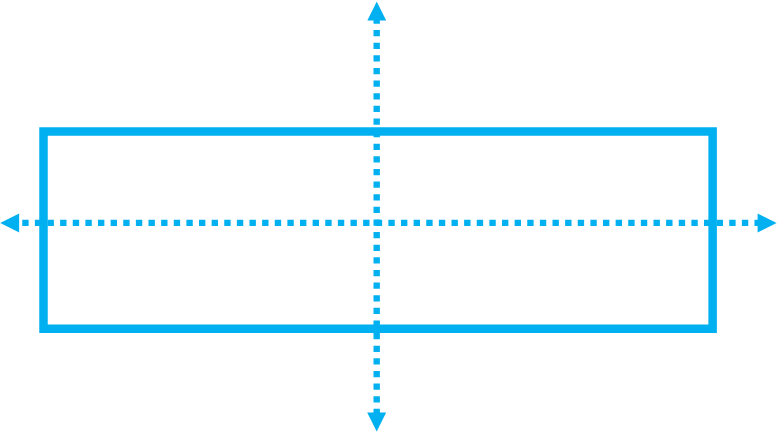
Rectangle $2$
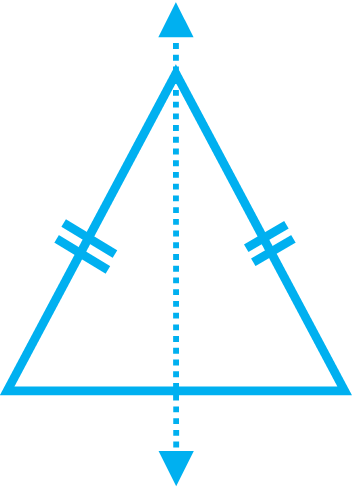
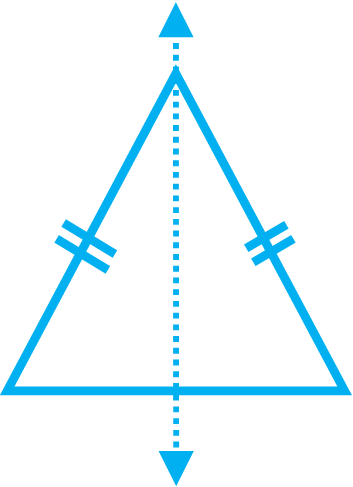
Isosceles Triangle $1$
Rhombus $2$
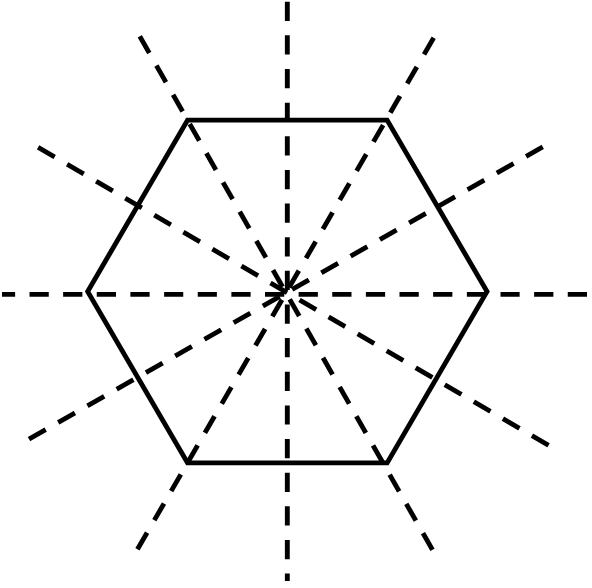
Circle Infinite
View full question & answer
Question 25 Marks
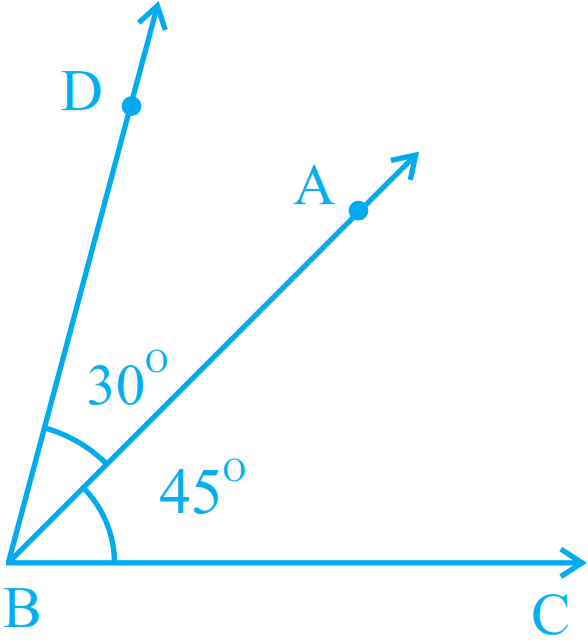
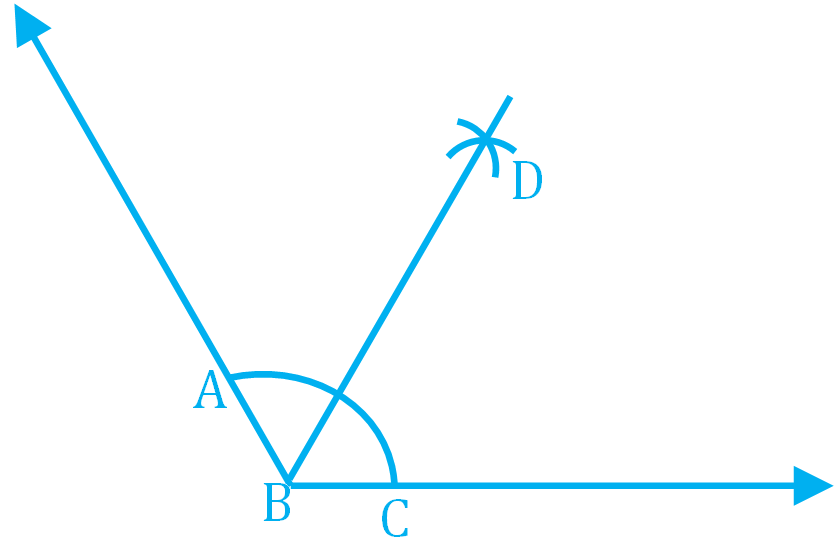
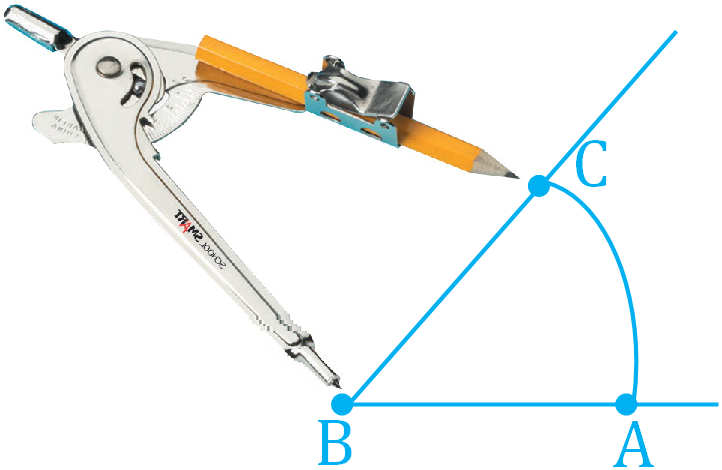
Draw an angle $ABC$ of measure $45^\circ$, using ruler and compasses. Now draw an angle $DBA$ of measure $30^\circ$, using ruler and compasses as shown in Figure. What is the measure of $\angle\text{DBC}?$
Answer
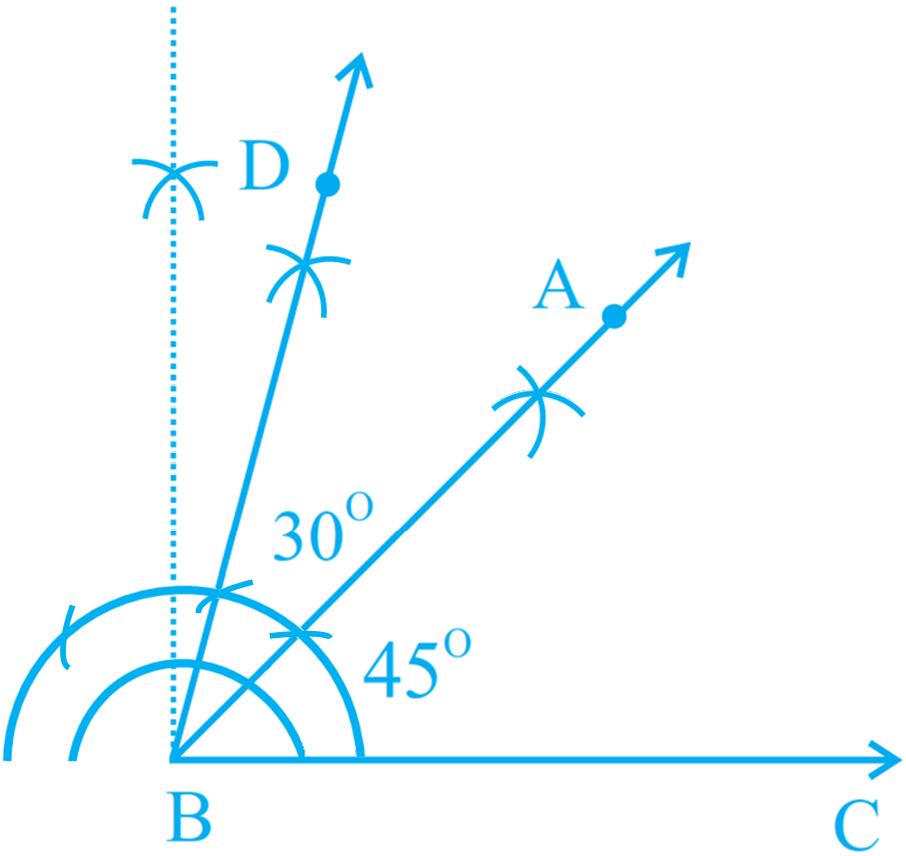
To draw an angle, we use following steps of construction:
Step I: Draw a line segment $BC$ of any length.
Step II: Place the compass pointer at $B$ and draw a right angle $(90^\circ ).$

Step III: Draw the angle bisector of the right angle, such that $\angle\text{ABC}= \frac12(90^\circ)=45^\circ.$
Step IV: Place the compass pointer at $B$ and draw an angle of $30^\circ $ on the base $\text{BA} (\angle\text{DBA).}$
Step V: By the help of protractor, we get $\angle\text{DBC} =75^\circ.$
View full question & answer
Question 35 Marks
Draw a line segment of length $6\ cm.$ Construct its perpendicular bisector. Measure the two parts of theline segment.
Answer
Steps of construction are as follows:
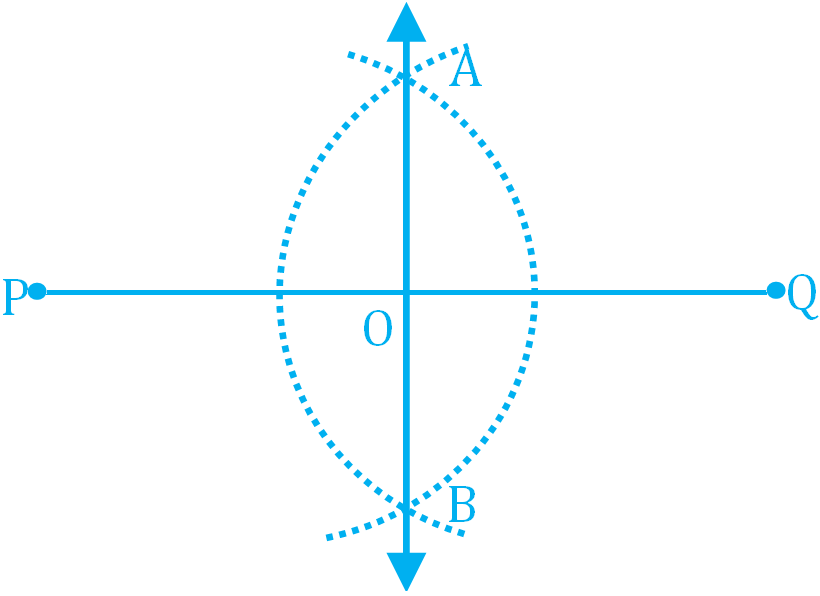
Step I: Draw a line segment $PQ = 6\ cm.$​​​​​​​

Step II: With $P$ as centre and a convenient radius $($more than $\frac12 PQ),$ draw an arc.
Step III: With $O$ as centre and same radius, draw another arc, such that it intersects the previous arc at $A$ and $B.$​​​​​​​

Step IV: Join $A$ and $B.$
Thus, $AB$ is perpendicular bisector of $PQ$ i.e. $\text{OP} = \text{OQ} =\frac12\times\text{PQ} =\frac12\times 6=3 \text{cm}.$
View full question & answer
Question 45 Marks
Write the letters of the word $\text{‘MATHEMATICS’}$ which have no line of symmetry.
Answer
The given word is $\text{‘MATHEMATICS’}$. The letter $M$ has one line of symmetry. The letter $A$ hase one line of symmetry. The letter $T$ hase one line of symmetry. The letter $H$ hase one line of symmetry. The letter $E$ hase one line of symmetry. The letter $I$ hase one line of symmetry. The letter $C$ hase one line of symmetry. And the letter $S$ hase one line of symmetry. Hence, only letter $'S'$ in word $\text{‘MATHEMATICS’}$ has no line of symmetry.
View full question & answer
Question 55 Marks
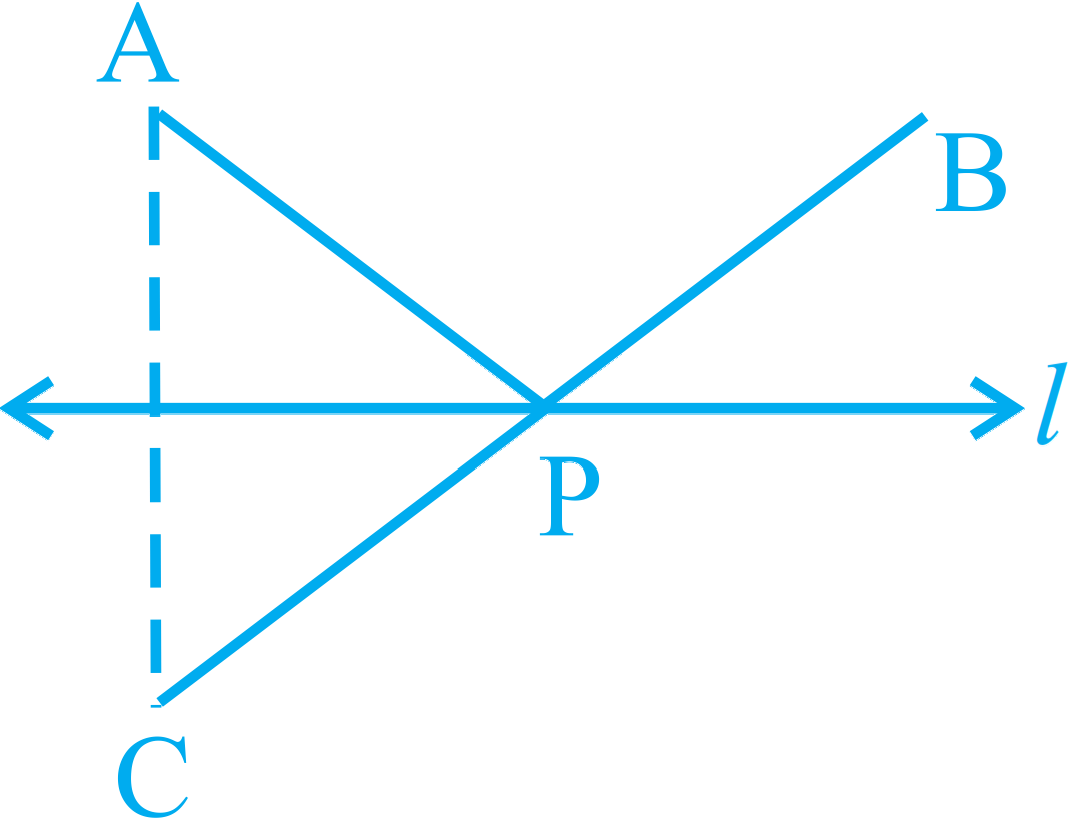
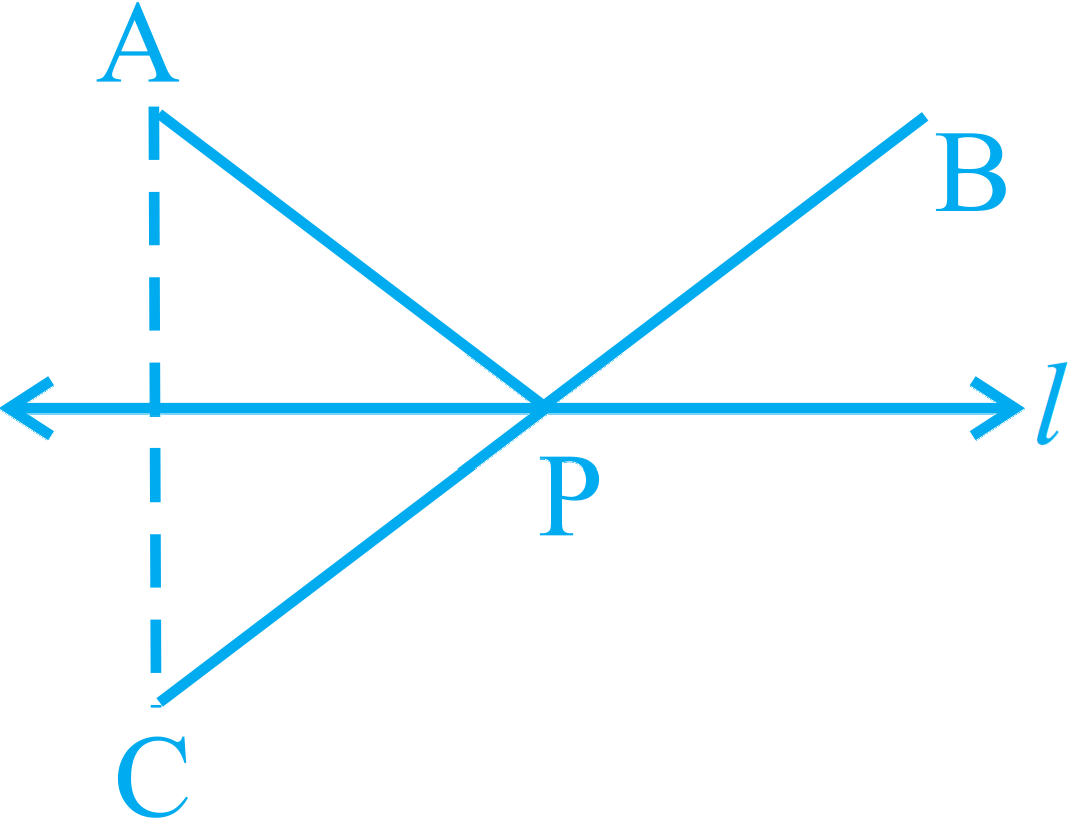
In Figure, the point $C$ is the image of point $A$ in line l and line segment $BC$ intersects the line $l$ at $P.$
$a.\ $Is the image of $P$ in line $l$ the point $P$ itself $?$
$b.\ $Is $PA = PC?$
$c.\ $Is $PA + PB = PC + PB?$
$d.\ $Is $P$ that point on line l from which the sum of the distances of points $A$ and $B$ is minimum$?$
Answer
Given, in figure, the image of the point $A$ is $C,$ in the line $l.$
$a.\ $Yes, the image of $P$ in line $l$ is the point it self.
$b.\ $Yes, $PA = PC.$
$c.\ $Yes, $\text{PA + PB = PC + PB}$ because the distance, $PA = PC.$
$d.\ $Yes, from the point $P$ in the line $l,$ the sum of the distances of points $A$ and $B$ is minimum.
View full question & answer
Question 65 Marks
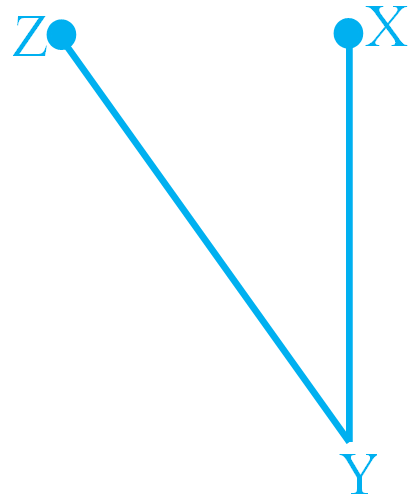
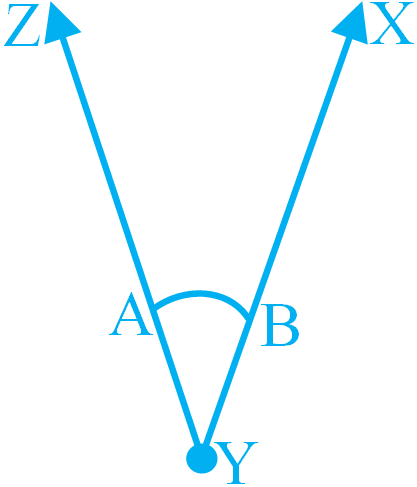
Bisect $\angle\text{XYZ}$ of Figure.
Answer
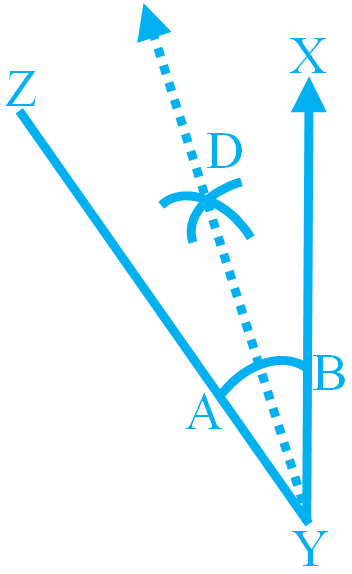
Steps of construction are as follows:Step I: With $Y$ as a centre and using compass, draw an arc that cuts both rays of $\angle\text{Y.}$ Label point of intersection as $A$ and $8.$

Step II: With $A$ as centre, draw $($in the interior of $\angle\text{Y})$ an arc, whose radius is more than half the length $AB.$
Step III: With $B$ as centre and the same radius draw another arc in the interior of $\angle\text{Y.}$ Let the two arcs intersect at $D.$ Join $YD$ Then, $YD$ is the required bisector of $\angle\text{XYZ.}$
View full question & answer
Question 75 Marks
Draw a line segment of length $7\ cm.$ Draw its perpendicular bisector, using ruler and compasses.
Answer
Steps of construction are as follows:
Step I: Draw a line segment, $PQ = 7\ cm.$  Step II: With $P$ as centre and a convenient radius $($more than $\frac12\text{PQ})$, draw arc.
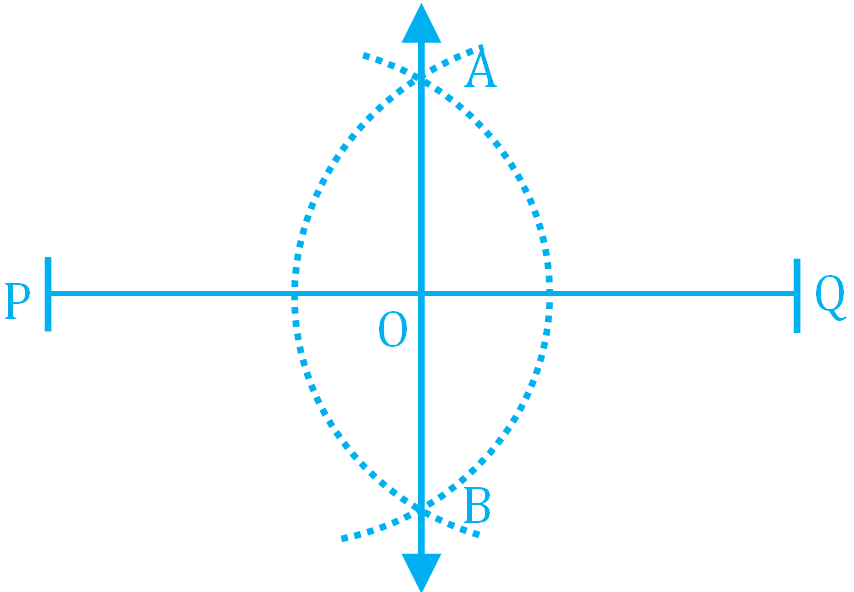
Step III: With $Q$ as centre and same radius, draw another arc, such that it intersects the previous arc at $A$ and $B.$ Step IV: Join $A $ and $B.$ Thus, $AB$ is perpendicular bisector of $PQ$ i.e. $OP = OQ = 3.5\ cm.$
View full question & answer
Question 85 Marks
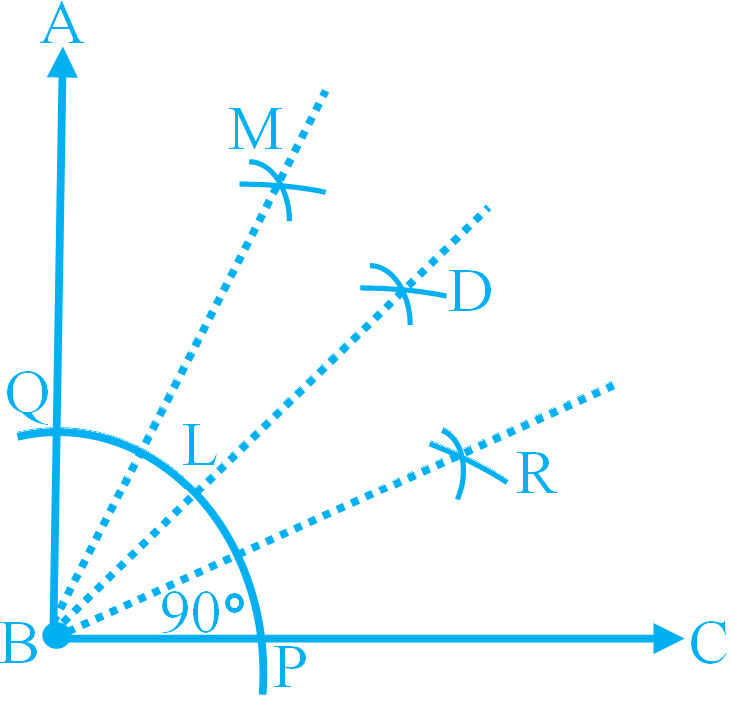
Bisect a right angle, using ruler and compasses. Measure each part. Bisect each of these parts. What will be the measure of each of these parts?
Answer
Steps of construction are as follows:
Step I: Construct an angle, $\angle\text{ABC}= 90^\circ$
Step II: With $B$ as centre, using compass, draw an arc which cuts both rays of $\angle\text{B}$ at $P$ and $Q.$
Step III: With $P$ as centre, draw $($in the interior of $\angle\text{B})$ an arc, whose radius is more than half of $PQ.$​​​​​​​
Step IV: With $Q$ as centre and the same radius, draw another arc in the interior of $\angle\text{B}.$ Let the two arcs intersect at $D.$ Join $BD,$ cutting arc $PQ$ at $L$. Then, $BD$ divides the $\angle\text{ABC}$ into two equal parts.

Step V: Now, taking $P$ and $L$ as centre having radius more than half of $PL,$ draw two arcs respectively, which cut each other at $R.$
View full question & answer
Question 95 Marks
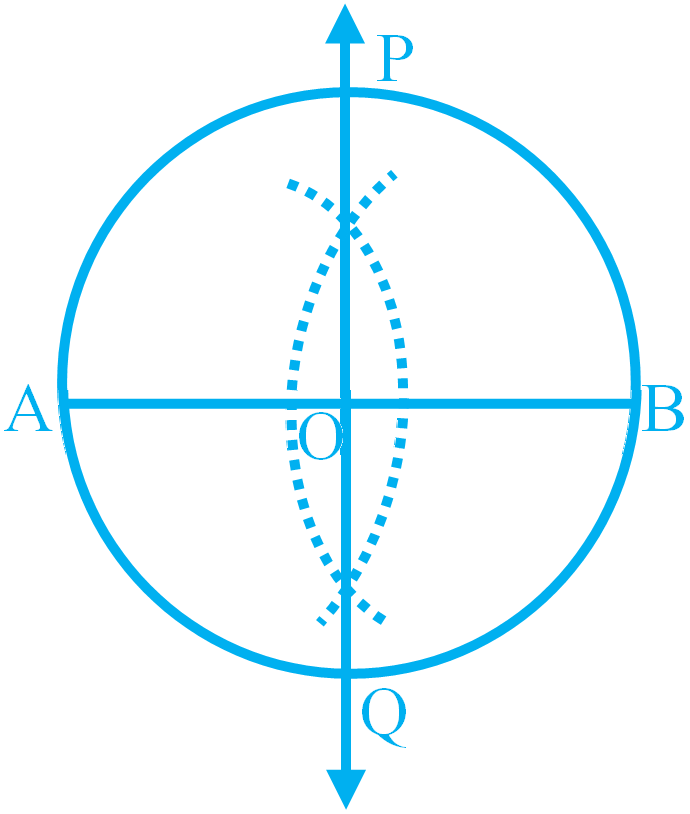
Draw a circle of radius $6\ cm$ using ruler and compasses. Draw one of its diameters. Draw the perpendicular bisector of this diameter. Does this perpendicular bisector contain another diameter of the circle?
Answer
Steps of construction are as follows:
Step I: Open the compass for the required radius $6 \ cm$ by putting the pointer on $0$ and open the pencil upto $6\ cm.$
Step II: Place the pointer of the compass at $O.$​​​​​​​
Step III: Turn the compass slowly to draw the circle.
Step IV: Draw a diameter $AS.$​​​​​​​
Step V: Draw the perpendicular bisector of $AS,$ which intersect $AS$ at $0.$​​​​​​​​​​​​​​
​​​​​​​
Clearly, the perpendicular bisector of $AS,$ i.e. $PQ$ is another diameter of the circle. Yes, the perpendicular bisector of $AS$ contain another diameter of the circle.
View full question & answer
Question 105 Marks
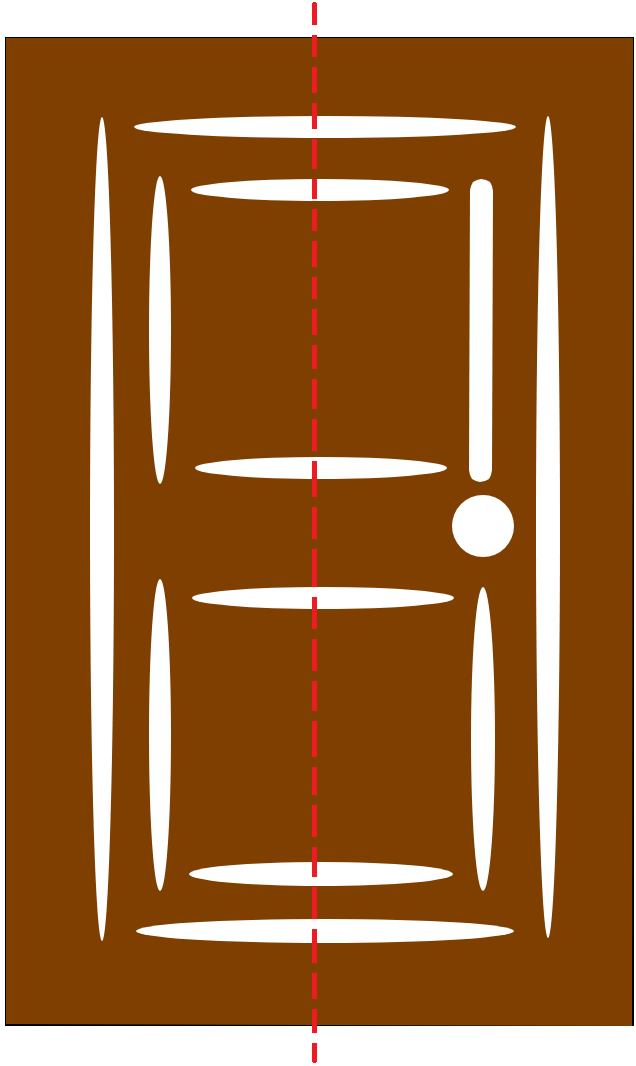
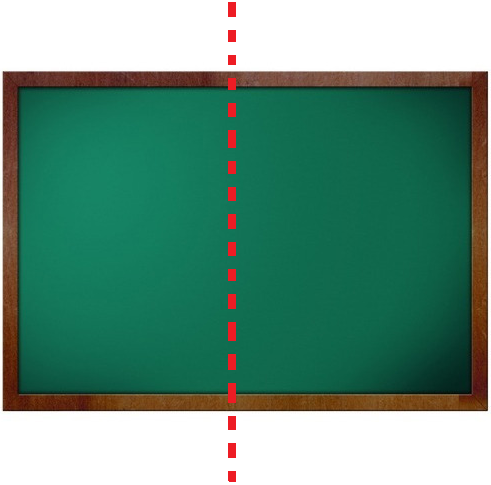
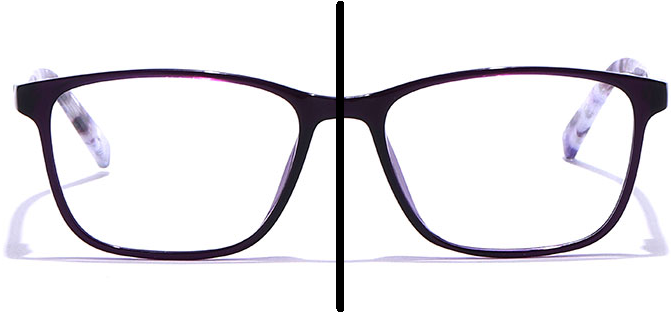
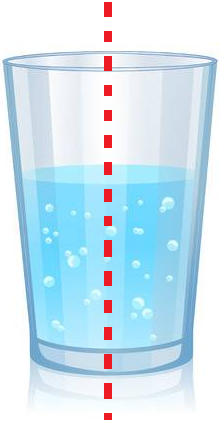
List any four symmetrical objects from your home or school. Also mention the line of symmetry.
Answer
$(i)$
$(ii)$
$(iii)$
$(iv)$
A gate
A green board
A pair of spectacles
A glass
View full question & answer
Question 115 Marks
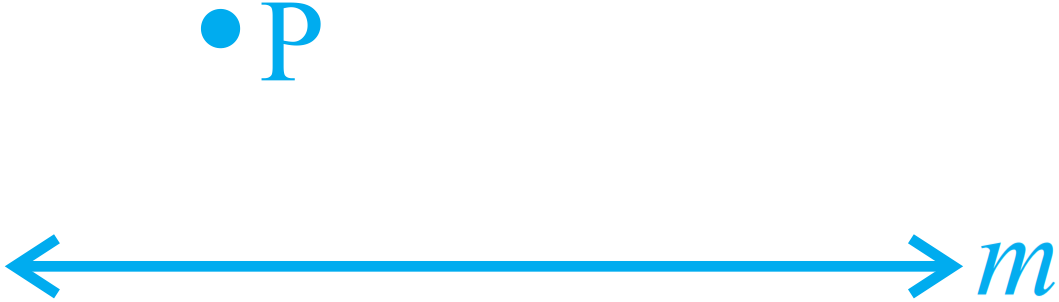
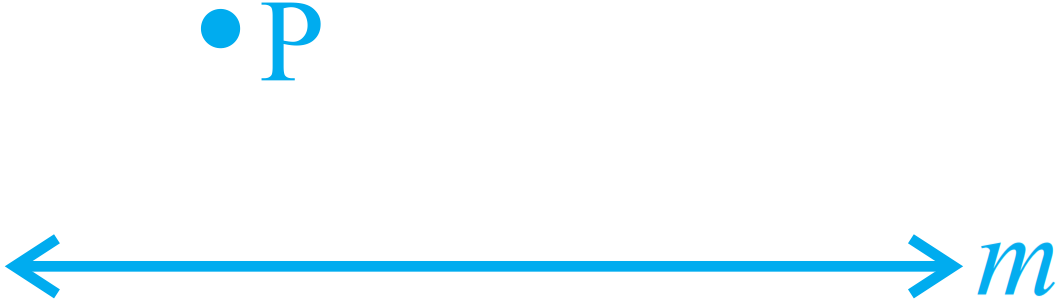
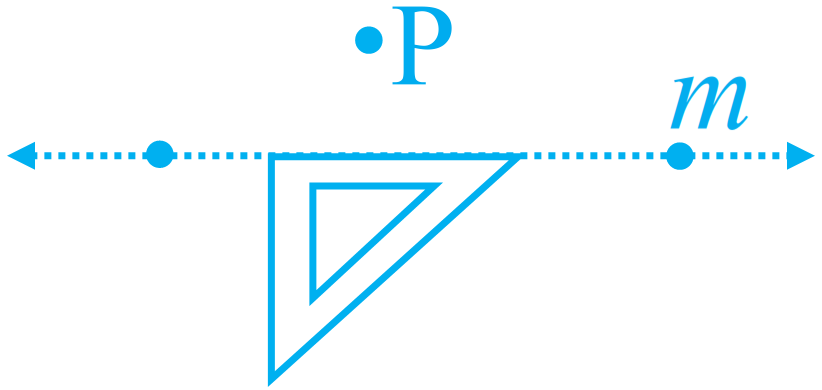
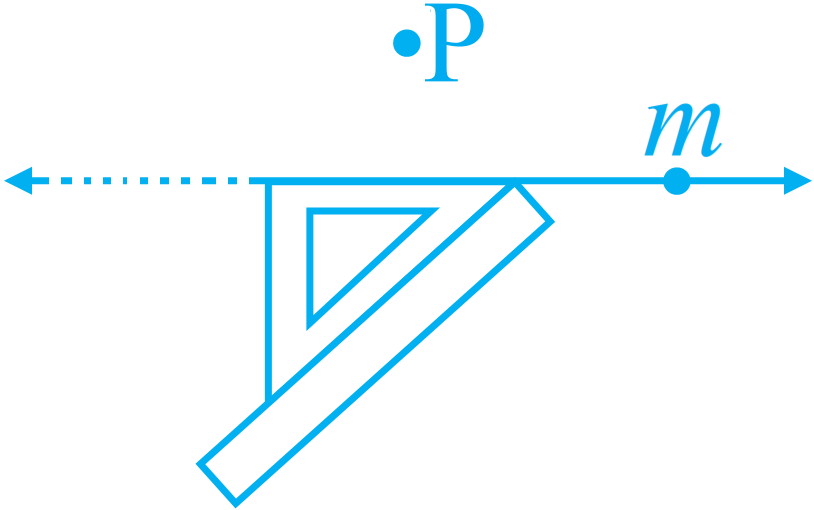
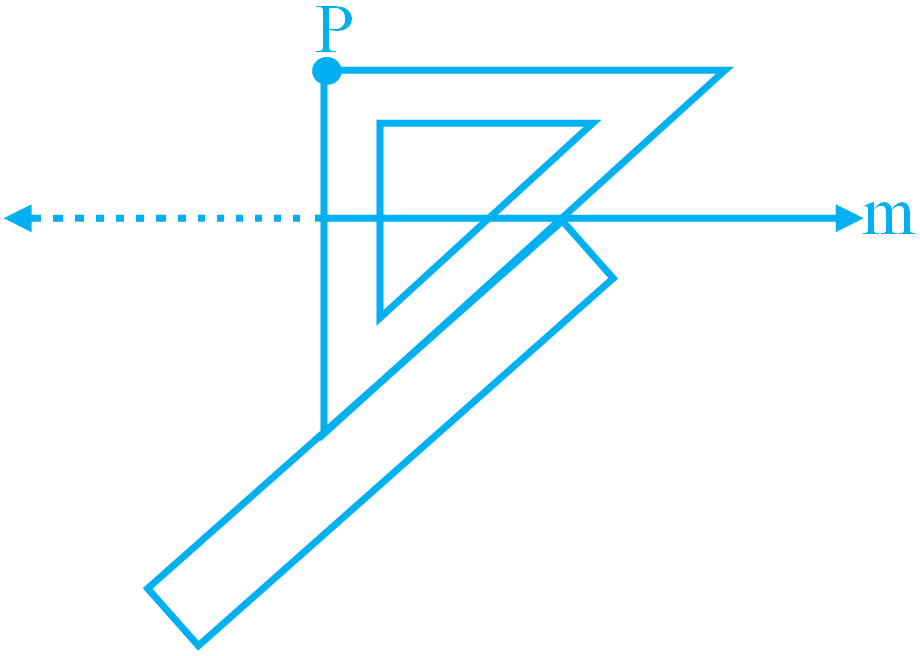
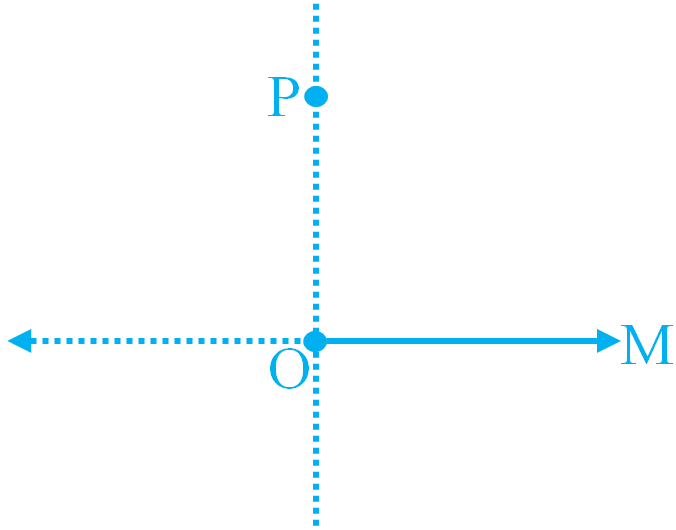
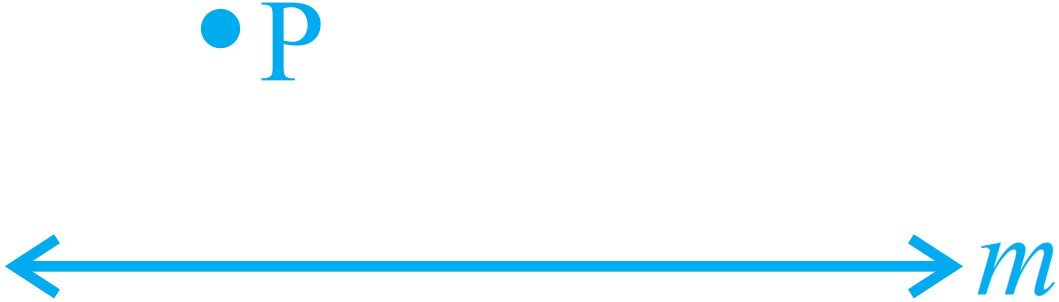
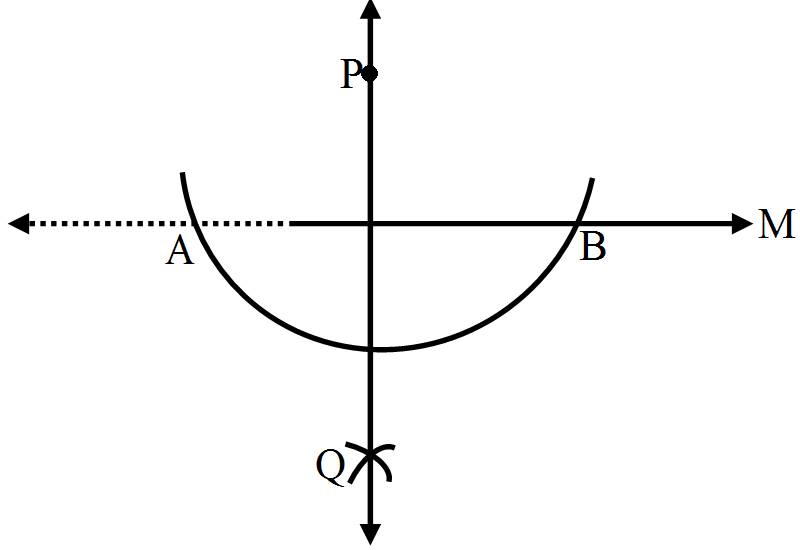
Copy Figure on your notebook and draw a perpendicular from $P$ to line $m,$ using $(i)$ set squares $(ii)$ Protractor $(iii)$ ruler and compasses. How many such perpendiculars are you able to draw$?$
Answer
 
We draw perpendicular to $m$ from $P,$ using
$I.\ $Set Squares:
Step $I:$ Let $m$ be the given line and $P$ be a point outside $m.$ Now, extend line m on both the sides.

Step $II:$ Place a set square on $m,$ such that one arm of its right angle aligns along $m.$

Step $III:$ Place a ruler along the edge opposite to the right angle of the set square.

Step $IV:$ Hold the ruler fixed. Slide the set square along the ruler till the point $P$ touches the other arm of the set square.

Step $V:$ Join $PM$ along the edge through $P.$ Meeting $m$ at $O.$
Now, $\text{PO}\bot\text{m.}$

$II.\ $Protractor:
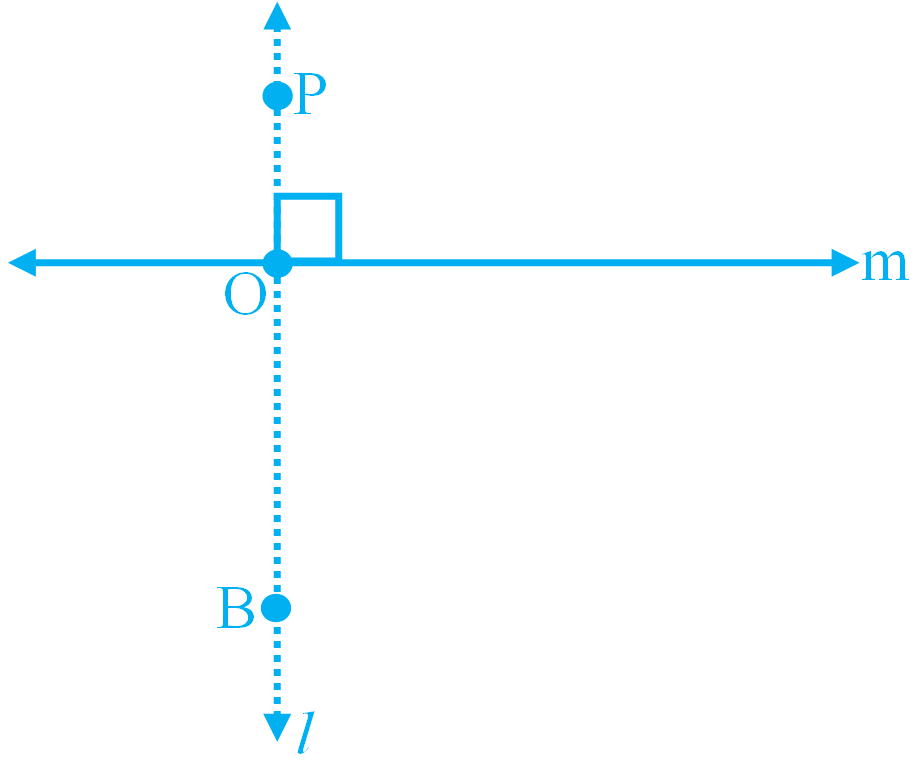
Step $I:$ Let $m$ be the given line and $P$ be a point outside $m.$

Step $II:$ Place the protractor on point $P,$ such that its centre coincides with point $P.$
Step $III:$ Mark a point $B$ against the $90^\circ$ mark on the protractor.
Step $IV:$ Remove the protractor and draw a line $l$ passing through $P$ and $B$ wich intersects line $m$ at $O.$
Then, $\text{PO}\bot\text{m}.$

Ruler and Compass:
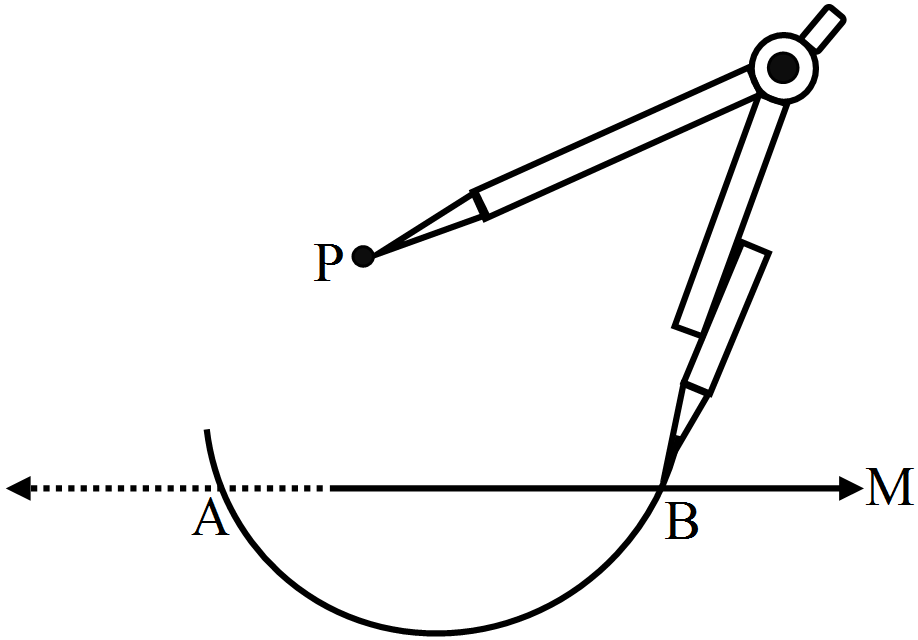
Step $I:$ Given, a line m and point $P,$ not it. Extend the given line in both derections.

Step $II:$ With $P$ as centre, draw an arc which intersects line m at two points $A$ and $B.$

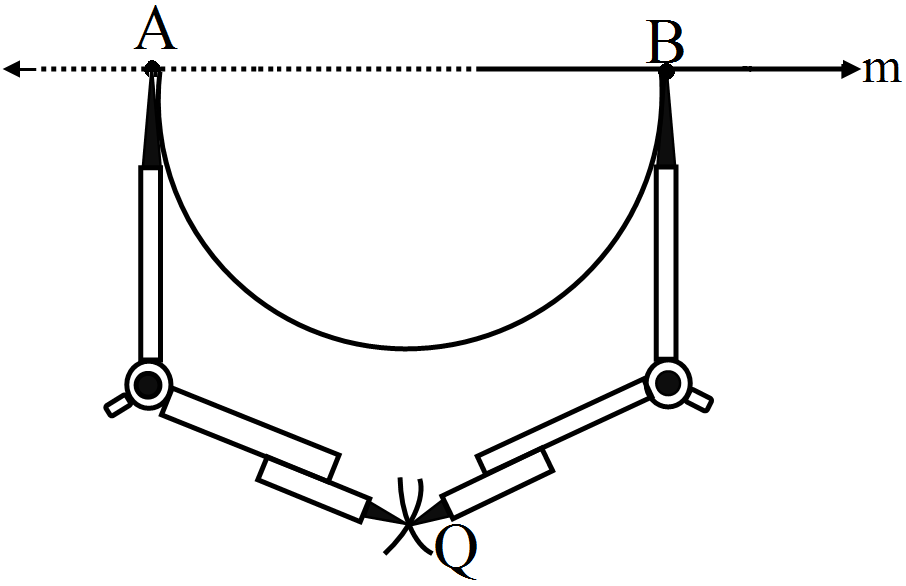
Step $III:$ With $A$ and $B$ as centres and the same redius draw two arcs which intersect at a point say $Q,$ on the other side.

Step $IV:$ Join $PQ.$​​​​​​​

Thus, $PQ$ is perpendicular to $m.$
We are able to draw one perpendicular line.
 
View full question & answer
Question 125 Marks
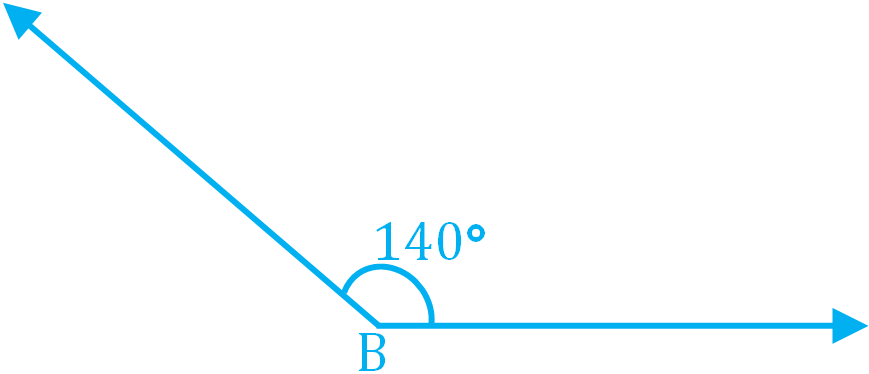
Draw an angle of $140^\circ$ with the help of a protractor and bisect it using ruler and compasses.
Answer
Step of construction are as follows:
Step I: Draw an angle $\angle\text{B}=140^\circ.$

Step II: With $6$ as a centre and using compass, draw an arc which cuts both rays of $\angle\text{B},$ at $A $ and $C.$
Step III: With $A$ as centre, draw $($in the interior of $\angle\text{B})$ an arc, whose radius is more than half the length $AC.$
Step IV: With $C$ as centre the same radius and draw another arc, in the interior of $\angle\text{B}.$ Let the two arcs intersect at $D.$ Then, $BD$ is the required bisector of $\angle\text{B}.$
View full question & answer
Question 135 Marks
Draw a line segment of length $10\ cm.$ Divide it into four equal parts. Measure each of these parts.
Answer
Steps of construction are as follows:
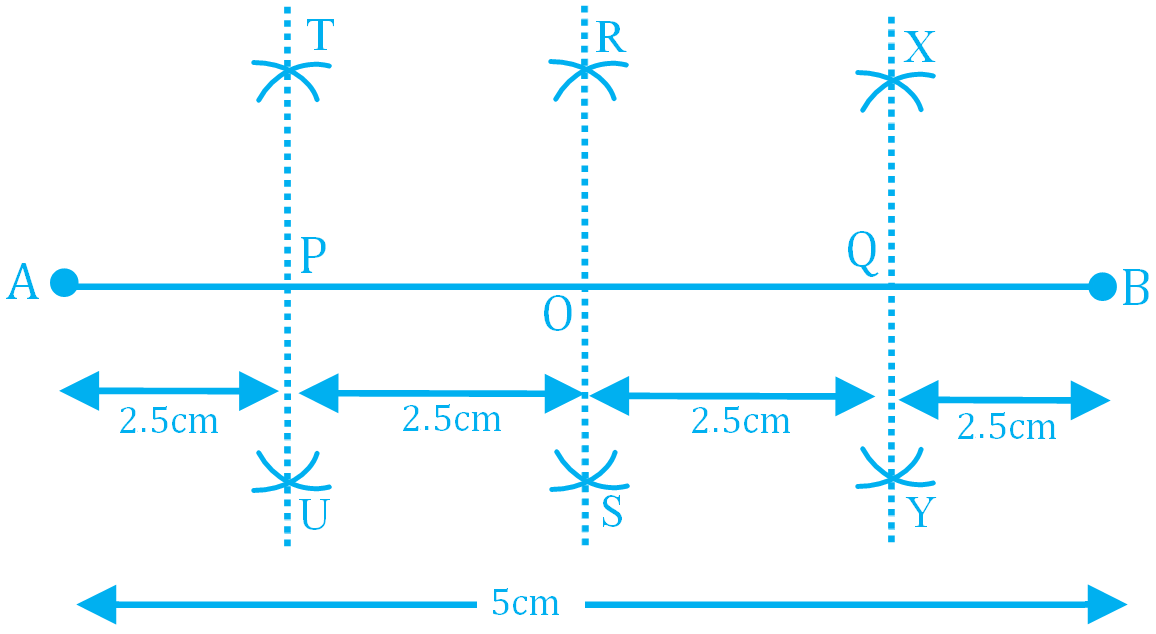
Step I: Firstly, draw a line segment  $AB = 10\ cm.$
Step II: With $A$ and $B$ as centre and the radius more than half of $AS,$ cut the arc both sides of $AS$ at $R$ and $S.$ Join $RS$, it is the bisector of $AS,$ i.e. $AO = OB.$​​​​​​​
Step III: Now, with $A$ and $O$ as centre and the radius more than half of $AO,$ cut the arc both sides of $AO$ at $T$ and $U.$ Join $TU$, it is the bisector of $AO,$ i.e. $AP = PO.$​​​​​​​
Step IV: Again, with $0$ and $B$ as centre and the radius more than half of $OB,$ cut the arc both sides of $OS$ at $X$ and $Y.$ Join $XY,$ it is the bisector of $OB,$ i.e. $OQ = QB.$​​​​​​​​​​​​​​

Step V: The line segment $AB$ is divided into $4$ equal parts; such that $AP, PO, OQ$ and $QB.$​​​​​​​
Step VI: By actual measurement, we have $AP = PO = QB = 2.5\ cm.$
View full question & answer
Question 145 Marks
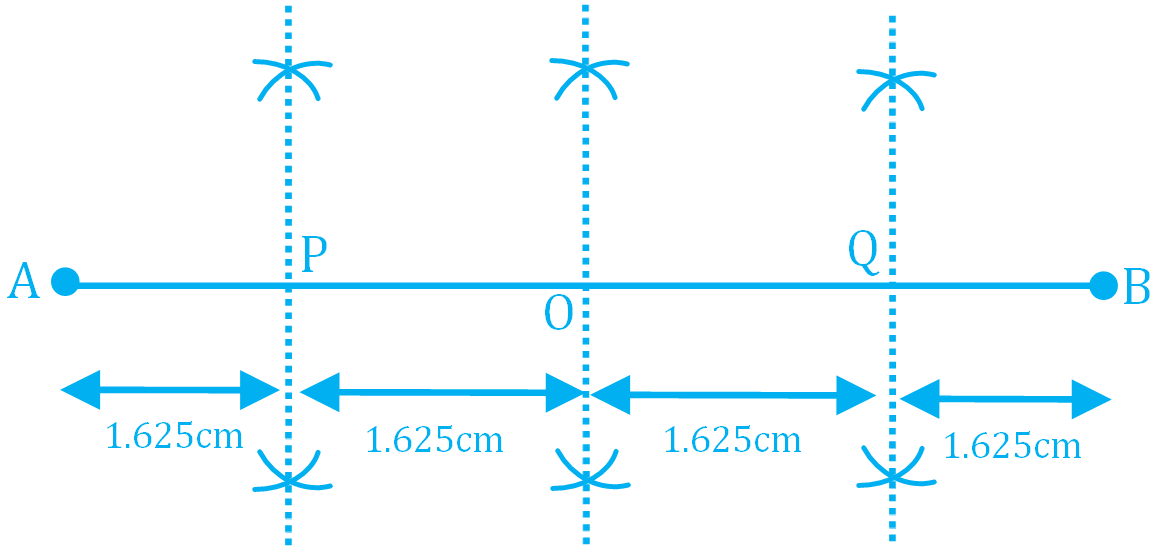
Draw a line segment of length $6.5\ cm$ and divide it into four equal parts, using ruler and compasses.
Answer
First of all, we construct $AB$ of length $6.5\ cm.$ Now, steps of construction are as follows:
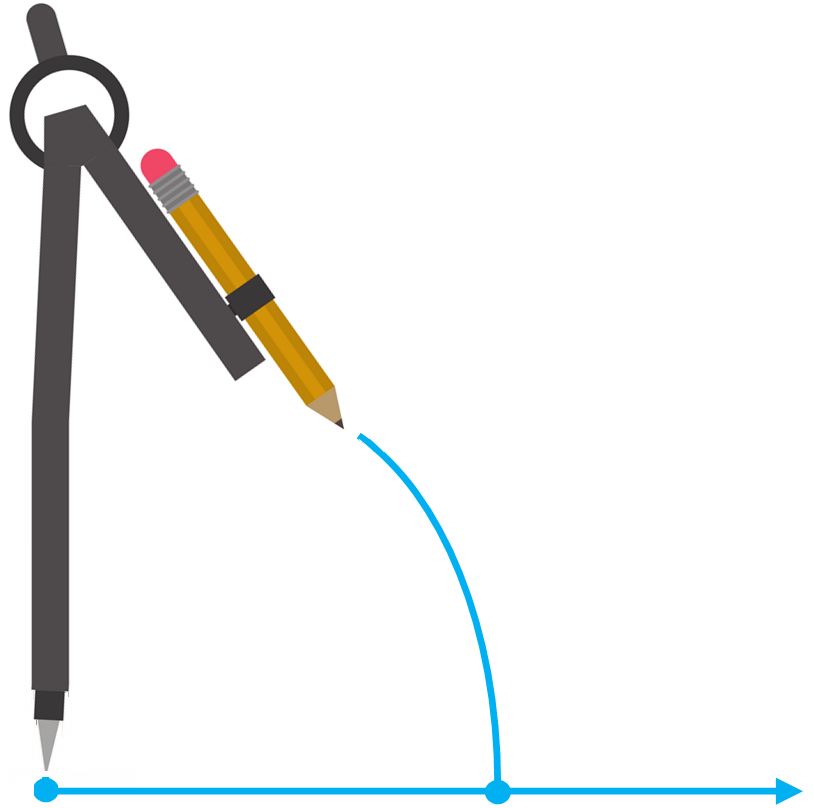
Step I: Draw a line segment $AB = 6.5\ cm.$
Step II: Draw perpendicular bisector of $AB,$ which meets $AB$ at $O (\therefore O$ is the mid point of $AB),$ i.e. $AO = OB.$​​​​​​​ Step III: Now, draw perpendicular bisector of $AO$ which meet $AB$ at $P,$ such that $AP = PO.$​​​​​​​
Step IV: Then, draw perpendicular bisector of $BO$ which meet $AB$ at $Q,$ such that $BQ = OQ.$​​​​​​​
Step V: The line segment $AB$ is divided into $4$ equal parts at $P O$ and $Q.$​​​​​​​
Step VI: By actual measurement, we have $AP = PO = OQ = QB = 1.625\ cm.$
View full question & answer
Question 155 Marks
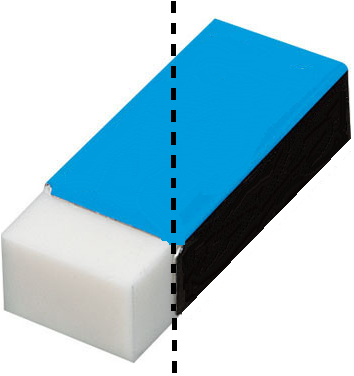
Identify the symmetrical instruments from your mathematical instrument box.
Answer
$(i)$
$(ii)$
$(iii)$
$(iv)$
$(v)$
A protractor
A divider
A ruler (scale)
A eraser
A pencil
View full question & answer
Question 165 Marks
Complete the following table:
No. Shapes Rough figure Number of lines of symmetry
$(i)$ Scalene triangle $0$
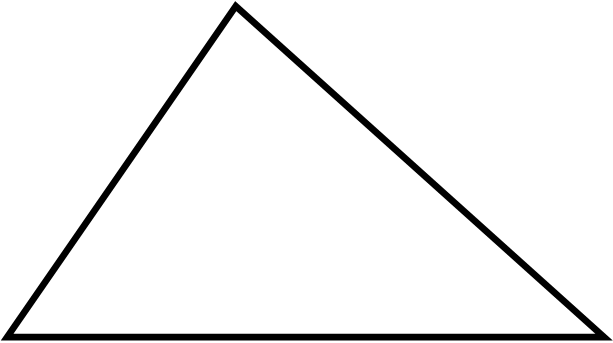
$(ii)$ Isosceles triangle $1$
$(iii)$ Equilateral triangle    
$(iv)$ Rectangle    
$(v)$ Square    
$(vi)$ Parallelogram    
$(vii)$ Rhombus    
$(viii)$ Line    
$(ix)$ Line segment    
$(x)$ Angle    
$(xi)$ Isosceles trapezium    
$(xii)$ Kite    
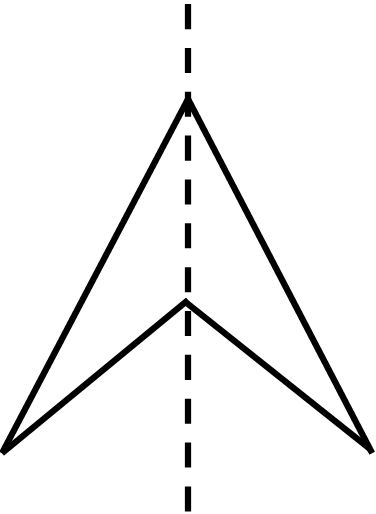
$(xiii)$ Arrow head    
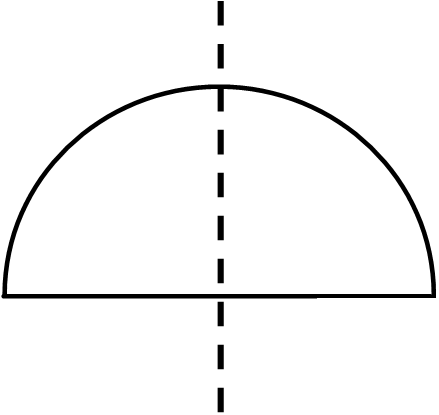
$(xiv)$ Semi-circle    
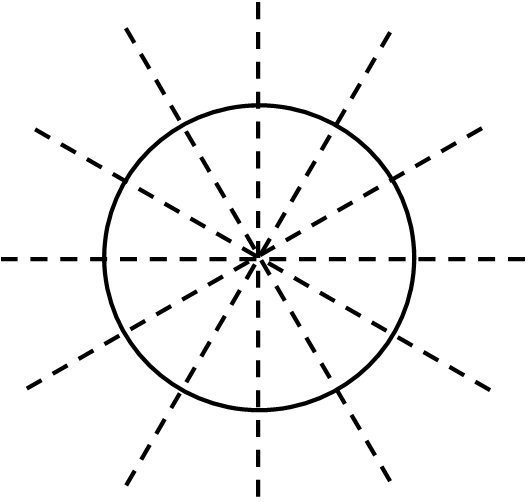
$(xv)$ Circle    
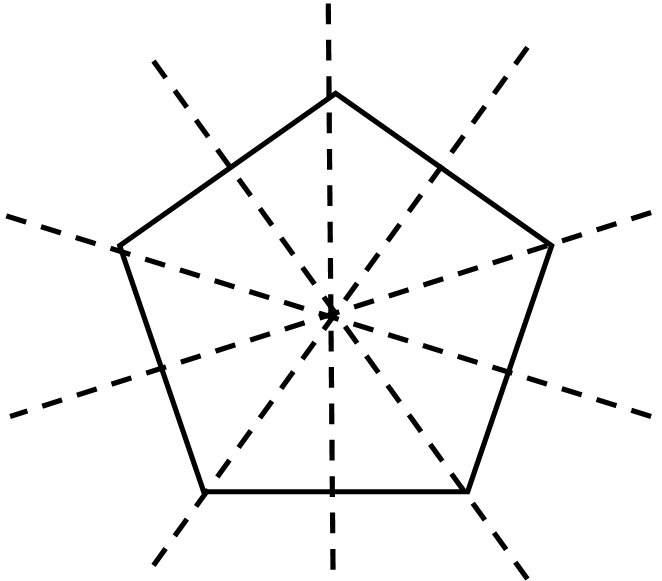
$(xvi)$ Regular pentagon    
$(xvii)$ Regular pentagon    
Answer
No. Shapes Rough figure Number of lines of symmetry
$(i)$ Scalene triangle $0$
$(ii)$ Isosceles triangle $1$
$(iii)$ Equilateral triangle $3$
$(iv)$ Rectangle $4$
$(v)$ Square  
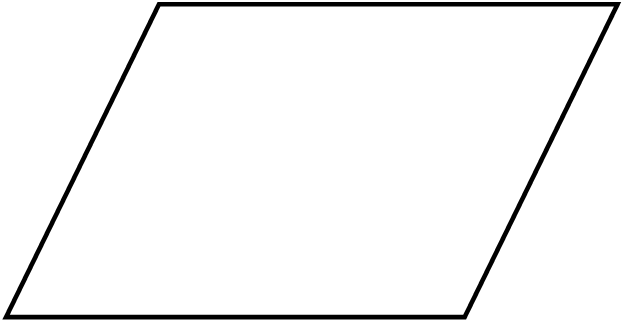
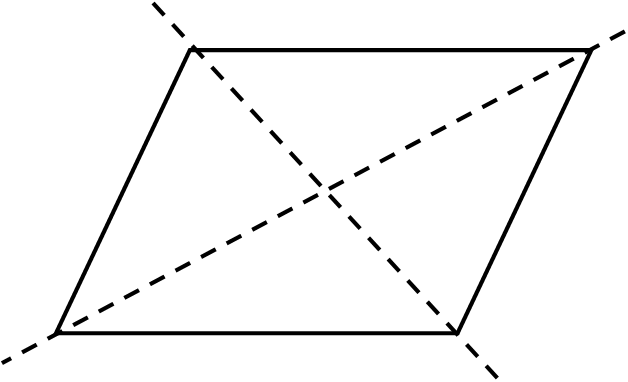
$(vi)$ Parallelogram $0$
$(vii)$ Rhombus $2$
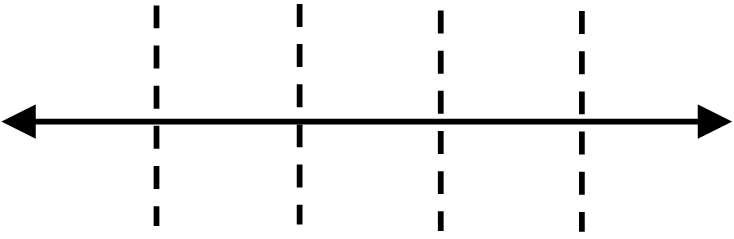
$(viii)$ Line Infinitely Many
$(ix)$ Line segment $1$
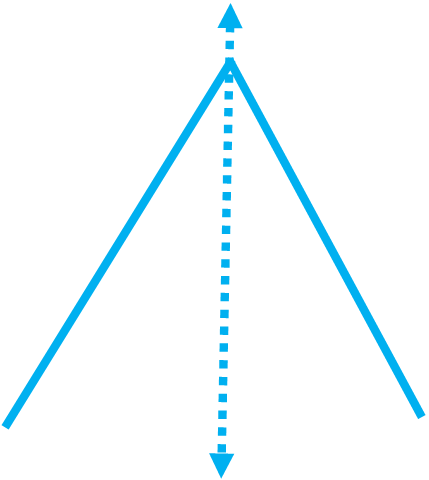
$(x)$ Angle $1$
$(xi)$ Isosceles trapezium $1$
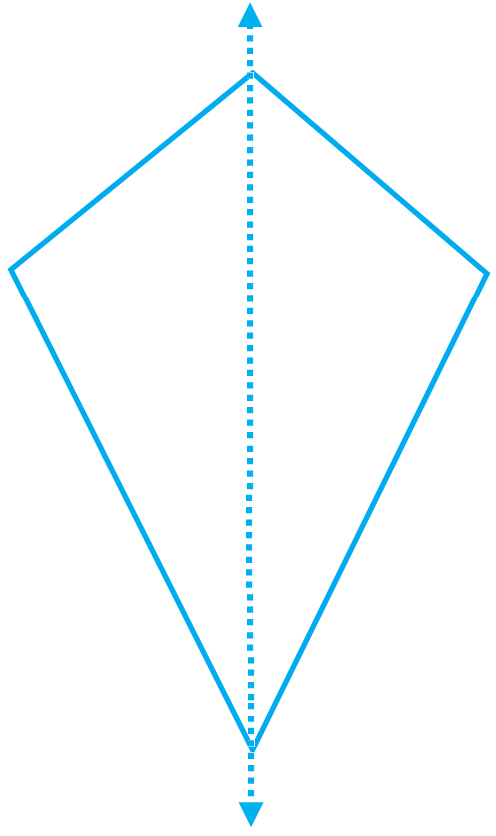
$(xii)$ Kite $1$
$(xiii)$ Arrow head $1$
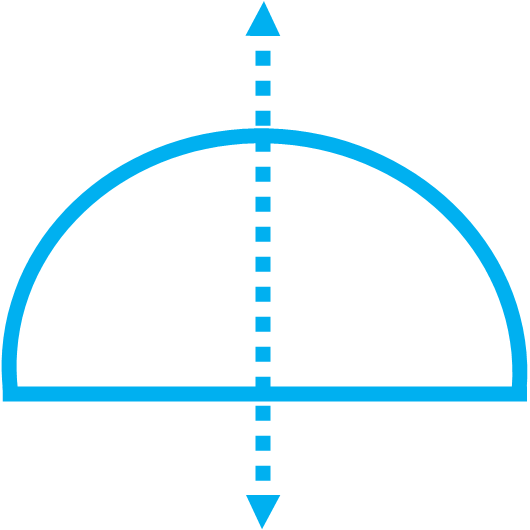
$(xiv)$ Semi-circle $1$
$(xv)$ Circle Infinitely Many
$(xvi)$ Regular pentagon $5$
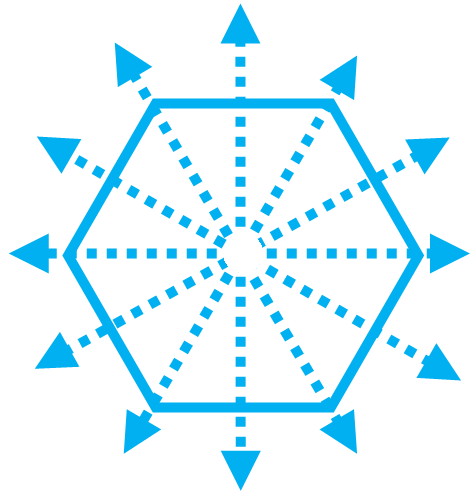
$(xvii)$ Regular hexagon $6$
View full question & answer
Question 175 Marks
Match the following:
S.No.
Shape
S.No.
Number of lines of symmetry
$i.$
Isosceles triangle.
$a.$
$6$
$ii.$
Square.
$b.$
$5$
$iii.$
Kite.
$c.$
$4$
$iv.$
Equilateral triangle.
$d.$
$3$
$v.$
Rectangle.
$e.$
$2$
$vi.$
Regular hexagon.
$f.$
$1$
$vii.$
Scalene triangle.
$g.$
$0$
Answer
$(i)$ An isosceles triangle has $1$ line of symmetry.

$ (ii)$ A square has $4$ lines of symmetry.

$ (iii)$ A kite has $1$ line of symmetry.

$​​​​​​​ (iv)$ An equilateral triangle has $3$ lines of symmetry.

$​​​​​​​ (v)$ A rectangle has $2$ lines of symmetry.

$​​​​​​​ (vi)$ A regular haxagon has $6$ lines of symmetry.

$(vii) $ A scalene triangle has no line of symmetry, i.e.
​​​​​​​$\therefore (i) \rightarrow f, (ii) \rightarrow c, (iii) \rightarrow f, (iv) \rightarrow d, (v) \rightarrow e, (vi) \rightarrow a, (vii) \rightarrow g.$
View full question & answer
Question 185 Marks
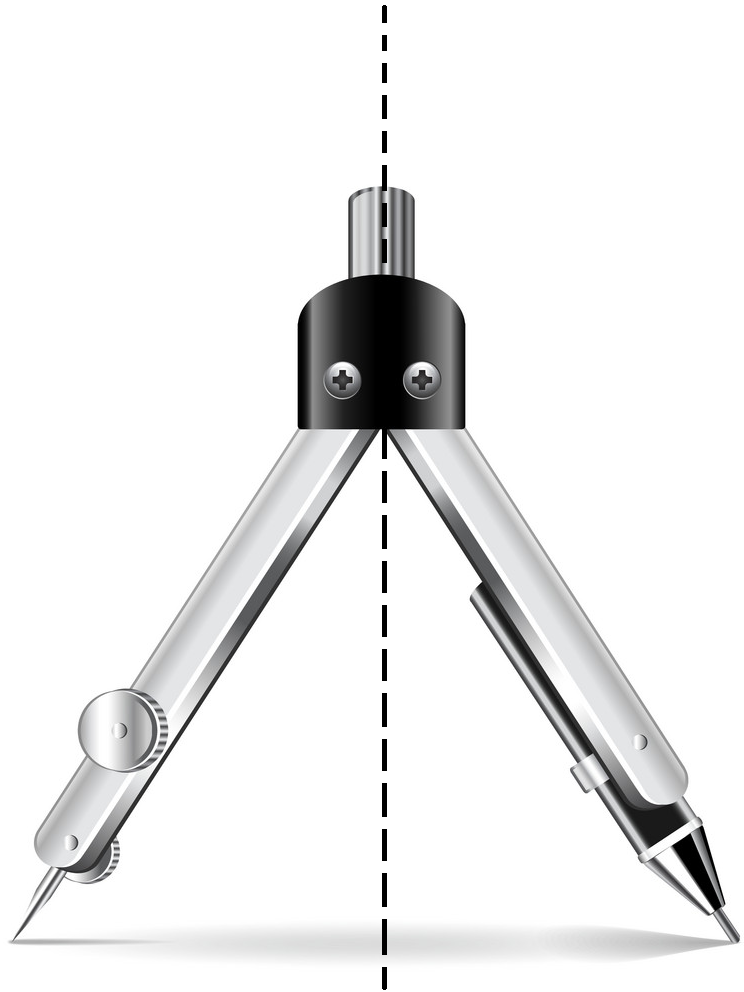
Open your geometry box. There are some drawing tools. Observe them and complete the following table:
S.No.
Name of the tool
Number of lines of symmetry
$i.$
The Ruler.
__________________
$ii.$
The Divider.
__________________
$iii.$
The Compasses.
__________________
$iv.$
The Protactor.
__________________
$v.$
Triangular piece with two equal sides.
__________________
$vi.$
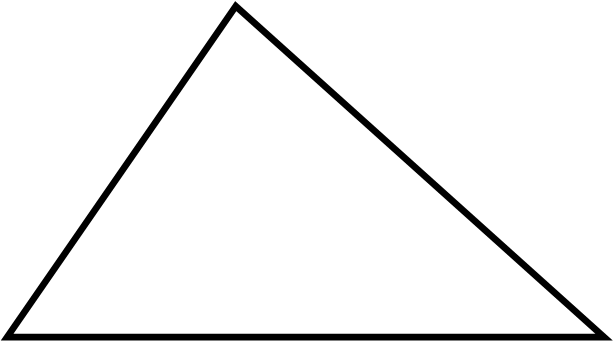
Triangular piece with unequal sides.
__________________
Answer
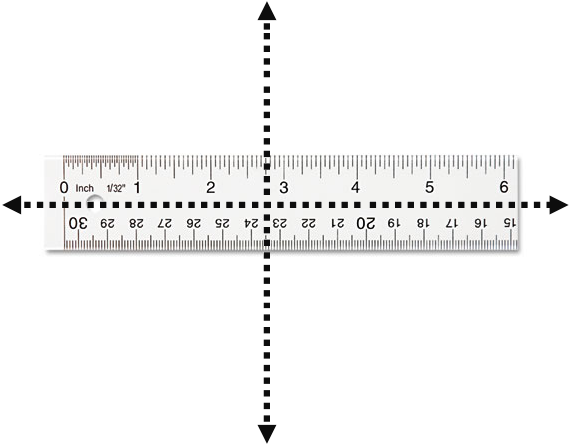
$(i)$ Ruler:

It has two lines of symmetry.
$(ii)$ Divider:

It has one line of symmetry.
$(iii)$ Compass:

Since, both the sides of a compass are not identical. Therefore, it has no line of symmetry.
$(iv)$ Protractor:

Since, a protractor has a shape od semi-circle and a semi-circle has only one line of symmetry.
$​​​​​​​(v)$ Triangular plece with two equal sides:

$ (vi)$ Triangular piece with unequal sides:

Since, all the sides are unequal. Therefore, it has no line of symmetry.
S.No.
Name of the tool
Number of lines of symmetry
$i.$
The Ruler.
$2$
$ii.$
The Divider.
$1$
$iii.$
The Compasses.
$0$
$iv.$
The Protactor.
$1$
$v.$
Triangular piece with two equal sides.
$1$
$vi.$
Triangular piece with unequal sides.
$0$
View full question & answer
Question 195 Marks
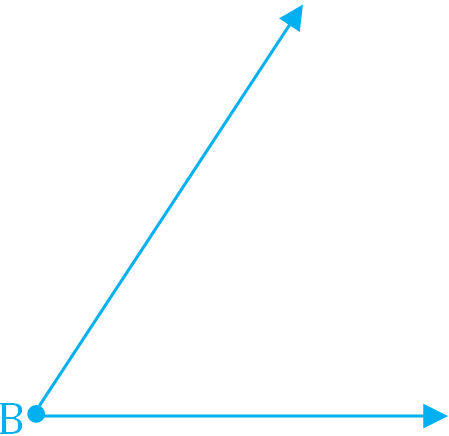
Draw an angle of $65^\circ$ and draw an angle equal to this angle, using ruler and compasses.
Answer
Given, $\angle\text{B}=65^\circ$

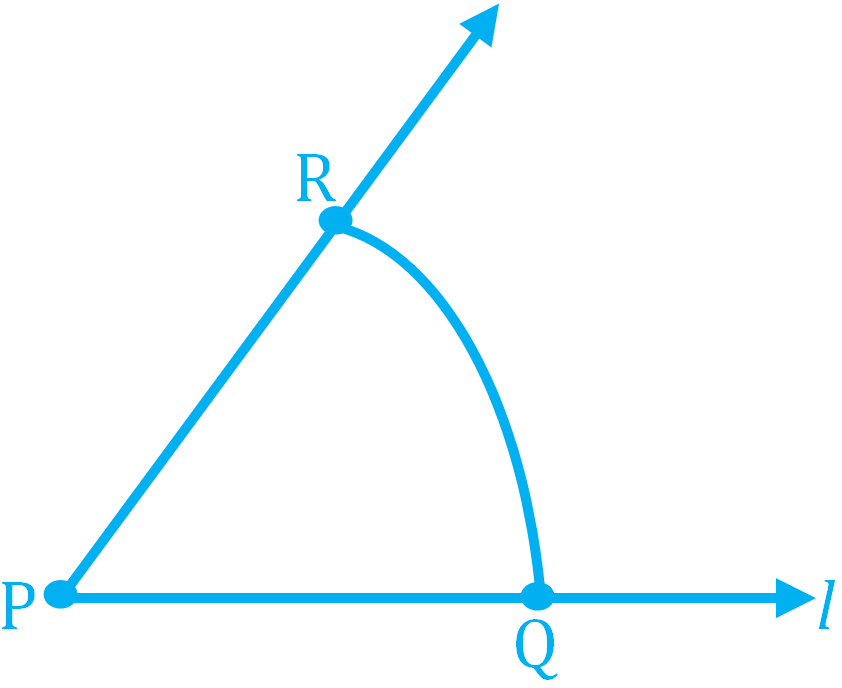
Step of construction are as follows: Step I: Draw a line $l $ and choose a point $P$ on it.

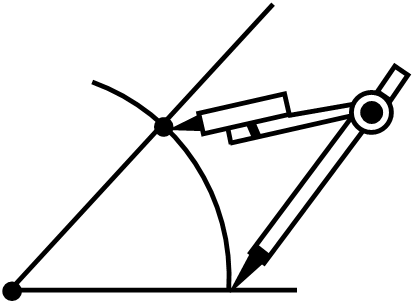
Step II: Place the compass at $B$ and draw an arc to cut the rays of $\angle\text{B}$ at $A$ and $C.$
Step III: Use the same compass setting to draw an arc with $P$ as centre, cutting $l$ at $Q.$​​​​​​​
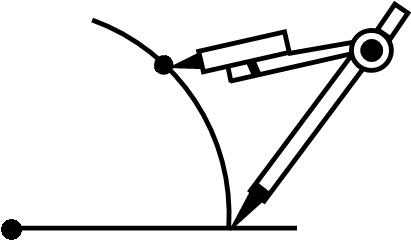
Step IV: Set your compass to the length $AC.$​​​​​​​

Step V: Place the compass pointer at $Q$ and draw the arc to cut the previous arc in $R.$
Step VI: Join $PR.$ This gives us $\angle \text{P}.$ It has the same measure as $\angle\text{B.}$
This means $\angle\text{QPR}$ has same measure as $\angle\text{ABC.}$
View full question & answer
Question 205 Marks
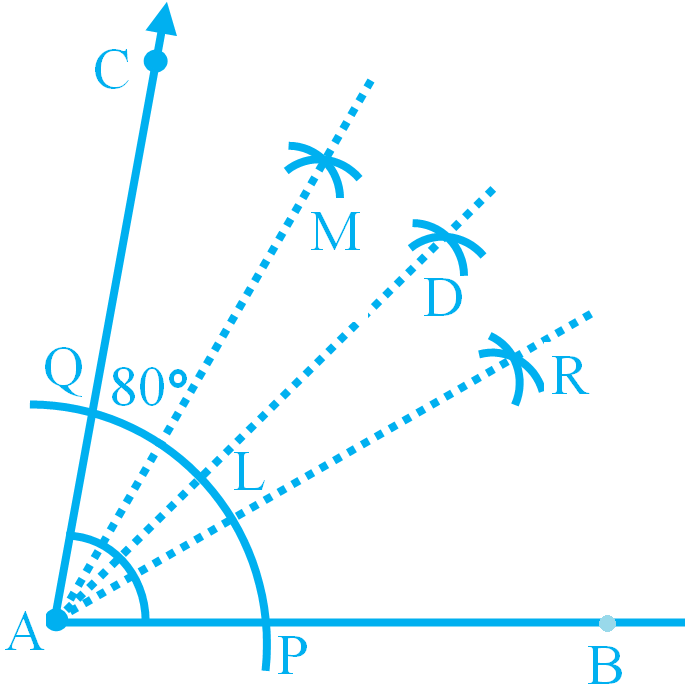
Draw an angle of $80^\circ$ using a protractor and divide it into four equal parts, using ruler and compasses. Check your construction by measurement.
Answer
Here, to divide an angle of measure $80^\circ $ into four equal parts, we use the following steps of construction:
Step I: Draw a line segment $AB $  of any length. Place the centre of the protractor at $A$ and the zero edge along $AB.$
Step II: Start with zero near $B$ and mark $C$ at $80^\circ .$​​​​​​​
Step III: Join $AC,$ then $\angle\text{BAC}$ is an angle of measure $80^\circ .$
Step IV: With $A$ as centre and using compass, draw an arc that cuts both the rays of $\angle\text{A}$ at $P$ and $Q.$​​​​​​​
Step V: With $P$ as centre, draw $($in the interior of $\angle\text{A})$ an arc, whose radius is more than half the length of $PQ.$​​​​​​​​​​​​​​ Step VI: With $Q$ as centre and the same radius, draw another arc in the interior of $A.$ Let the two arcs intersect at $D.$ Join $AD,$ cutting arc $PQ$ at $L.$ Then, $AD$ divides the $\angle\text{BCA}$ into two equal parts.

Step VII: Now, taking $P$ and $L$ as centre, having radius more than half of length $PL,$ draw two arcs respectively, which cut each other at $R.$​​​​​​​
Step VIII: Join $AR,$ which divides $\angle\text{BAD}$ into two equal parts.
Step IX: Now, taking $Q$ and $L$ as centre, having radius more than half of length $QL,$ draw two arcs respectively, which cut each other at $M.$​​​​​​​
Step X: Join $AM,$ which divide $\angle\text{CAD}$ into two equal parts. Thus, $AM, AD$ and $AR$ divide $\angle\text{BAC}$ into four equal parts.
View full question & answer
Question 215 Marks
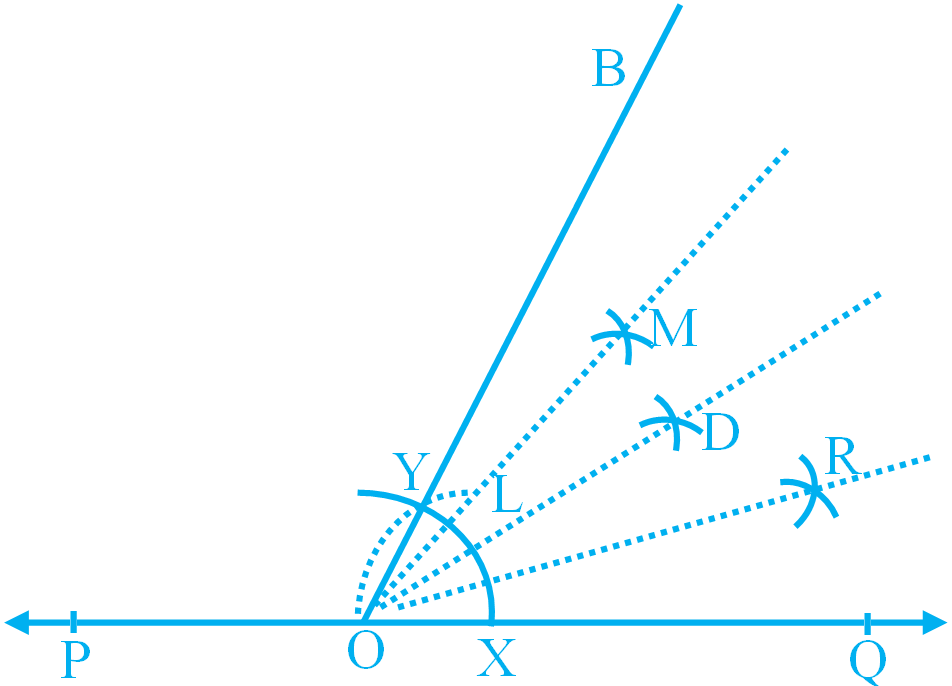
Draw an angle of $60^\circ$ using ruler and compasses and divide it into four equal parts. Measure each part.
Answer
Step of contruction are as follows:
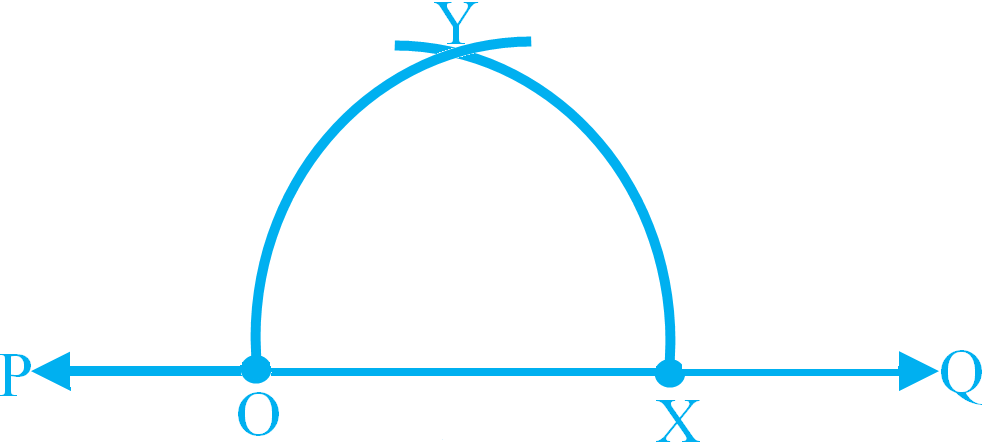
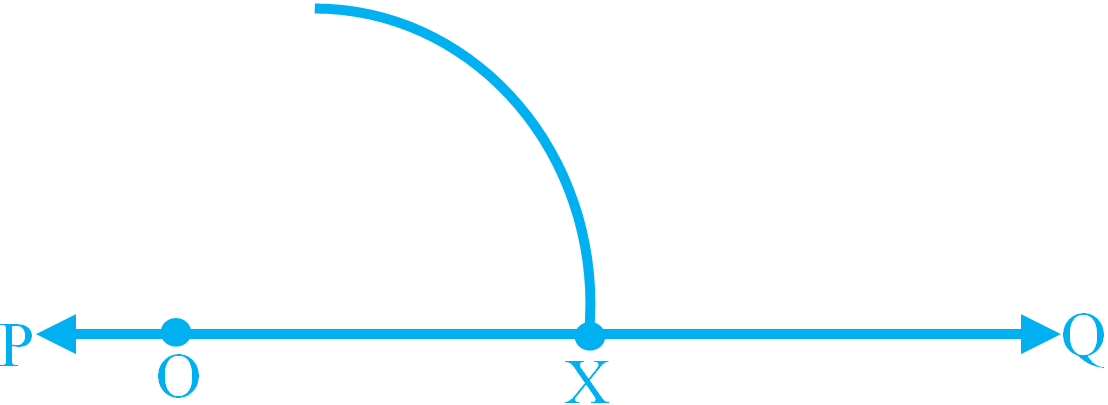
Step I: Draw a line segment $\overline{\text{PQ}}$ and mark a point $O$ on it.

Step II: Place the pointer of the compass at $O$ (as center) and draw an arc of convenient redius, which cuts the line $PQ$ at a point $X.$

Step III: With the pointer at $X$ (as center) and same redius, draw an arc that passes through $O,$ which intersect at $Y.$​​​​​​​

Step IV: Join $OY $ and produce it to $B$. We get $\angle\text{BOX,}$ whose measure is $60^\circ$.

Step V: With $0$ as a centre and using compass draw an arc that cuts both rays of $\angle\text{O}$ at $X$ and $Y.$​​​​​​​
Step VI: With $X$ as centre, draw $($in the interior of $\angle\text{O})$ an arc, whose radius is more than half the length of $XY$​​​​​​​
Step VII: With the same radius with $Y$ as centre, draw another arc in the interior of $\angle\text{O.}$ Let the two arcs intersects at $D.$ Join $OD,$ cutting arc $XY$ at $L.$ Then, $OD$ divides the $(\angle\text{XOB or}\ \angle\text{QOB)}$ into two equal parts.
Step VIII: Now, taking $X$ and $L $ as centre, having radius more than half of length $XL,$ draw two arcs respectively, which cut each other at $R.$​​​​​​​
Step IX: Join $OR,$ which divides $\angle\text{XOD}$ into two equal parts.
Step X: Now, taking $Y$ and $L$ as centre, having radius more than half of length $YL,$ draw two arcs respectively, which cut each other at $M.$​​​​​​​
Step XI: Join $OM,$ which divide $\angle\text{BOD}$ into two equal parts.
Thus, $OM, OR$ and $OD$ divide $\angle\text{XOB} (\text{or}\ \angle\text{QOB})$ into four equal parts.
View full question & answer
Question 225 Marks
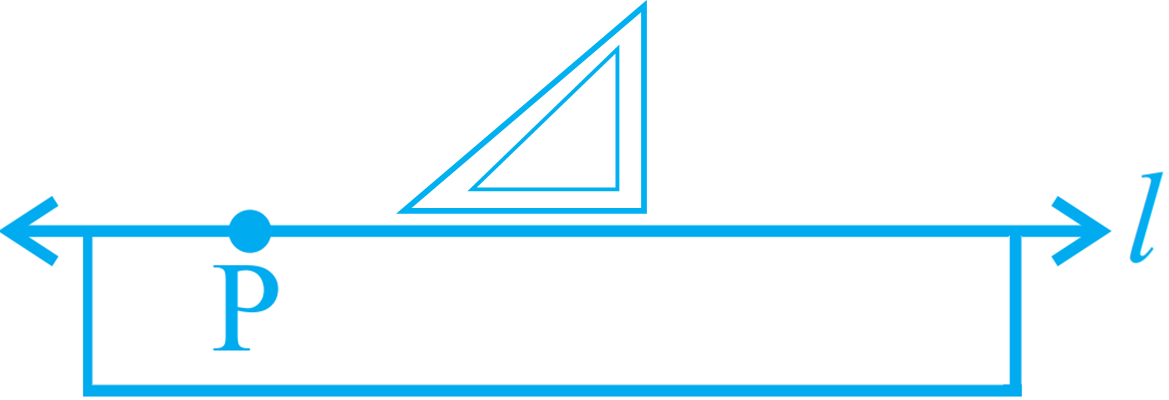
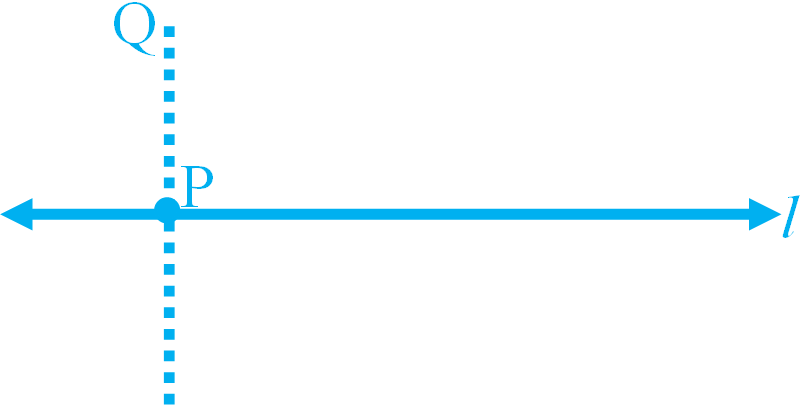
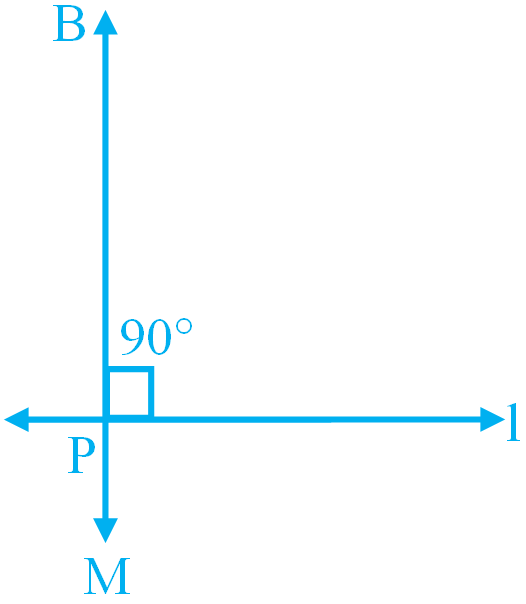
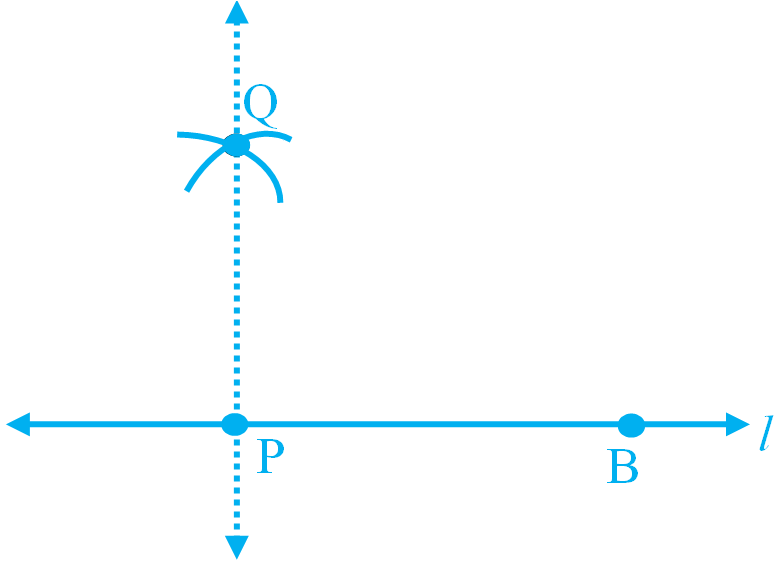
Copy Figure on your notebook and draw a perpendicular to $l$ through $P,$ using $(i)$ set squares $(ii)$ Protractor $(iii)$ ruler and compasses. How many such perpendiculars are you able to draw?
Answer
 
 
We draw perpendicular to $l$ through $P$ using.
$I.\ $Set square:
Steps of construction are as follows:
Step $I:$ A line $l$ and a point $P$ are given. Note that $P$ is on the line $l.$

Step $II:$ Place a ruler with one of its edges along $l.$ Hold it firmly.

Step $III:$ Place a set square with one of its edges along the already aligned edge of the ruler, such that the right angled comer is in contact with the ruler.

Step $IV:$ Hold the set square firmly in this position. Draw $\overline{\text{PQ}}$ along the edge of the set square.

$II.\ $Protractor:
Step $I:$ A line $l$ and a point $P$ are given. Note that $P$ is on the line $l.$

Step $II:$ Place the protractor on the line, such that its base line coincides with l and its centre falls on $P.$
Step $III:$ Mark a point $B$ against the $90^\circ$ mark on the protractor.
Step $IV:$ Remove the protractor and draw a line m passing through $P$ and $B.$
Then, $\text{PB}\bot\text{l}$

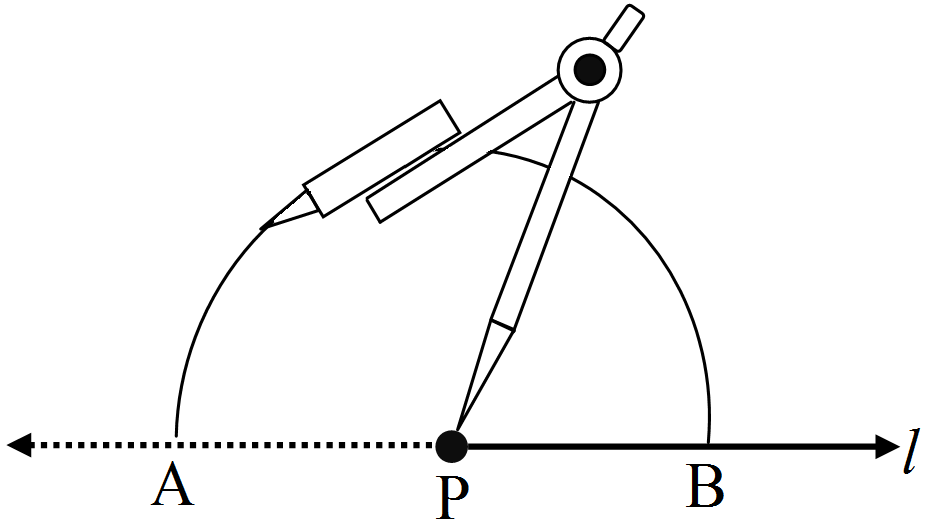
Ruler and Compass:
Step $I:$ Given, a point $P$ on a line $l.$​​​​​​​

Step $II:$ With $P$ as centre and a convenient radius, construct an arc intersecting the line $l$ at two points $A$ and $B.$​​​​​​​

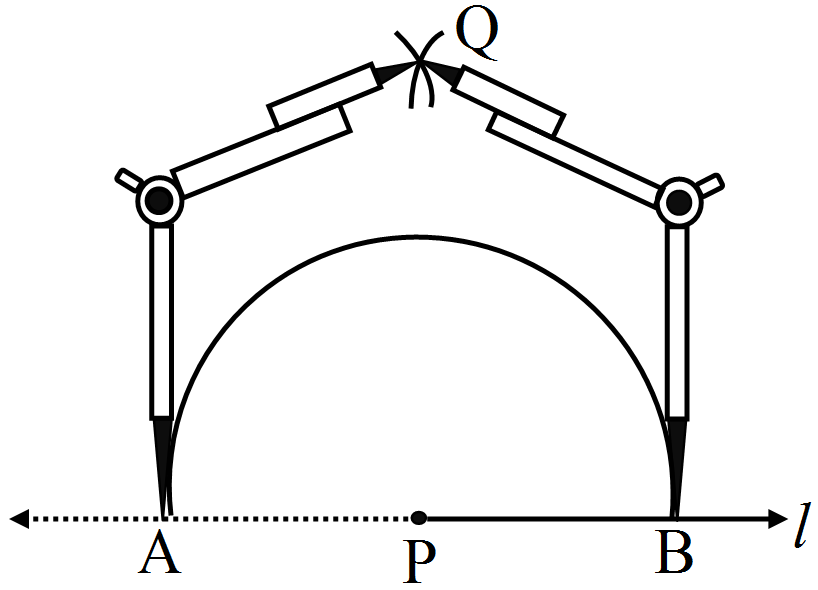
Step $III:$ With $A$ and $B$ as centres and a redius greater than $AP$ construct two arcs, which cut each other at $Q.$​​​​​​​

Step $IV:$ Join $PQ.$ Then, $PQ$ is perpendicular to $l.$​​​​​​​

Hence, we are able to draw one perpendicular line.
 
View full question & answer