Question
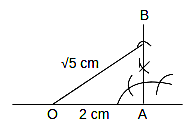
Draw a line segment of length $\sqrt{5} \mathrm{~cm}$.

Answer

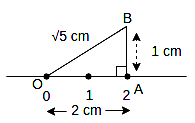
Construct a right$-$angled triangel $\mathrm{OAB}$ with


$ \mathrm{OA}=2 \mathrm{~cm}$
$ \angle \mathrm{OAB}=90^{\circ}$  and
$ \mathrm{AB}=1 \mathrm{~cm}$
Using $ \mathrm{OB}^2=\mathrm{OA}^2+\mathrm{AB}^2$
$ \mathrm{OB}^2=2^2+1^2$
$ \mathrm{OB}^2=4+1$
$ \mathrm{OB}^2=5$
$ \mathrm{OB}=\sqrt{5}$

Need a full question paper?

Generate a complete, print-ready paper with questions like this in minutes — across 16+ boards, with answer keys.
Start Generating Free

Similar questions

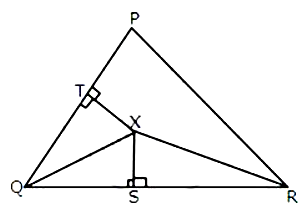
In the adjoining figure, $\mathrm{OX}$ and $\mathrm{RX}$ are the bisectors of the angles $Q$ and $R$ respectively of the $\triangle P Q R$.If $X S \perp Q R$ and $X T \perp P Q$;

prove that: $(i) \triangle \mathrm{XTQ} \cong \triangle \mathrm{XSQ}.(ii) \mathrm{PX}$ bisects angle $\mathrm{P}$
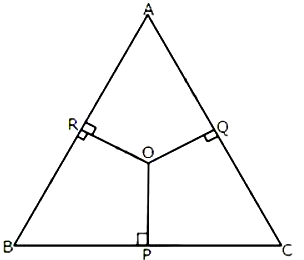
In the following figure, $O P, O Q$ and $O R$ are drawn perpendiculars to the sides $B C, C A$ and $A B$ respectively of $\triangle A B C$.Prove that: $AR ^2+ BP ^2+ CQ ^2= AQ ^2+ CP ^2+ BR ^2$
Rationalise the denominator of $: \frac{1}{\sqrt{ 3} -\sqrt{2 } +1}$
In rectangle $\text{ABCD},$ diagonal $\text{BD} = 26 \ cm$ and cotangent of $\angle \text{ABD} = 1.5.$ Find the area and the perimeter of the rectangle $\text{ABCD}.$
Draw a graph of each of the following equations:$ 3x - 2y = 6$
Two poles of heights $6\ m$ and $11\ m$ stand vertically on a plane ground. If the distance between their feet is $12\ m;$find the distance between their tips.
$D$ and $F$ are mid$-$points of sides $AB$ and $AC$ of a $ \triangle ABC.$ A line through $F$ and parallel to $AB$ meets $BC$ at point $E$.
  1. Prove that BDFE is a parallelogram
  2. Find AB, if EF = 4.8 \ cm.
Prove that $: \tan \left(45^{\circ}- A \right) \tan \left(45^{\circ}+ A \right)=1$.
$\left[\right.$ Hint . $\left.\tan \left(45^{\circ}- A \right)=\tan \left[90^{\circ}-\left(45^{\circ}+ A \right)\right]=\cot \left(45^{\circ}+ A \right)\right]$.
The perimeter of a rhombus is $100 \ cm$ and obtuse angle of it is $120^\circ .$ Find the lengths of its diagonals.
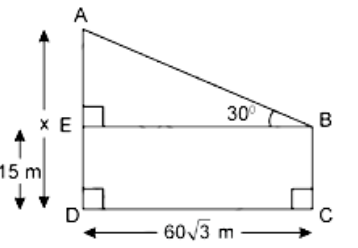
Find the value $'x\ ',$ if:
Image