Maharashtra BoardEnglish MediumSTD 12 SciencePhysicsSemiconductor Devices4 Marks
Question
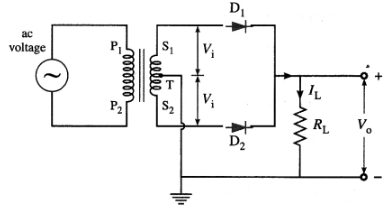
Draw a neat diagram of a full wave rectifier and explain it’s working.
✓
Answer
A device or a circuit which rectifies both halves of each cycle of an alternating voltage is called a full-wave rectifier. Electric circuit : The alternating voltage to be rectified is applied across the primary coil ( $P _1 P _2$ ) of a transformer with a centre-tapped secondary coil ( $S _1 S_2$ ). The terminals and S 2 of the secondary are connected to the two p-regions of two junction diodes $D_1$ and $D_2$, respectively. The centre-tap $T$ is connected to the ground. The load resistance RL is connected across the common $n$-regions and the
$P _1 P _2, S_1 S_2$ : Primary and secondary of transformer,
$T$ : Centre-tap on secondary; $D _1 D _2$ : Junction diodes,
$R _{ L }$ : Load resistance, $I _{ L }$ : Load current,
$V _{ i }$ : AC input voltage, $V _0$ : DC output voltage
Above Figure : Full-wave rectifier circuit
Working : During one half cycle of the input, terminal $S _1$ of the secondary is positive while $S _2$ is negative with respect to the ground (the centre-tap $T$ ). During this half cycle, diode $D _1$ is forward biased and conducts, while diode $D _2$ is reverse biased and does not conduct. The direction of current $Z_L$ through $R_L$ is in the sense shown.
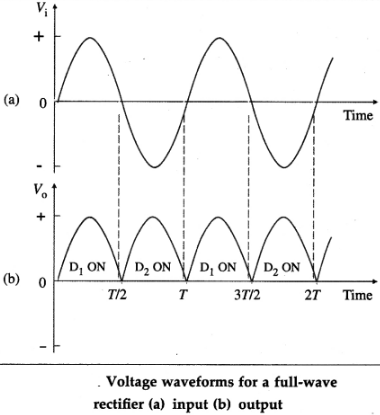
During the next half cycle of the input voltage, S2 becomes positive while $S$, is negative with respect to $T$. Diode D2 now conducts sending a current IL through RL in the same sense as before. Dt now does not conduct. Thus, the current through RL flows in the same direction, i.e., it is unidirectional, for both halves or the full-wave of the input.
This is called full-wave rectification.
The output voltage has a fixed polarity but varies periodically with time between zero and a maximum value. Above figure shows the input and output voltage waveforms. The pulsating dc output voltage of a full-wave rectifier has twice frequency of the input.
Need a full question paper?
Generate a complete, print-ready paper with questions like this in minutes — across 16+ boards, with answer keys.