Question
Draw a neat labelled diagram for a liquid surface in contact with a solid, when the angle of contact is acute.

Answer

Get the step-by-step solution for this question inside the Vidyadip app.

Get the answer in the app

Need a full question paper?

Generate a complete, print-ready paper with questions like this in minutes — across 16+ boards, with answer keys.
Start Generating Free

Similar questions

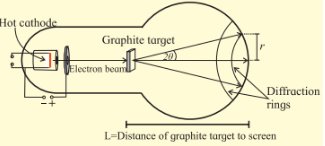
Diffraction results described above can be produced in the laboratory using an electron diffraction tube as shown in figure. It has a filament which on heating produces electrons. This filament acts as a cathode. Electrons are accelerated to quite high speeds by creating large potential difference between the cathode and a positive electrode. On its way, the beam of electrons comes across a thin sheet of

Image
graphite. The electrons are diffracted by the atomic layers in the graphite and form diffraction rings on the phosphor screen. By changing the voltage between the cathode and anode, the energy, and therefore the speed, of the electrons can be changed. This will change the wavelength of the electrons and a change will be seen in the diffraction pattern. By increasing the voltage, the radius of the diffraction rings will decrease. Try to explain why?

A uniform solid sphere has a radius \(0.1 m\) and density \(6 \times 10^3 kg / m ^3\). Find its moment of inertia about a tangent to its surface.
The relative velocity between two layers of a fluid, separately by $0.1 \mathrm{~mm}$, is $2 \mathrm{~cm} / \mathrm{s}$. Calculate the velocity gradient.
Two capacitors each of capacity 2 μF are connected in parallel. This system is connected in series with the third capacitor of 12μF capacity. Find the equivalent capacity of the system.
A stone of mass $5 \mathrm{~kg}$, tied at one end of a rope of length $0.8 \mathrm{~m}$, is whirled in a vertical circle. Find the minimum velocity at the highest point and at the midway point, $[\mathrm{g}=9.8$ $\left.\mathrm{m} / \mathrm{s}^2\right]$
The total energy of a body of mass $2\ kg$ performing S.H.M. is $40\ J.$ Find its speed while crossing the center of the path.
Find the maximum speed with which a car can be safely driven along a curve of radius $100 \mathrm{~m}$, if the coefficient of friction between its tyres and the road is $0.2\left[\mathrm{~g}=9.8 \mathrm{~m} / \mathrm{s}^2\right]$.
What is the turns ratio of a transformer? What can you say about its value for a (1) step-up transformer (2) step-down transformer?
Derive an expression for energy stored in the magnetic field in terms of induced current.
A motor cyclist (to be treated as a point mass) is to undertake horizontal circles inside the cylindrical wall of a well of inner radius \(4 m\). The co-efficient of static friction between tyres and the wall is 0.2 . Calculate the minimum speed and period necessary to perform this stunt.