Question
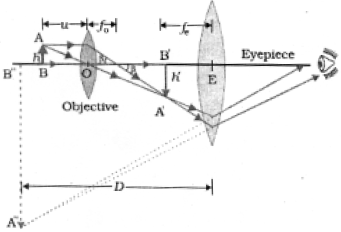
  1. Draw a neat labelled ray diagram of a compound microscope. Explain briefly its working.
  2. Why must both the objective and the eye-piece of a compound microscope have short focal lengths?
Answer


The objective forms a real, inverted, magnified image of the object. This serves as the object for the second lens, the eyepiece, which functions essentially like a simple microscope or magnifier, produces the final image, which is enlarged and virtual.
To achieve a large magnification of a small object; both the objective and eyepiece should have small focal lengths.

Need a full question paper?

Generate a complete, print-ready paper with questions like this in minutes — across 16+ boards, with answer keys.

Start Generating Free

Similar questions

Write and explain principle of superposition for stationary electric forces.
Describe the working principle of a moving coil galvanometer. Why is it necessary to use (i) a radial magnetic field and (ii) a cylindrical soft iron core in a galvanometer? Write the expression for current sensitivity of the galvanometer.
Can a galvanometer as such be used for measuring the current? Explain.
Show that the radius of the orbit in hydrogen atom varies as $n^2,$ where n is the principal quantum number of the atom.
In a photodiode, the conductivity increases when the material is exposed to light. It is found that the conductivity changes only if the wavelength is less than 620nm. What is the band gap?
Two identical particles, each having a charge of $2.0 \times 10^{-4}C$ and mass of 10g, are kept at a separation of 10cm and then released. What would be the speeds of the particles when the separation becomes large?
A thin conducting spherical shell of radius R has charge Q spread uniformly over its surface. Using Gauss’s law, derive an expression for an electric field at a point outside the shell.Draw a graph of electric field E(r) with distance r from the centre of the shell for $0\underline{<}\text{r}\underline{<}\infty.$
A horizontal straight wire $10 \ m$ long extending from east to west is falling with a speed of $5.0 ms^{-1}$, at right angles to the horizontal component of the earth's magnetic field, $0.30 \times 10^{-4} Wb m ^{-2}$.
$a.$ What is the instantaneous value of the emf induced in the wire?
$b.$ What is the direction of the emf?
$c.$ Which end of the wire is at the higher electrical potential?
Define the terms (i) drift velocity, (ii) relaxation time.
A conductor of length L is connected to a dc source of emf ε. If this conductor is replaced by another conductor of same material and same area of cross-section but of length 3L, how will the drift velocity change?
A charge of 1.0C is placed at the top of your college building and another equal charge at the top of your house. Take the separation between the two charges to be 2.0km. Find the force exerted by the charges on each other. How many times of your weight is this force?
Indium antimonide has a band gap of 0.23eV between the valence and the conduction band. Find the temperature at which kT equals the band gap.