Question
Provide the classification of semi-conductors with example.

Answer

The Semi-conductors can be classified as follows:
(i) Elemental Semi-conductors : $S i$ and Ge
(ii) Compound Semi-conductors :
Example are :
(a) Inorganic : $C d S, G a A s, C d S e, I n P$ etc.
(b) Organic : anthracene, doped pthalocyanines, etc.
(c) Organic polymers : polypyrrole, polyaniline, polythiophene etc.
Most of the currently available semi-conductor devices are based on elemental semiconductors $S i$ or $G e$ and compound inorganic semiconductors.

Need a full question paper?

Generate a complete, print-ready paper with questions like this in minutes — across 16+ boards, with answer keys.
Start Generating Free

Similar questions

The magnetic field inside a tightly wound, long solenoid is $\text{B}=\mu_0\text{ni}.$ It suggests that the field does not depend on the total length of the solenoid, and hence if we add more loops at the ends of a solenoid the field should not increase. Explain qualitatively why the extra-added loops do not have a considerable effect on the field inside the solenoid.
Two large glass plates are placed vertically and parallel to each other inside a tank of water with separation between the plates equal to 1mm. Find the rise of water in the space between the plates. Surface tension of water = 0.075N/m.
A 44mH inductor is connected to 220V, 50Hz ac supply. Determine the rms value of the current in the circuit.
Horizontal component of earth’s magnetic field at a place is $\sqrt{3}$ times its vertical component. What is the value of angle of dip at that place?
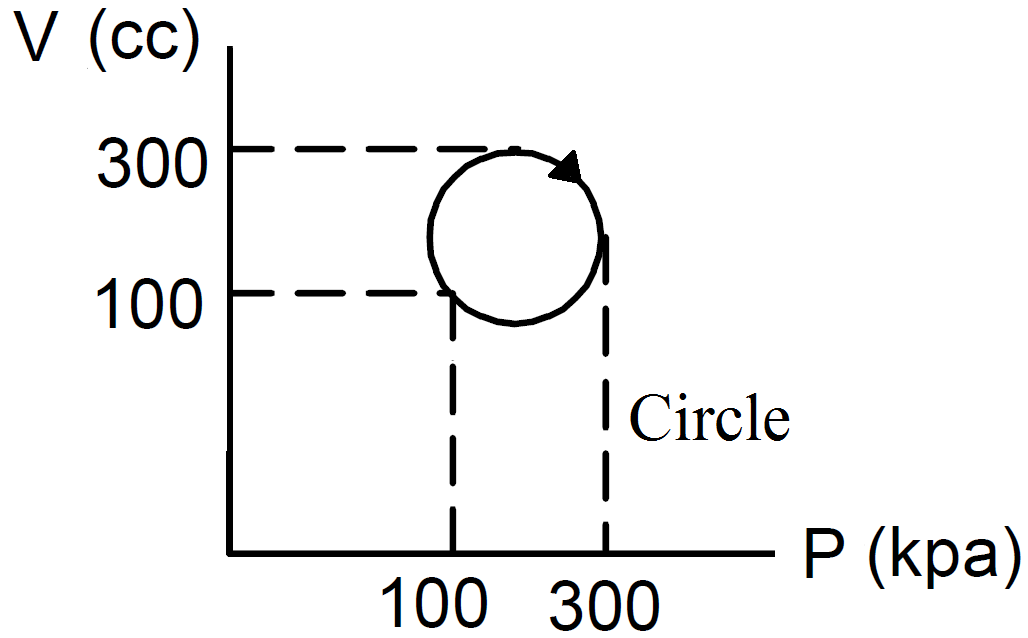
Calculate the heat absorbed by a system in going through the cyclic process shown in figure.
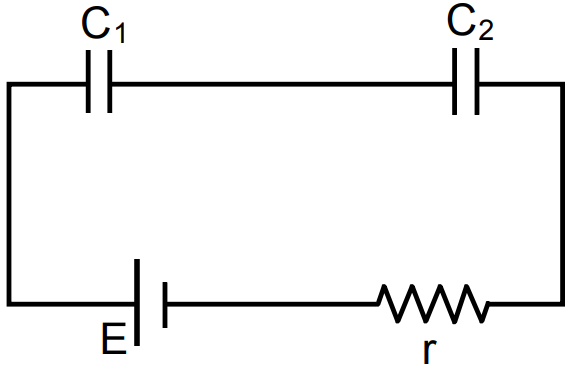
Consider the situation shown in figure. The switch is closed at t = 0 when the capacitors are uncharged. Find the charge on the capacitor $C_1$ as a function of time t.
A steady current $\left(I_1\right)$ flows through a long straight wire. Another wire carrying steady current $\left(I_2\right)$ in the same direction is kept close and parallel to the first wire. Show with the help of a diagram how the magnetic field due to the current $\mathrm{I}_1$ exerts a magnetic force on the second wire. Write the expression for this force.
A sample of paramagnetic salt contains $2.0 \times 10^{24}$ atomic dipoles each of dipole moment $1.5 \times 10^{-23} JT ^{-1}$. The sample is placed under homogeneous magnetic field of $0.84 \ T$ and cooled to the temperature of $4.2 \ K $. The degree of magnetic saturation achieved is equal to $15 \%$. What is the total dipole moment of the sample for a magnetic field of $0.98 \ T$ and a temperature of $2.8 \ K ($assume Curie's law$)$?
Two heating coils, one of fine wire and other of thick wire, made of the same material and of the same length are connected one by one to a source of electricity. Which coil will produce heat at a greater rate?
The equation $\omega=\frac{\mu_\text{v}-\mu_\text{r}}{\mu-1}$ asderived for a prism having small refracting angle. Is it also valid for a prism of large refracting angle? Is it also valid for a glass slab or a glass sphere?