Question
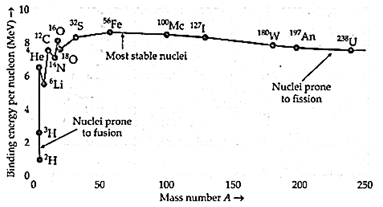
Draw a plot showing the variation of binding energy per nucleon with mass number A. Write two important conclusions which you can draw from this plot. Explain with the help of this plot, the release in energy in the processes of nuclear fusion and fission.

Answer

Image

Binding energy per nucleon as a function of mass number A.
Two important conclusions from this graph are:
i. Nuclear forces non-central and short ranged force.
ii. Nuclear forces between proton-neutron and neutron-neutron are strong and attractive in nature.
Explanation of Nuclear Fission: When a heavy nucleus (A ≥ 235 say) breaks into two lighter nuclei (nuclear fission), the binding energy per nucleon increases i.e, nucleons get more tightly bound. This implies that energy would be released in nuclear fission. 
Explanation of Nuclear Fusion: When two very light nuclei (A  ≤ 10) join to form a heavy nucleus, the binding is energy per nucleon of fused heavier nucleus more than the binding energy per nucleon of lighter nuclei, so again energy would be released in nuclear fusion.

Need a full question paper?

Generate a complete, print-ready paper with questions like this in minutes — across 16+ boards, with answer keys.

Start Generating Free

Similar questions

An electron and photon have same energy 100eV. Which has greater associated wavelength?
The magnetic field B inside a long solenoid, carrying a current of 5.00A, is $3.14 \times 10^{-2}T.$ Find the number of turns per unit length of the solenoid.
  1. Using the phenomenon of polarisation, show how transverse nature of light can be demonstrated.
  2. Two polaroids $\mathrm{P}_1$ and $\mathrm{P}_2$ are placed with their pass axes perpendicular to each other. Unpolarised light of intensity lo is incident on $P_1$. A third polaroid $P_3$ is kept in between $P_1$ and $P_2$ such that its pass axis makes an angle of $30^{\circ}$ with that of $P_1$. Determine the intensity of light transmitted through $P_1, P_2$ and $P_3$.
A charge of $+2.0 \times 10^{-8}C$ is placed on the positive plate and a charge of $-1.0 \times 10^{-8}C$ on the negative plate of a parallel-plate capacitor of capacitance $1.2\times10^{-3}\mu\text{F}.$ Calculate the potential difference developed between the plates.
A charge Q is uniformly distributed over a rod of length l. Consider a hypothetical cube of edge l with the centre of the cube at one end of the rod. Find the minimum possible flux of the electric field through the entire surface of the cube.
Two long and parallel straight wires A and B carrying currents of 8.0 A and 5.0 A in the same direction are separated by a distance of 4.0 cm. Estimate the force on a 10 cm section of wire A.
One end of a steel rod $(\text{K}=46\text{Js}^{-1}\text{m}^{-1}{^{\circ}}\text{C}^{-1})$ of length 1.0m is kept in ice at 0°C and the other end is kept in boiling water at 100°bC. The area of cross section of the rod is $0.04cm^2$. Assuming no heat loss to the atmosphere, find the mass of the ice melting per second. Latent heat of fusion of ice $=3.36\times10^5\text{Jkg}^{-1}.$
Calculate the ratio of energies of photons produced due to transition of electron of hydrogen atom from its;
  1. Second permitted energy level to the first level.
  2. Highest permitted energy level to the second permitted level.
Two identically charged particles are fastened to the two ends of a spring of spring constant $100\ Nm^{-1}$ and natural length 10cm. The system rests on a smooth horizontal table. If the charge on each particle is $2.0 \times 10^{-8}C$, find the extension in the length of the spring. Assume that the extension is small as compared to the natural length. Justify this assumption after you solve the problem.
  1. How does one explain the emission of electrons from a photosensitive surface with the help of Einstein's photoelectric equation?
  2. The work function of the following metals is given: Na 2.75 ev, K = 2.3 eV, Mo = 4.17 eV and Ni = 5.15 eV. Which of these metals will not cause photoelectric emission for radiation of wavelength 3300 Å from a laser source placed 1 m away from these metals? What happens if the laser source is brought nearer and placed 50 cm away?