Question
  1. Draw a ray diagram showing the image formation by a compound microscope. Hence obtain expression for total magnification when the image is formed at infinity.
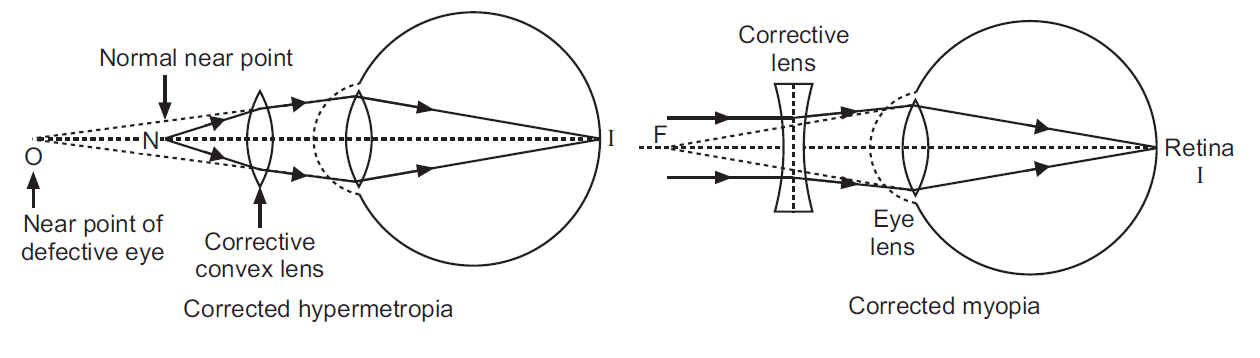
  2. Distinguish between myopia and hypermetropia. Show diagrammatically how these defects can be corrected.
Answer

  1. Difference between myopia and hypermetropia
Myopia Hypermetropia
  1. The eye ball is elongated.
  1. The eye ball is shortened.
  1. Person cannot see distant objects clearly.
  1. Person cannot see near objects clearly.
  • Myopic eye is corrected by interposing a concave lens between eye and object.
  • Hypermetropia is corrected by interposing a convex lens between eye and object.
  1. If image $A 'B\ '$ is exactly at the focus of the eyepiece, then image $A "B\ "$ is formed at infinity. If the object $AB$ is very close to the focus of the objective lens of focal length $f_o,$ then magnification $M_o$ by the objective lens
$\text{M}_{e} = \frac{\text{L}}{\text{f}_{o}}$
where $L$ is tube length $($or distance between lenses $L_o$ and $L_e)$
Magnification $M_e$ by the eyepiece
$\text{M}_{e} = \frac{\text{D}}{\text{f}_{e}}$
where $D =$ Least distance of distinct vision Total magnification $m = M_oM_e$​​​​​​​
$ = \bigg(\frac{\text{L}}{\text{f}_{o}}\bigg)\bigg(\frac{\text{D}}{\text{f}_{e}}\bigg).$

Need a full question paper?

Generate a complete, print-ready paper with questions like this in minutes — across 16+ boards, with answer keys.

Start Generating Free

Similar questions

Consider the situation of the previous problem. Suppose each of the blocks is pulled by a constant force $F$ instead of any impulse. Find the maximum elongation that the spring will suffer and the distances moved by the two blocks in the process.
Three samples $A, B$ and $C$ of the same gas $(\gamma=1.5)$ have equal volumes and temperatures. The volume of each sample is doubled, the process being isothermal for $A,$ adiabatic for $B$ and isobaric for $C.$ If the final pressures are equal for the three samples, find the ratio of the initial pressures.
Two particles A and B having charges q and 2q respectively are placed on a smooth table with a separation d. A third particle C is to be clamped on the table in such a way that the particles A and B remain at rest on the table under electrical forces. What should be the charge on C and where should it be clamped?
A heavy but uniform rope of length L is suspended from a ceiling.
  1. Write the velocity of a transverse wave travelling on the string as a function of the distance from the lower.
  2. If the rope is given a sudden sideways jerk at the bottom, how long will it take for the pulse to reach the ceiling?
  3. A particle is dropped from the ceiling at the instant the bottom end is given the jerk. Where will the particle meet the pulse ?
Consider a circular ring of radius r, uniformly charged with linear charge density $\lambda.$ Find the electric potential at a point on the axis at a distance x from the centre of the ring. Using this expression for the potential, find the electric field at this point.
Explain the vector form of Coulomb's law and write its important facts.
Describe the potential energy of an electric dipole in an external field in different positions also draw the diagram.
A normal eye has retina 2cm behind the eye-lens. What is the power of the eye-lens when the eye is
  1. Fully relaxed,
  2. Most strained?
An eye can distinguish between two points of an object if they are separated by more than $0.22\ mm$ when the object is placed at $25\ cm$ from the eye. The object is now seen by a compound microscope having a $20D$ objective and $10D$ eyepiece separated by a distance of $20\ cm$. The final image is formed at $25\ cm$ from the eye. What is the minimum separation between two points of the object which can now be distinguished?
Two metre scales, one of steel and the other of aluminium, agree at $20^\circ C$. Calculate the ratio aluminium$-$centimetre/ steel$-$centimetre at:
  1. $0^\circ C,$
  2. $40^\circ C$
  3. $100C. \alpha for steel = 1.1 \times 10^{-5 }^\circ C^{-1}$ and for aluminium$= 2.3 \times 10^{-5} ^\circ C^{-1}.$