Question
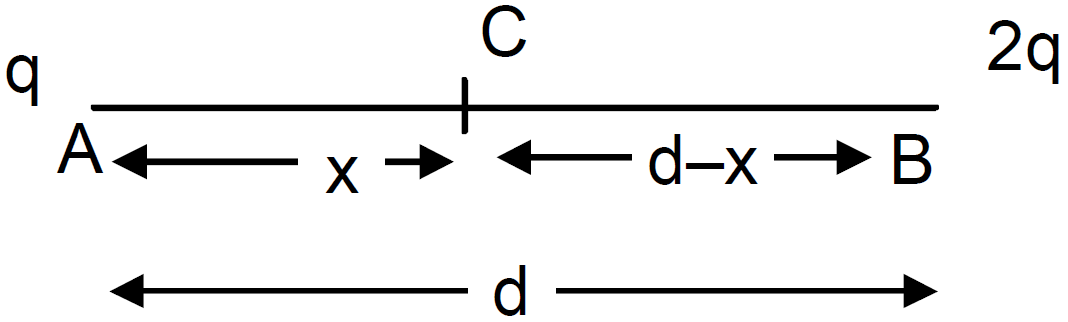
Two particles A and B having charges q and 2q respectively are placed on a smooth table with a separation d. A third particle C is to be clamped on the table in such a way that the particles A and B remain at rest on the table under electrical forces. What should be the charge on C and where should it be clamped?
Answer


Let the charge on C = q
So, net force on c is equal to zero
So, $\text{F}_{\overline{\text{AC}}}+\text{F}_{\overline{\text{BA}}}=0,$
But $\text{F}_{\overline{\text{AC}}}=\text{F}_{\overline{\text{BC}}}$
$\Rightarrow\frac{\text{kqQ}}{\text{x}^2}=\frac{\text{k}2\text{qQ}}{(\text{d}-\text{x})^2}$
$\Rightarrow2\text{x}^2=(\text{d}-\text{x})^2$
$\Rightarrow\sqrt{2}\text{x}=\text{d}-\text{x}$
$\Rightarrow\text{x}=\frac{\text{d}}{\sqrt{2}+1}$
$=\frac{\text{d}}{\big(\sqrt{2}+1\big)}\times\frac{\big(\sqrt{2}-1\big)}{\big(\sqrt{2}-1\big)}$
$=\text{d}\big(\sqrt{2}-1\big)$
For the charge on rest, $\text{F}_\text{AC}+\text{F}_\text{AB}=0$
$(2.414)^2\frac{\text{kqQ}}{\text{d}^2}+\frac{\text{kq}(2\text{q})}{\text{d}^2}=0$
$\Rightarrow\frac{\text{kq}}{\text{d}^2}\big[(2.414)^2\text{Q}+2\text{q}\big]=0$
$\Rightarrow2\text{q}=-(2.414)^2\text{Q}$
$\Rightarrow\text{Q}=\frac{2}{-\big(\sqrt{2}+1\big)^2}\text{q}$
$=-\Big(\frac{2}{3+2\sqrt{2}}\Big)\text{q}$
$=-(0.343)\text{q}$
$=-\big(6-4\sqrt{2}\big)$

Need a full question paper?

Generate a complete, print-ready paper with questions like this in minutes — across 16+ boards, with answer keys.

Start Generating Free

Similar questions

A circular loop carrying a current i is made of a wire of length L. A uniform magnetic field B exists parallel to the plane of the loop.
  1. Find the torque on the loop.
  2. If the same length of the wire is used to form a square loop, what would be the torque? Which is larger?
A parallel $-$ plate capacitor has plate area $25.0\ cm^2$ and a separation of $2.00\ mm$ between the plates. The capacitor is connected to a battery of $12.0V$:
  1. Find the charge on the capacitor.
  2. The plate separation is decreased to $1.00\ mm$. Find the extra charge given by the battery to the positive plate.
Calculate the electric field in a copper wire of cross$-$sectional area $2.0\ mm^2$ carrying a current of $1A.$
The resistivity of copper $=1.7\times10^{-8}\Omega\text{-m}.$
A uniform ladder of length 10.0m and mass 16.0kg is resting against a vertical wall making an angle of 37° with it. The vertical wall is frictionless but the ground is rough. An electrician weighing 60.0kg climbs up the ladder. If he stays on the ladder at a point 8.00m from the lower end, what will be the normal force and the force of friction on the ladder by the ground? What should be the minimum coefficient of friction for the elctrician to work safely?
Two samples $A$ and $B,$ of the same gas have equal volumes and pressures. The gas in sample $A$ is expanded isothermally to double its volume and the gas in $B$ is expanded adiabatically to double its volume. If the work done by the gas is the same for the two cases, show that $\gamma$ satisfies the equation $1-2^{1-\gamma}=(\gamma-1)\text{ln}2.$
A capacitor having a capacitance of $100\mu\text{F}$ is charged to a potential difference of 24V. The charging battery is disconnected and the capacitor is connected to another battery of emf 12V with the positive plate of the capacitor joined with the positive terminal of the battery:
  1. Find the charges on the capacitor before and after the reconnection.
  2. Find the charge flown through the 12V battery.
  3. Is work done by the battery or is it done on the battery? Find its magnitude.
  4. Find the decrease in electrostatic field energy.
  5. Find the heat developed during the flow of charge after reconnection.
A parallel $-$ plate capacitor of plate area $40\ cm^2$ and separation between the plates $0.10\ mm,$ is connected to a battery of emf $2.0V$ through a $16\Omega$ resistor. Find the electric field in the capacitor $10\ ns$ after the connections are made.
A parallel$-$plate capacitor of plate area $40\ cm^2$ and separation between the plates $0.10\ mm,$ is connected to a battery of emf $2.0V$ through a $16\Omega$ resistor. Find the electric field in the capacitor $10\ ns$ after the connections are made.
A particle slides on the surface of a fixed smooth sphere starting from the topmost point. Find the angle rotated by the radius through the particle, when it leaves contact with the sphere.
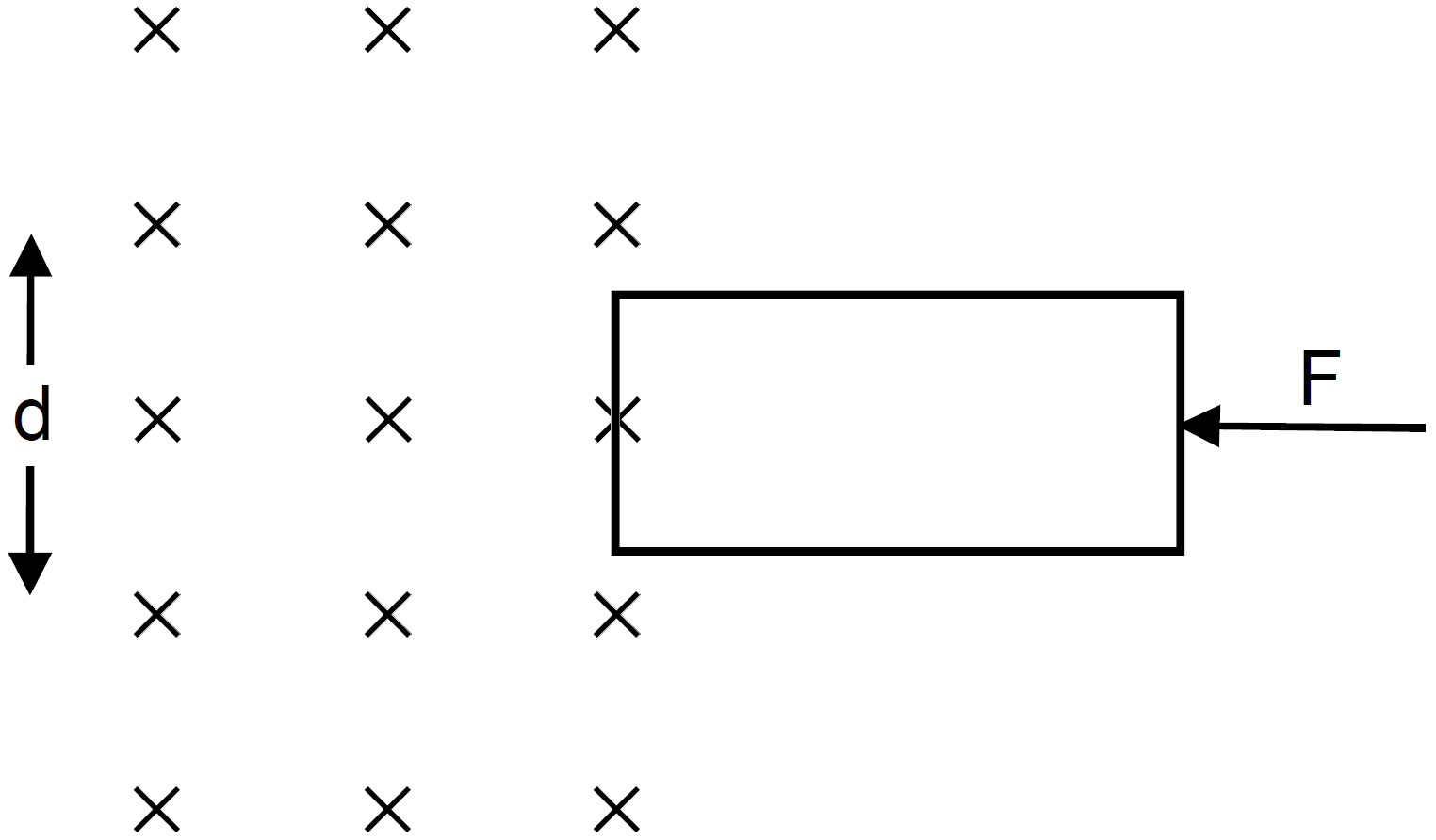
The rectangular wire-frame, shown in figure, has a width $d$, mass m, resistance $R$ and a large length. A uniform magnetic field $B$ exists to the left of the frame. A constant force $F$ starts pushing the frame into the magnetic field at $t = 0.$
  1. Find the acceleration of the frame when its speed has increased to $v.$
  2. Show that after some time the frame will move with a constant velocity till the whole frame enters into the magnetic field. Find this velocity $v_0.$
  3. Show that the velocity at time t is given by $\text{v}=\text{v}_0\Big(1-\text{e}^{-\frac{\text{ft}}{\text{mv}_0}}\Big)$