Question
  1. Draw a ray diagram showing the image formation by a compound microscope. Hence obtain expression for total magnification when the image is formed at infinity.
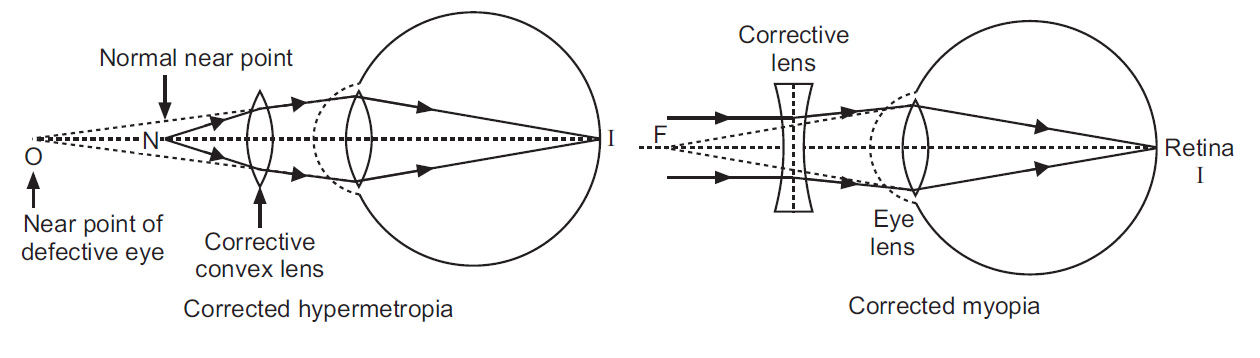
  2. Distinguish between myopia and hypermetropia. Show diagrammatically how these defects can be corrected.
Answer

  1. Difference between myopia and hypermetropia
Myopia

Hypermetropia

  1. The eye ball is elongated.
  1. The eye ball is shortened.
  1. Person cannot see distant objects clearly.
  1. Person cannot see near objects clearly.
  • Myopic eye is corrected by interposing a concave lens between eye and object.
  • Hypermetropia is corrected by interposing a convex lens between eye and object.

  1. If image A 'B' is exactly at the focus of the eyepiece, then image A "B" is formed at infinity. If the object AB is very close to the focus of the objective lens of focal length fo, then magnification Mo by the objective lens

$\text{M}_{e} = \frac{\text{L}}{\text{f}_{o}}$

where L is tube length (or distance between lenses Lo and Le)

Magnification Me by the eyepiece

$\text{M}_{e} = \frac{\text{D}}{\text{f}_{e}}$

where D = Least distance of distinct vision Total magnification m = MoMe

$ = \bigg(\frac{\text{L}}{\text{f}_{o}}\bigg)\bigg(\frac{\text{D}}{\text{f}_{e}}\bigg).$

Need a full question paper?

Generate a complete, print-ready paper with questions like this in minutes — across 16+ boards, with answer keys.

Start Generating Free

Similar questions

In an agricultural experiment, a solution containing 1 mole of a radioactive material $\Big(\text{t}_{\frac{1}{2}}=14.3\text{ days}\Big)$ was injected into the roots of a plant. The plant was allowed 70 hours to settle down and then activity was measured in its fruit. If the activity measured was $1\mu\text{Ci},$ what per cent of activity is transmitted from the root to the fruit in steady state?
State Gauss's Theorem and prove it.
A particle is observed from two frames S1 and. S2. The frame Smoves with respect to Swith an acceleration a. Let F1 and F2 be the pseudo forces on the particle when seen from S1 and S2 respectively. Which of the following are not possible?
  1. F1 = 0, F2 ≠ 0
  2. F1 ≠ 0, F2 = 0
  3. F1 ≠ 0, F2 ≠ 0
  4. F= 0, F= 0
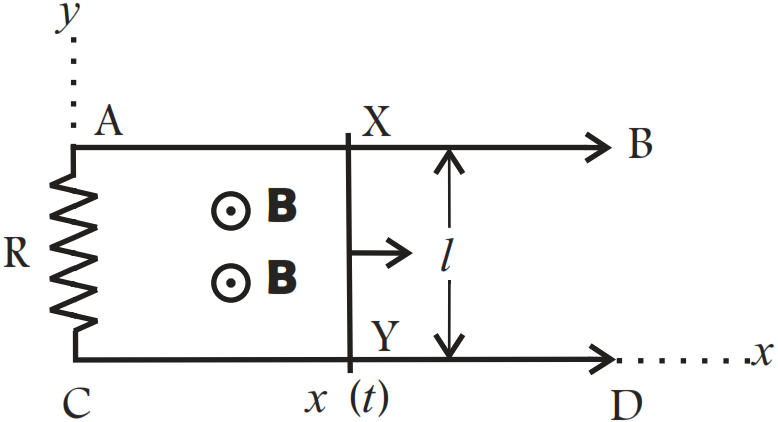
A conducting wire XY of mass m and neglibile resistance slides smoothly on two parallel conducting wires as shown in Fig. The closed circuit has a resistance R due to AC. AB and CD are perfect conductors. There is a magnetic field $\text{B}=\text{B}(\text{t})\hat{\text{k}}$.

  1. Write down equation for the acceleration of the wire XY.
  2. If B is independent of time, obtain v(t), assuming v(0) = u0.
  3. For (b), show that the decrease in kinetic energy of XY equals the heat lost in R.
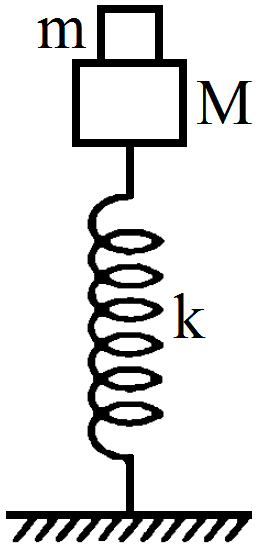
A small block of mass m is kept on a bigger block of mass M which is attached to a vertical spring of spring constant k as shown in the figure. The system oscillates vertically.
  1. Find the resultant force on the smaller block when it is displaced through a distance x above its equilibrium position.
  2. Find the normal force on the smaller block at this position. When is this force smallest in magnitude?
  3. What can be the maximum amplitude with which the two blocks may oscillate together?

A magnetic field set up using Helmholtz coils (described in Exercise 4.16) is uniform in a small region and has a magnitude of 0.75 T. In the same region, a uniform electrostatic field is maintained in a direction normal to the common axis of the coils. A narrow beam of (single species) charged particles all accelerated through 15 kV enters this region in a direction perpendicular to both the axis of the coils and the electrostatic field. If the beam remains undeflected when the electrostatic field is 9.0 × 10–5 V m–1, make a simple guess as to what the beam contains. Why is the answer not unique?
An ornament weighing 36g in air, weighs only 34g in water. Assuming that some copper is mixed with gold to prepare the ornament, find the amount of copper in it. Specific gravity of gold is 19.3 and that of copper is 8.9.
The property of diamagnetism is said to be present in all materials. Then, why are some materials paramagnetic or ferromagnetic?
A coil having an inductance L and a resistance R is connected to a battery of emf $\in.$ Find the time taken for the magnetic energy stored in the circuit to change from one fourth of the steady-state value to half of the steady-state value.
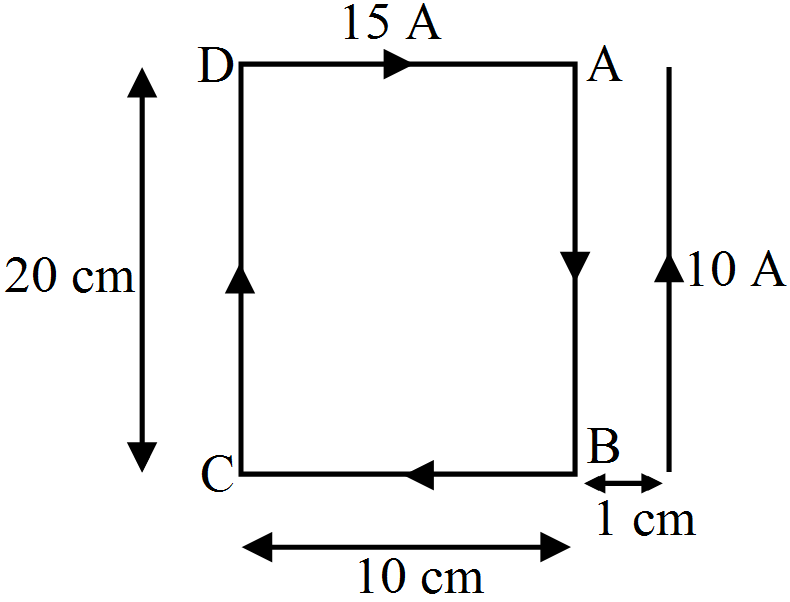
A rectangular current carrying loop is placed 1cm away from a long straight current-carrying conductor as shown.

  1. Will the net force acting on the loop due to straight conductor be attractive or repulsive in nature? Justify your answer. Calculate the magnitude of this force.