Question
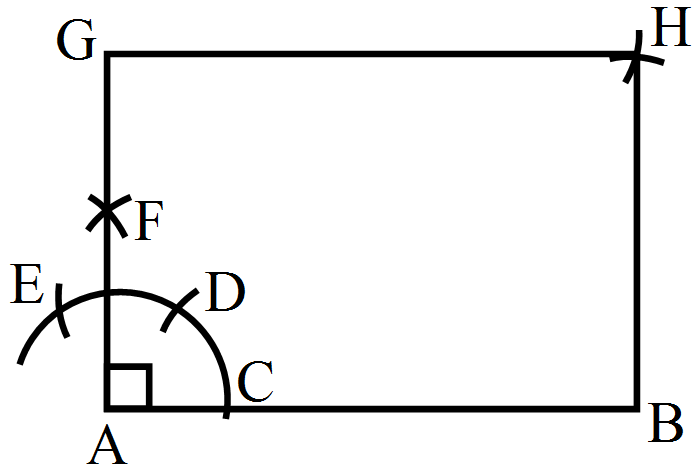
Draw a rectangle whose two adjacent sides are $5\ cm$ and $3.5\ cm$. Make use of a pair of compasses and a ruler only.
Answer


Steps of Construction:
$1.$Draw a line-segment $AB = 5\ cm$ with the help of a rular.
$2.$With Aas centre and suitable radius draw an arc cutting $AB$ at $C.$
$3.$With C as centre and same radius cut the previous arc at $D$ and then with $D$ as centre and same radius cut the arc at $E.$
$4.$With $D$ as centre and radius more than half $DE$ draw an arc.
$5.$With $E$ as centre and same radius draw another arc to cut the previous arc at $F.$
$6.$Join $AF$ and produce it to $G$ such that $AG = 3.5\ cm$. Then $\angle\text{BAG}=90^\circ.$
$7.$With $G$ as centre and radius equal to $AB$ draw an arc. With $B$ as centre and radius equal to $AG$ draw another arc to cut the previous arc at $H.$
$8.$Join $GH$ and $BH$. Then, $AB HG$ is the required rectangle.

Need a full question paper?

Generate a complete, print-ready paper with questions like this in minutes — across 16+ boards, with answer keys.
Start Generating Free

Similar questions

A square piece of paper is folded in half. The square is then cut into two rectangles along the fold. Regardless of the size of the square, one of the following statements is always true. Which statement is true here?
(a) The area of each rectangle is larger than the area of the square.
(b) The perimeter of the square is greater than the perimeters of both the rectangles added together.
(c) The perimeters of both the rectangles added together are always $1 \frac{1}{2}$ times the perimeter of the square.
(d) The area of the square is always three times as large as the areas of both rectangles added together.
Draw a line segment of length $9.5\ cm$ and construct its perpendicular bisector.
Using number line write the integer which is $3$ more than $5.$
Draw number line and locate the points on them: $\frac12,\;\frac14,\frac34,\;\frac44$
Four flower beds having sides 2 m long and 1 m wide are dug at the four comers of a garden that is 15 m long and 12 m wide. How much area is now available for laying down a lawn?
Use a pair of compasses and construct the following angles: $150^\circ $
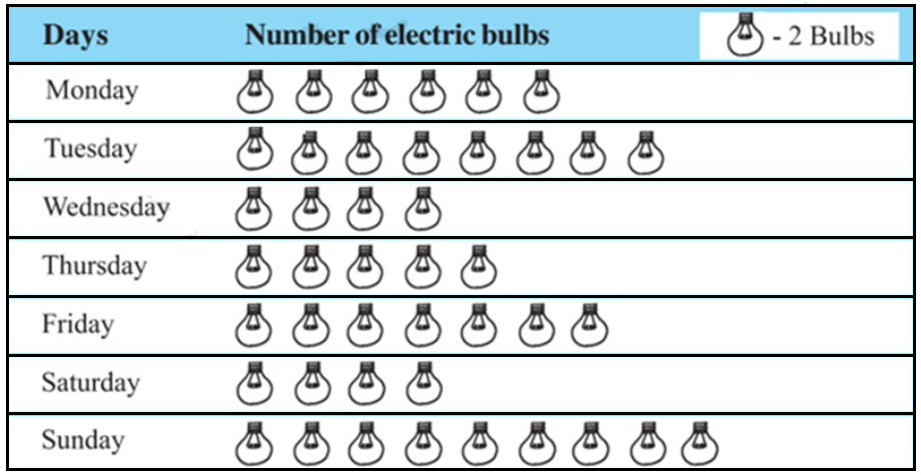
The sale of electric bulbs on different days of a week is shown below:

Observe the pictograph and answer the following questions:
$i.\ $How many bulbs were on Friday?
$ii.\ $On which day maximum number of bulbs were sold?
$iii.\ $If one bulb was sold at the rate of $Rs\ 10$, what was the total earning on sunday?
$iv.\ $Can you find out the total earning of the week?
$v.\ $If one big carton can hold $9$ bulbs. How many cartons were needed in the given week, more than $7$, more than $8$ or more than $9$?
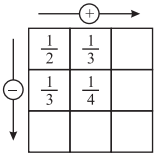
Complete the addition-subtraction box.

The production of saleable steel in some of the steel plants of our country during $1999$ is given below:
Plant
Bhilai
Durgapur
Rourkela
Bokaro
Production (in thousand tonnes)
$160$
$80$
$200$
$150$
Construct a bar graph to represent the above data on a graph paper by using the scale $1$ big divisions $= 20$ thousand tonnes.
The weights of new born babies (in kg) in a hospital on a particular day are as follows:
2.3, 2.2, 2.1, 2.7, 2.6, 3.0, 2.5, 2.9, 2.8, 3.1, 2.5, 2.8, 2.7, 2.9,
(i) Rearrange the weights in descending order.
(ii) Determine the highest weight.
(iii) Determine the lowest weight.
(iv) Determine the range.
(v) How many babies were born on that day?
(vi) How many babies weigh below 2.5 kg?
(vii) How many babies weigh more than 2.8 kg?
(viii) How many babies weigh 2.8 kg?