Question
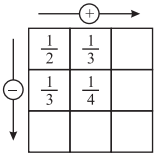
Complete the addition-subtraction box.
Answer

Here,
$\frac{1}{2}+\frac{1}{3}=\frac{(1 \times 3)+(1 \times 2)}{6}=\frac{3+2}{6}=\frac{5}{6}$
$\frac{1}{3}+\frac{1}{4}=\frac{(1 \times 4)+(1 \times 3)}{12}=\frac{4+3}{12}=\frac{7}{12}$
$\frac{1}{2}-\frac{1}{3}=\frac{(1 \times 3)-(1 \times 2)}{6}=\frac{3-2}{6}=\frac{1}{6}$
$\frac{1}{3}-\frac{1}{4}=\frac{(1 \times 4)-(1 \times 3)}{12}=\frac{4-3}{12}=\frac{1}{12}$
Also,
$\frac{1}{6}+\frac{1}{12}=\frac{(1 \times 2)+1}{12}=\frac{2+1}{12}=\frac{3}{12}=\frac{1}{4}$
Hence, the above-given table can be completed as follows:
$\frac{1}{2}$ $\frac{1}{3}$ $\frac{5}{6}$
$\frac{1}{3}$ $\frac{1}{4}$ $\frac{7}{12}$
$\frac{1}{6}$ $\frac{1}{12}$ $\frac{1}{4}$

Need a full question paper?

Generate a complete, print-ready paper with questions like this in minutes — across 16+ boards, with answer keys.

Start Generating Free

Similar questions

Total number of students of a school in different years is shown in the following table:
Year
Number of students
$1996$
$400$
$1998$
$550$
$2000$
$450$
$2002$
$600$
$2006$
$650$
Represent the above data by a pictograph. Prepare a pictograph of students using one symbol an icon of a student to represent students and answer the following questions:
$i.\ $How many symbols represent total number of students in the year $2002$?
$ii.\ $How many symbols represent total number of students for the year $1998$?
Mark the following points on a sheet of paper. Tell how many line segments can be obtained in each case:
(i) Two points $A, B$.
(ii) Three non-collinear points $A, B, C$.
(iii) Four points such that no three of them belong to the same line.
(iv) Any five points so that no three of them are collinear.
[Hint: Put $n=2,3,4,5$ in the following formula and check the truth of the statement in each case: If there are $n$ points in a plane such that no three of them are collinear, then the number of line segments obtained by joining these points is equal to $\frac{n(n-1)}{2}$ ]
Is there a 4-sided figure in which all the sides are equal in length but is not a square? if such a figure exists, can you construct it?
Find the $HCF$ of the numbers in the following using the division method:$1794, 2346, 4761$
Draw a circle with centre $C$ and radius $3.4\ cm.$ Draw any chord $\overline{\text{AB}}$. Construct the perpendicular bisector of $\overline{\text{AB}}$ and examine if it passes through $C. $ if $\overline{\text{AB}}$ happens to be a diameter.
Draw a circle of radius $4\ cm. $ Draw any two of its chords. Construct the perpendicular bisectors of these chords. Where do they meet?
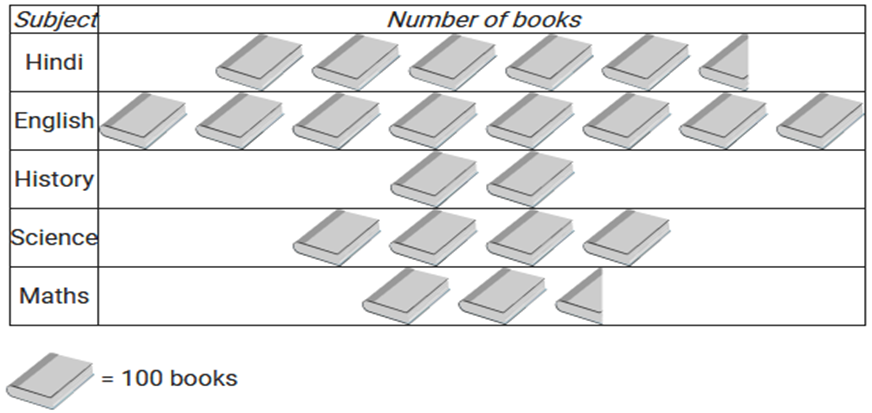
The pictograph shown different subject books which are kept in a library.

$i.\ $How many English books are there in the library?
$ii.\ $How many maths books are there?
$iii.\ $Which books are maxmimum in number?
$iv.\ $Which books are minimum in number?
Draw a line segment $AB = 5.6\ cm.$ Draw the right bisector of $AB.$
Draw a line segment $A B$ and bisect it. Bisect one of the equal parts to obtain a line segment of length $\frac{1}{2}(A B)$.
See the figure and find the ratio of number of triangles to the number of circles inside the rectangle.
8