Question
Draw a triangle $\triangle\text{ABC}$ in which AB = 4cm, BC = 6cm and AC = 9cm. Construct a triangle similar to $\triangle\text{ABC}$ with scale factor $\frac{3}{2}.$ Justify the construction. Are the two triangles congruent? Note that all the three angles and two sides of the two triangles are equal.
Answer

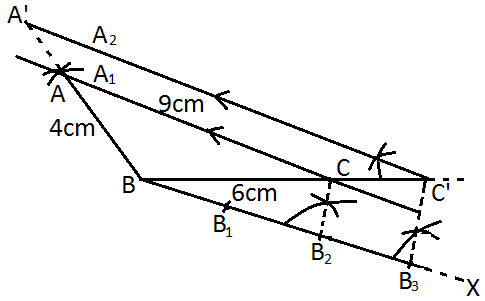
Scale factor $\frac{3}{2}>1$ So, the resulting figure will be greater than $\triangle\text{ABC}.$
Steps of construction:
1. Draw line segment $B C=6 cm$.
2. From $B$ as centre, draw an arc $A_1$, of 6 cm .
3. From Cas centre, draw another arc $A_2$, of 9 cm .
4. Arcs $A_1$ and $A_2$ intersect at $A$. Join $A$ to $B$ and $C$.
5. Make an acute angle of $\angle CBX$ on other side of $A$.
6. Make the equispaced marks $B_1, B_2, B_3$ with compass.
7. Join $B_2 C$ and draw $B_3 C^{\prime} \| B_2 C$, where $C^{\prime}$ is on $B C$ produced.
8. Draw CA || C'A', where $A^{\prime}$ is on $B A$ produced.
$\therefore\ \triangle\text{A}'\text{BC}'-\triangle\text{ABC}$ with scale factor $\frac{3}{2}.$
Justification:In $\triangle \text{BB}_{3}\text{C}'$ and $\triangle\text{BB}_{2}\text{C}$
$\angle\text{B} = \angle\text{B}$ [Common]
$\text{B}_{3}\text{C}'\ ||\ \text{B}_{2}\text{C}$ [By construction]
$\therefore \ \angle\text{BB}_{2}\text{C} = \angle\text{BB}_{3}\text{C}'$ [Corresponding angles]
$\therefore \triangle \text{BB}_{3}\text{C}' \sim\triangle\text{BB}_{2}\text{C}$ [By AA criterion of similarity]
$\Rightarrow \frac{\text{BC}'}{\text{CB}} = \frac{\text{BB}_{3}}{\text{BB}_{2}} = \frac{\text{3x}}{\text{2x}} = \frac{3}{2}$ $[\because\ \text{BB}_{1} = \text{B}_{1}\text{B}_{2} = \text{B}_{2}\text{B}_{3} = \text{x}]$
$\Rightarrow\frac{\text{BC}'}{\text{BC}} = \frac{3}{2}$
In $\triangle\text{ABC}$ and $\triangle\text{A}'\text{BC}',$
$\angle\text{B} = \angle\text{B}$ [Common]
$\because \text{A}'\text{C}'\ ||\ \text{AC}$
$\therefore\angle\text{A}'\text{C}'\text{B} = \angle\text{ACB}$ [Corresponding angles]
$\therefore \triangle\text{ABC} \sim\triangle\text{A}'\text{BC}'$ [By AA criterion of similarity]
$\Rightarrow \frac{\text{A}'\text{C}'}{\text{AC}} = \frac{\text{A}'\text{B}'}{\text{AB}} = \frac{\text{C}'\text{B}'}{\text{BC}}$
$\Rightarrow\frac{\text{A}'\text{C}'}{\text{AC}} = \frac{\text{A}'\text{B}'}{\text{AB}} = \frac{3}{2}$
Hence, proved.

Need a full question paper?

Generate a complete, print-ready paper with questions like this in minutes — across 16+ boards, with answer keys.

Start Generating Free

Similar questions

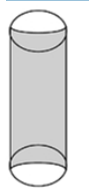
A wooden article was made by scooping out a hemisphere from each end of a solid cylinder as shown in the figure. If the height of the cylinder is $10 \ cm$ and its base is of radius $3.5 \ cm,$ find the total surface area of the article.
Image
Solve for x and y:
4x + 6y = 3xy,
8x + 9y = 5xy $(\text{x}\neq0,\ \text{y}\neq0).$
The weekly observation on cost of living index in a certain city for the year 2004 – 2005 are given below. Compute the weekly cost of living index.
Cost of living Index
Number of Students
Cost of living Index
Number of Students
1400-1500
5
1700-1800
9
1500-1600
10
1800-1900
6
1600-1700
20
1900-2000
2
Each side of an equilateral triangle is 10cm.
Find:
  1. The area of the triangle.
  2. The height of the triangle.
Rachel, an engineering student, was asked to make a model shaped like a cylinder with two cones attached at its two ends by using a thin aluminium sheet. The diameter of the model is 3 cm and its length is 12 cm. If each cone has a height of 2 cm, find the volume of air contained in the model that Rachel made. (Assume the outer and inner dimensions of the model to be nearly the same).
The sum of the third and the seventh terms of an AP is 6 and their product is 8. Find the sum of the first sixteen terms of the AP.
In the given figure, $\text{MNOP}$ is a parallelogram and $AB \| MP$. Prove that $QC \| PO.$
Image
Find the value of ' $c$ ' for which the quadratic equation
$(c+1) x^2-6(c+1) x+3(c+9)=0 ; c \neq-1$
has real and equal roots.
Two circles with centres O and O' of radii 3cm and 4cm, respectively intersect at two points P and Q such that OP and O'P are tangents to the two circles. Find the length of the common chord PQ.
If G be the centroid of a triangle ABC and P be any other point in the plane, prove that $PA^2 + PB^2 + PC^2 = GA^2 + GB^2 + GC^2 + 3GP^2.$