Questions

5 Marks Questions

Take a timed test

11 questions · self-marked practice — reveal the answer and mark yourself.

Question 15 Marks
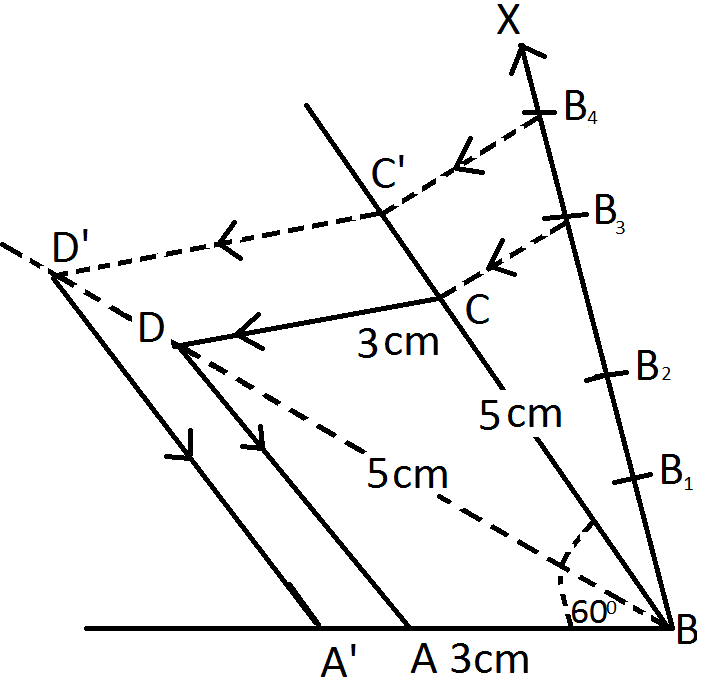
Draw a parallelogram ABCD in which BC = 5cm, AB = 3cm and $\angle\text{ABC}=60^\circ,$ divide it into triangles BCD and ABD by the diagonal BD. Construct the triangle BD'C' similar to $\triangle\text{BDC}$ with scale factor $\frac{4}{3}.$ Draw the line segment D'A' parallel to DA where A' lies on extended side BA. Is A'BC'D' a parallelogram?
Answer
Steps of construction:

1. Draw a line segment $A B=3 cm$.
2. Make $\angle A B C=60^{\circ}$ such that $B C=5 cm$.
3. Draw $C D \| A B$ and $A D \| B C, \square A B C D$ is the required parallelogram.
4. Join diagonal $B D$ and produce it.
5. Make acute angle $C B X$ on opposite of $D$ with respect to $B C$.
6. Mark (equi spaced) $B_1, B_2, B_3, B_4$ by compass.
7. Join $B_3 C$ and draw $B_3 C \| B_4 C^{\prime}$ on $B C$ produced.
8. Again, draw $C^{\prime} D^{\prime} \| C D$, where $D^{\prime}$ is on $B D$ produced.
9. Now, draw $D^{\prime} A^{\prime} \| D A$ where $A^{\prime}$ is on $B A$ produced. Parallelogram $A^{\prime} B C^{\prime} D^{\prime}$ is similar to parallelogram $A B C D$ with scale factor $\frac{4}{3}$.
View full question & answer
Question 25 Marks
Draw a triangle ABC in which BC = 6cm, CA = 5cm and AB = 4cm. Construct a triangle similar to it and of scale factor $\frac{5}{3}.$
Answer
Steps of construction:
1. Draw a line segment $B C=6 cm$.
2. Taking Sand Cas centres, draw two arcs of radii 4 cm and 5 cm intersecting each other at $A$.
3. Join $B A$ and $C A . \triangle A B C$ is the required triangle.
4. From $B$, draw any ray $B X$ downwards making at acute angle.
5. Mark five points $B_1, B_2, B_3, B_4$ and $B_5$ on $B X$, such that
$BB_1=B, B_2=B_2 B_3=B_3 B_4=B_4 B_5$
6. Join $B_3 C$ and from $B_5$ draw $B_5 M| | B_3 C$ intersecting the extended line segment $B C$ at
7. From point $M$ draw $M N \| C A$ intersecting the extended line segment $B A$ at $N$.
Then, $\triangle NBM$ is the required triangle whose sides is equal to $\frac{5}{3}$ of the corresponding sides of the $\triangle ABC$.
Hence, $\triangle NBM$ is the required triangle.
View full question & answer
Question 35 Marks
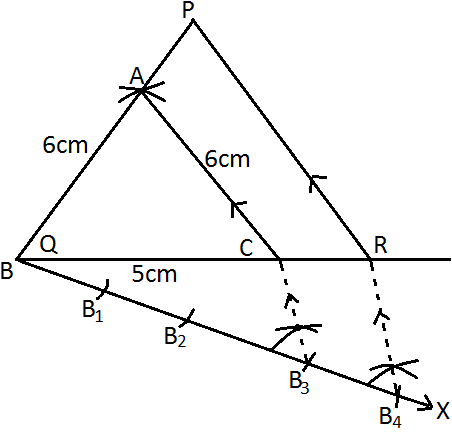
Draw an isosceles triangle ABC in which AB = AC = 6cm and BC = 5cm. Construct a triangle PQR similar to ABC in which PQ = 8cm. Also justify the construction.
Answer
We have to draw,

$\triangle\text{PQR}\sim\triangle\text{ABC}$ $\text{PQ}=8\text{cm}$ $\therefore\frac{\text{PQ}}{\text{AB}}=\frac{8}{6}=\frac{4}{3}\ \ (\because\text{AB}=6\text{cm})$ So, PQ = QR = 8cm So, we have to draw $\triangle\text{PQR}\sim\triangle\text{ABC}$ with scale factor $\frac{4}{3}>1$ resulting $\triangle\text{PQR}$ will be larger than $\triangle\text{ABC}.$ Steps of Construction:
1. Draw $B C=5 cm$
2. Draw two arcs of 6 cm each from $B$ and $C$ in same direction let it be upside.
3. Join $A B$ and $A C$.
4. Draw acute $\angle CBX$ and mark $B , B _1, B_2, B_3, B_4$, with compass.
5. Join $B_3 C$ and draw $B_4 R \| B_3 C, R$ is on $B C$ produced.
6. Again, draw $R P \| C A$. $P$ is on $B A$ produced.
Therefore, $\triangle\text{PQR}\sim\triangle\text{ABC}$ with PQ = PR = 8cm. It's scale factor is $\frac{4}{3}.$
View full question & answer
Question 45 Marks
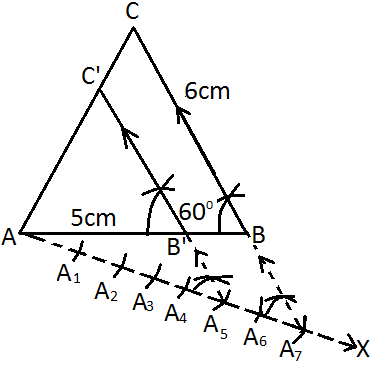
Draw a triangle $\triangle\text{ABC}$ in which AB = 5cm, BC = 6cm and ABC= 60º. Construct a triangle similar to $\triangle\text{ABC}$ with scale factor $\frac{5}{7}.$ Justify the construction.
Answer


Scale factor $\frac{5}{7}<1,$ so the resulting $\triangle$ will be smaller than $\triangle\text{ABC}.$
Steps of construction:
  1. Draw AB=5cm.
  2. Draw $\triangle\text{ABC}=60^\circ,$ cut BC = 6cm and join AC.
  3. Draw acute $\angle\text{BAX}$ and mark it equispaced marks $A_1, A_2, ..., A_7$as shown in figure.
  4. Join $A_7B$ and draw $A_5B' || A_7$​​​​​​​ B. B' is on segment AB.
Draw B'C' || BC, point C' is on AC.
$\triangle\text{AB}'\text{C}'\sim\triangle\text{ABC}$ with scale factor $\frac{5}{7}.$
Justification:
In $\triangle\text{AA}_5\text{B}'\text{and AA}_7\text{B},$ $\text{A}_7\text{B}\ ||\ \text{A}_5\text{B}'$
$\therefore\ \angle\text{A}_5=\angle\text{A}_7\ \ [\text{Correponding}\ \angle\text{s}]$
$\angle\text{BAA}_5=\angle\text{BAA}_7\ \ [\text{Common}]$
$\therefore\ \triangle\text{AA}_5\text{B}'\sim\triangle\text{AA}_7\text{B}$ [By AA criterion of similarity]
$\Rightarrow\ \frac{\text{AB}'}{\text{AB}}=\frac{\text{AA}_5}{\text{AA}_7}=\frac{5\text{x}}{7\text{x}}=\frac{5}{7}\ \ ...(\text{i})$
where $\text{x}=\text{AA}_1=\text{A}_1\text{A}_2=...\text{A}_6\text{A}_7$
Similarly, $\triangle\text{AB}'\text{C}'\sim\triangle\text{ABC}$ [By AA criterion of similarity]
$\Rightarrow\ \frac{\text{AB}'}{\text{AB}}=\frac{\text{AC}'}{\text{AC}}=\frac{\text{B}'\text{C}'}{\text{BC}}$
$\Rightarrow\ \frac{5}{7}=\frac{\text{AC}'}{\text{AC}}=\frac{\text{B}'\text{C}'}{\text{BC}}$
Hence, $\triangle\text{AB}'\text{C}'\sim\triangle\text{ABC}$ with scale factor $\frac{5}{7}.$
View full question & answer
Question 55 Marks
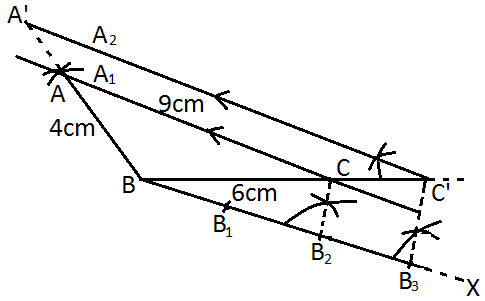
Draw a triangle $\triangle\text{ABC}$ in which AB = 4cm, BC = 6cm and AC = 9cm. Construct a triangle similar to $\triangle\text{ABC}$ with scale factor $\frac{3}{2}.$ Justify the construction. Are the two triangles congruent? Note that all the three angles and two sides of the two triangles are equal.
Answer
Scale factor $\frac{3}{2}>1$ So, the resulting figure will be greater than $\triangle\text{ABC}.$
Steps of construction:
1. Draw line segment $B C=6 cm$.
2. From $B$ as centre, draw an arc $A_1$, of 6 cm .
3. From Cas centre, draw another arc $A_2$, of 9 cm .
4. Arcs $A_1$ and $A_2$ intersect at $A$. Join $A$ to $B$ and $C$.
5. Make an acute angle of $\angle CBX$ on other side of $A$.
6. Make the equispaced marks $B_1, B_2, B_3$ with compass.
7. Join $B_2 C$ and draw $B_3 C^{\prime} \| B_2 C$, where $C^{\prime}$ is on $B C$ produced.
8. Draw CA || C'A', where $A^{\prime}$ is on $B A$ produced.
$\therefore\ \triangle\text{A}'\text{BC}'-\triangle\text{ABC}$ with scale factor $\frac{3}{2}.$
Justification:In $\triangle \text{BB}_{3}\text{C}'$ and $\triangle\text{BB}_{2}\text{C}$
$\angle\text{B} = \angle\text{B}$ [Common]
$\text{B}_{3}\text{C}'\ ||\ \text{B}_{2}\text{C}$ [By construction]
$\therefore \ \angle\text{BB}_{2}\text{C} = \angle\text{BB}_{3}\text{C}'$ [Corresponding angles]
$\therefore \triangle \text{BB}_{3}\text{C}' \sim\triangle\text{BB}_{2}\text{C}$ [By AA criterion of similarity]
$\Rightarrow \frac{\text{BC}'}{\text{CB}} = \frac{\text{BB}_{3}}{\text{BB}_{2}} = \frac{\text{3x}}{\text{2x}} = \frac{3}{2}$ $[\because\ \text{BB}_{1} = \text{B}_{1}\text{B}_{2} = \text{B}_{2}\text{B}_{3} = \text{x}]$
$\Rightarrow\frac{\text{BC}'}{\text{BC}} = \frac{3}{2}$
In $\triangle\text{ABC}$ and $\triangle\text{A}'\text{BC}',$
$\angle\text{B} = \angle\text{B}$ [Common]
$\because \text{A}'\text{C}'\ ||\ \text{AC}$
$\therefore\angle\text{A}'\text{C}'\text{B} = \angle\text{ACB}$ [Corresponding angles]
$\therefore \triangle\text{ABC} \sim\triangle\text{A}'\text{BC}'$ [By AA criterion of similarity]
$\Rightarrow \frac{\text{A}'\text{C}'}{\text{AC}} = \frac{\text{A}'\text{B}'}{\text{AB}} = \frac{\text{C}'\text{B}'}{\text{BC}}$
$\Rightarrow\frac{\text{A}'\text{C}'}{\text{AC}} = \frac{\text{A}'\text{B}'}{\text{AB}} = \frac{3}{2}$
Hence, proved.
View full question & answer
Question 65 Marks
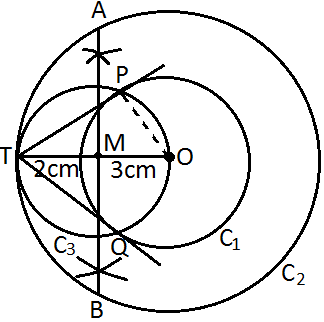
Draw two concentric circles of radii 3cm and 5cm. Taking a point on outer circle construct the pair of tangents to the other. Measure the length of a tangent and verify it by actual calculation.
Answer
Steps of construction:

1. Draw two concentric circles $C_1, C_2$ of radiü 3 cm and 5 cm respectively taking ' $O$ ' as centre.
2. Draw perpendicular bisector $A B$ of $O T . T$ is any point on $C_2$.
3. Draw circle $C_3$ taking radius $TM = OM$ and M as centre.
4. Circle $C_3$ intersect the circle $C_1$ at $P$ and $Q$. Join $T P$ and $T Q$. These are the required tangents. $T P=T Q=4.1 cm$ by measuring.
Mathematically length of tangent:
Join OP. OP and TP are radius and tangent respectively at contact point P. So, $\angle\text{TPO}=90^\circ.$

By Pythagoras theorem in $\triangle\text{TPO},$

$PT^2= OT^2- OP^2 = 5^2- 3^2 = 25 - 9 = 16$

⇒ PT = 4cm

Difference in measurement and by mathematical calculation

PT = 4.1cm - 4cm = 0.1cm.
View full question & answer
Question 75 Marks
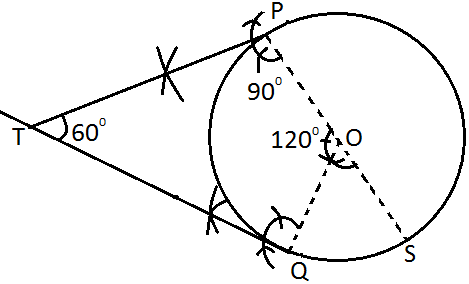
Draw a circle of radius 4cm. Construct a pair of tangents to it, the angle between which is 60º. Also justify the construction. Measure the distance between the centre of the circle and the point of intersection of tangents.
Answer

Angle between tangents is 60°. So angles between their radii is 180° - 60° = 120°.
As the angles between tangents and their corresponding radii are supplementary.
Steps of construction:
  1. Draw a circle of radius 4cm.
  2. Draw any diameter POS.
  3. Draw OQ making $\angle\text{AOC}=120^\circ.$
  4. Draw tangent at P by drawing $\angle\text{OPT}=90^\circ.$
  5. Similarly, draw $\angle\text{OQT}$ equal to 90° to draw tangent.
  6. Both PT, QT tangents intersect at T and make angle of 60°.
Hence, the two tangents on circle are TP and TQ inclined at 60°.
Justification:
Because the radius OP and tangent PT at contact point makes angle $\angle\text{TPO}=90^\circ.$
Similarly, $\angle\text{TQO}=90^\circ.$
In quadrilateral $\text{TPOQ},$
$\angle\text{T}+\angle\text{P}+\angle\text{O}+\angle\text{Q}=360^\circ$
$\Rightarrow\ \angle\text{T}+90^\circ+120^\circ+90^\circ=360^\circ$
$[\because\ \angle\text{O}=120^\circ\ \text{by construction}]$
$\Rightarrow\ \angle\text{T}=360^\circ-300^\circ$
$\Rightarrow\ \angle\text{T}=60^\circ.$
Hence, verified.
View full question & answer
Question 85 Marks
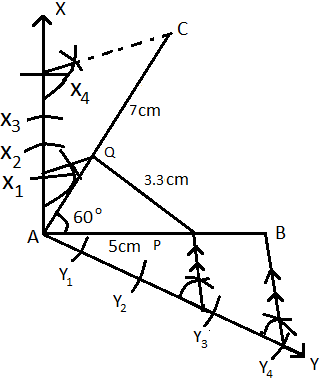
Two line segments AB and AC include an angle of 60° where AB = 5cm and AC = 7cm. Locate points P and Q on AB and AC, respectively such that
$\text{AP}=\frac{3}{4}\text{AB and AQ}=\frac{1}{4}\text{AC}.$ Join P and Q and measure the length PQ.
Answer


1. Draw $\angle B A C=60^{\circ}$ such that $A B=5 cm$ and $A C=7 cm$.
2. Draw acute angle $C A X$ and mark $X_1, X_2, X_3$, and $X_4$ equally spaced.
3. Join $X _4 C$.
4. Draw $X_1 Q \| X_4 C$.
5. Similarly, draw $\angle B A Y$ and divide $A Y$ in 4 equal parts i.e., $Y_1, Y_2, Y_3$ and $Y_4$.
6. Join $Y_4 B$ and draw $Y_3 P \| Y_4 B$.
7. Join PQ and measure it.
8. $P Q$ is equal to 3.3 cm .
View full question & answer
Question 95 Marks
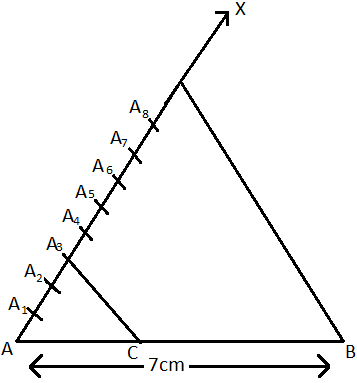
Draw a line segment of length 7cm. Find a point P on it which divides it in the ratio 3 : 5.
Answer
Steps of construction:
  1. Draw a line segment AB = 7cm.
  2. Draw a ray AX, making an acute $\angle\text{BAX}$
  3. Along AX, mark 3 + 5 = 8 points
$A_1, A_2, A_3, A_4, A_5, A_6, A_7, A_8$ such that
$AA_1 = A_1A_2 = A_2A_3 = A_3A_4 = A_4A_5 = A_5A_6 = A_6A_7 = A_7A_8$
  1. Join $A_8B$
  2. From $A_3$, draw $A_3C || A_8B$ meeting AB at C.
$[$by making an angle equal to $\angle\text{BA}_8\text{A at A}_3]$
Then, C is the point on AB which divides it in the ratio 3 : 5,
Thus, AC : CB = 3 : 5

Justification:Let $AA_1 = A_1A_2 = A_2A_3 = A_3A_4 = ... = A_7A_8 = x$
In $\triangle\text{ABA}_8,$ we have
$\text{A}_3\text{C}\ ||\ \text{A}_8\text{B}$
$\therefore\ \frac{\text{AC}}{\text{CB}}=\frac{\text{AA}_3}{\text{A}_3\text{A}_8}=\frac{3\text{x}}{5\text{x}}=\frac{3}{5}$
Hence, $\text{AC}:\text{CB}=3:5$
View full question & answer
Question 105 Marks
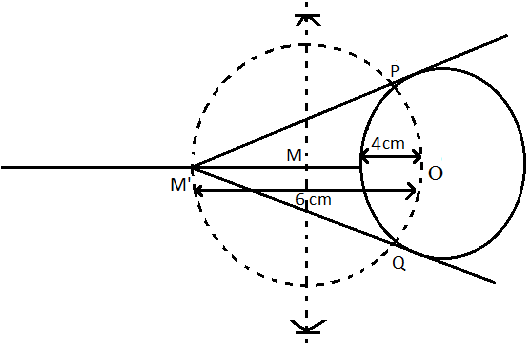
Construct a tangent to a circle of radius 4cm from a point which is at a distance of 6cm from its centre.
Answer

Given, a point M’is at a distance of 6cm from the centre of a circle of radius 4cm.
Steps of construction:
  1. Draw a circle of radius 4cm. Let centre of this circle is O.
  2. Join OM' and bisect it. Let M be mid-point of OM'.
  3. Taking M as centre and MO as radius draw 6cm a circle to intersect circle (0, 4) at two points, P and Q.
  4. Join PM' and QM'. PM' and QM' are the required tangents from M' to circle C (0, 4).
View full question & answer
Question 115 Marks
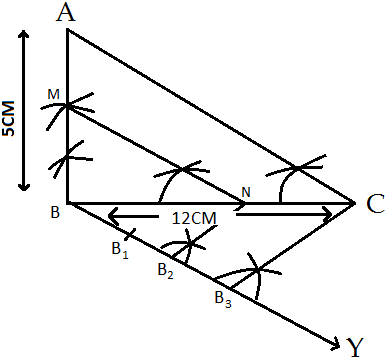
Draw a right triangle ABC in which BC = 12cm, AB = 5cm and $\angle\text{B}=90^\circ.$ Construct a triangle similar to it and of scale factor $\frac{2}{3}.$ Is the new triangle also a right triangle?
Answer
Steps of construction:
Draw a line segment BC = 12cm,
From 6 draw a line AB = 5cm which makes right angle at B.


3. Join $A C, \triangle A B C$ is the given right triangle.
4. From B draw an acute $\angle CBY$ downwards.
5. On ray $B Y$, mark three points $B_1, B_2$ and $B_3$, such that $B B_1=B_1 B_2=B_2 B_3$.
6. Join $B _3 C$.
7. From point $B_2$ draw $B_2 N \| B_3 C$ intersect $B C$ at $N$.
8. From point $N$ draw $N M \| C A$ intersect $B A$ at $M . \triangle M B N$ is the required triangle. $\triangle M B N$ is also a right angled triangle at B .

View full question & answer