Question
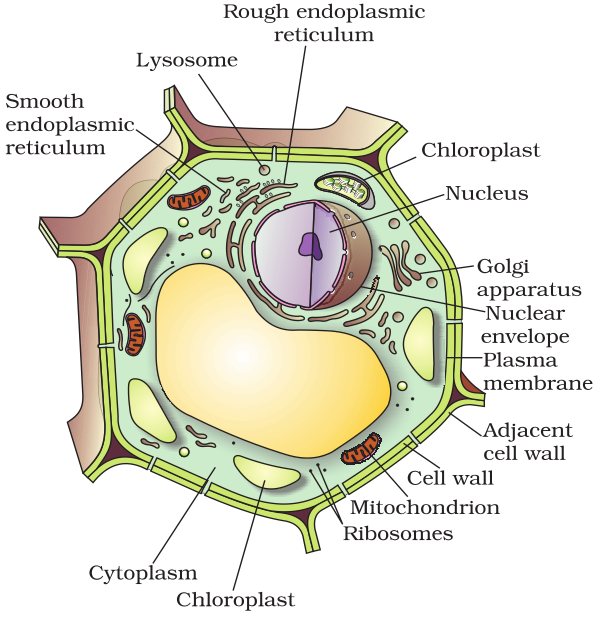
Draw and label a plant cell. Write the main function of:
  1. Chloroplast.
  2. Plasma membrane.
  3. Cell wall.
  4. Lysosomes.
  5. Chromosomes.
    ​​​​​​​

Answer


  1. Chloroplast: It contains the green pigment called CHLOROPHYLL, which helps in photosynthesis.
  2. Cell Wall: The cell wall is made up of dead particles which stiffens the plant.
  3. Plasma Membrane: It protects the cell and provide shape to the cell.
  4. Lysosomes: Contains enzymes which helps in breaking down or destroying the various materials.
  5. Chromosomes: It is only when a cell is dividing that the chromosomes can be seen in it. It helps in cell division.

Need a full question paper?

Generate a complete, print-ready paper with questions like this in minutes — across 16+ boards, with answer keys.
Start Generating Free

Similar questions

A truck of mass $500\ kg$ moving at $4\ m/s$ collides with another truck of mass $1500\ kg$ moving in the same direction at $2\ m/s.$ What is their common velocity just after the collision if they move off together?
What are longitudinal waves and transverse waves? Explain with the help of labelled diagrams.
Describe the various steps involved in the separation of iodine, iron filings and salt from a mixture.
State and explain Newton’s second law of motion.
State and explain the law of conservation of energy with an example.
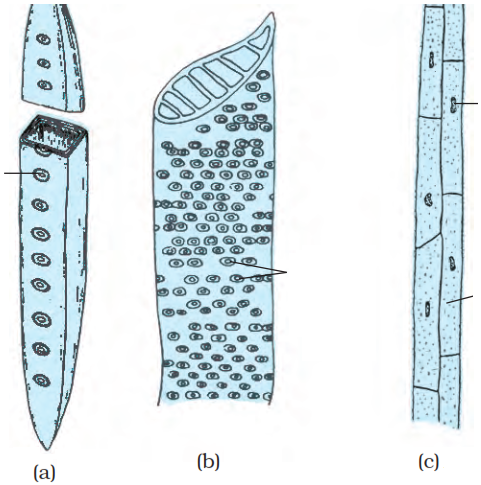
  1. Identify the structures marked below as A, B and C.
  2. Complete the labeling of each structure.
  3. Write the function of each structure.
Pragya tested the solubility of three different substances at different temperatures and collected the data as given below (results are given in the following table, as grams of substance dissolved in 100 grams of water to form a saturated solution).
Substance Dissolved  Temperature in K
283 293 313 333 353
Solubility
Potassium nitrate 21 32 62 106 167
Sodium chloride 36 36 36 37 37
Potassium chloride 35 35 40 46 54
Ammonium chloride 24 37 41 55
66
  1. What mass of potassium nitrate would be needed to produce a saturated solution of potassium nitrate in 50 grams of water at 313K?
  2. Pragya makes a saturated solution of potassium chloride in water at 353K and leaves the solution to cool at room temperature. What would she observe as the solution cools? Explain.
  3. Find the solubility of each salt at 293K. Which salt has the highest solubility at this temperature?
  4. What is the effect of change of temperature on the solubility of a salt?
A body starting from rest travels with uniform acceleration. If it travels 100m in 5s, what is the value of acceleration?
Give an account of structure and function of xylem.
How does the force of attraction between the two bodies depend upon their masses and distance between them?