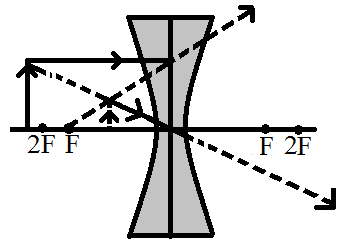
Draw ray diagrams showing the image formation by a concave lens when an object is placed:
Beyond twice the focal length of the lens.
Beyond twice the focal length of the lens.
Download our app for free and get started

Download our appand get started for free
Experience the future of education. Simply download our apps or reach out to us for more information. Let's shape the future of learning together!No signup needed.*
Similar Questions
- 1View SolutionWhich kind of mirror is used in the headlights of a car? Why is it used for this purpose?
- 2View SolutionAn object is placed at a distance of 40cm in front of a convex mirror of radius of curvature 40cm. List four characteristics of the image formed by the mirror.
- 3View SolutionWhat is the difference between a real image and a virtual image? Give one example of each type of image.
- 4View SolutionDraw a labelled ray diagram to show the formation of image of an object by a convex mirror. Mark clearly the pole, focus and centre of curvature on the diagram.
- 5View SolutionA lens has a focal length of, -10cm. What is the power of the lens and what is its nature?
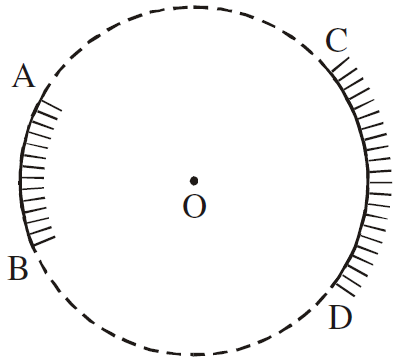
- 6AB and CD, two spherical mirrors, form parts of a hollow spherical ball with its centre at O as shown in the diagram. If arc $\text{AB}=\frac{1}{2}$ arc CD, what is the ratio of their focal lengths? State which of the two mirrors will always form virtual image of an object placed in front of it and why.View Solution
- 7View Solution‘‘A concave mirror of focal length 15cm can form a magnified erect as well as inverted image of an object placed in front of it.’’ Justify this statement stating the position of the object with respect to the pole of the mirror in both cases for obtaining the images.
- 8View SolutionName the type of mirror used by dentists. How does it help?
- 9View SolutionAn object is placed at a distance of 30 cm from a concave lens of focal length 15 cm. List four characteristics (nature, position, etc.) of the image formed by the lens.
- 10View SolutionBriefly describe how you would find the focal length of a concave mirror quickly but approximately.