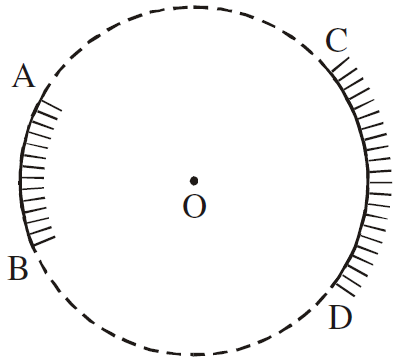
AB and CD, two spherical mirrors, form parts of a hollow spherical ball with its centre at O as shown in the diagram. If arc $\text{AB}=\frac{1}{2}$ arc CD, what is the ratio of their focal lengths? State which of the two mirrors will always form virtual image of an object placed in front of it and why.
CBSE FOREIGN - SET 1 2016
Download our app for free and get started
Focal length of both the mirrors will be the same/ 1: 1
Mirror AB will always form virtual image as it is a diverging/convex mirror.
Mirror AB will always form virtual image as it is a diverging/convex mirror.

Download our appand get started for free
Experience the future of education. Simply download our apps or reach out to us for more information. Let's shape the future of learning together!No signup needed.*
Similar Questions
- 1View Solution
Explain how to read the following message which was found on some blotting paper:

- 2View SolutionWhat type of lens is shown in the diagram on the right? What will happen to the parallel rays of light? Show by completing the ray diagram.
- 3View SolutionWhat is the difference between a real image and a virtual image? Give one example of each type of image.
- 4View SolutionWhat do you mean by laterally inverted?
- 5The refractive indices of three media are given below :View Solution
A ray of light is travelling from $A$ to $B$ and another ray is travelling from $B$ to $C$.Medium Refractive Index A 1.6 B 1.8 C 1.5
(a) In which of the two cases the refracted ray bends towards the normal?
(b) In which case does the speed of light increase in the second medium?
Give reasons for your answer. - 6View Solution“A ray of light incident on a rectangular glass slab immersed in any medium emerges parallel to itself.” Draw labeled ray diagram to justify this statement.
- 7View SolutionAn object is placed well outside the principal focus of a convex lens. Draw a ray diagram to show how.
- 8View Solution‘‘A concave mirror of focal length 15cm can form a magnified erect as well as inverted image of an object placed in front of it.’’ Justify this statement stating the position of the object with respect to the pole of the mirror in both cases for obtaining the images.
- 9View SolutionWhat is the minimum number of rays required for locating the image formed by a concave mirror for an object. Draw a ray diagram to show the formation of a virtual image by a concave mirror.
- 10View SolutionA wall reflects light and a mirror also reflects light. What difference is there in the way they reflect light?