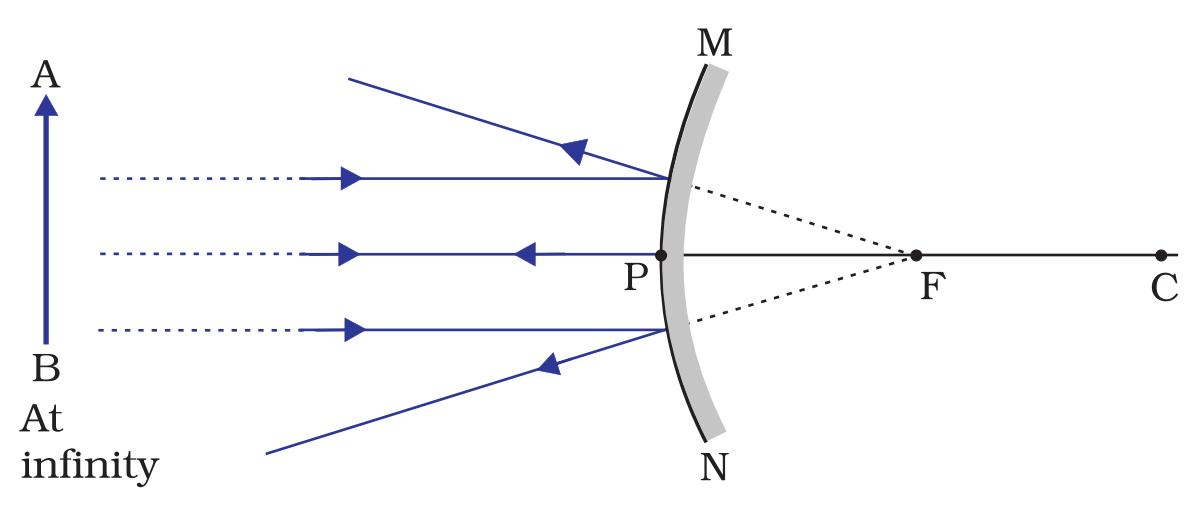
Draw ray diagrams showing the image formation by a convex mirror when an object is placed:
At infinity.
At infinity.
Download our app for free and get started

Download our appand get started for free
Experience the future of education. Simply download our apps or reach out to us for more information. Let's shape the future of learning together!No signup needed.*
Similar Questions
- 1View SolutionState any four characteristics of the image of an object formed by a plane mirror.
- 2View SolutionName the two types of spherical mirrors. What type of mirror is represented by the:
- Back side of a shining steel spoon?
- Front side of a shining steel spoon?
- 3View SolutionA student focuses the image of a candle flame, placed at about 2 m from a convex lens of focal length 10 cm, on a screen. After that he moves gradually the flame towards the lens and each time focuses its image on the screen.
- In which direction does he move the lens to focus the flame on the screen?
- What happens to the size of the image of the flame formed on the screen?
- What difference is seen in the intensity (brightness) of the image of the flame on the screen?
- What is seen on the screen when the flame is very close (at about 5 cm) to the lens?
- 4View SolutionName the lens which always forms a virtual image of an object.
- 5View SolutionDefine and show on a diagram, the following terms relating to a concave mirror:
- Aperture.
- Radius of curvature.
- 6View SolutionState and explain the laws of refraction of light with the help of a labelled diagram.
- 7View SolutionExplain why, concave mirrors are used as shaving mirrors.
- 8View SolutionA student places a candle flame at a distance of about 60 cm from a convex lens of focal length 10 cm and focuses the image of the flame on a screen. After that he gradually moves the flame towards the lens and each time focuses the image on the screen.
- In which direction-toward or away from the lens, does he move the screen to focus the image?
- How does the size of the image change?
- How does the intensity of the image change as the flame moves towards the lens?
- Approximately for what distance between the flame and the lens, the image formed on the screen is inverted and of the same size?
- 9View SolutionIdentify the device used as a spherical mirror or lens in following cases, when the image formed is virtual and erect in each case.
Object is placed between device and its focus, image formed is enlarged and behind it. - 10In an experiment with a rectangular glass slab, a student observed that a ray of light incident at an angle of $55^{\circ}$ with the normal on one face of the slab, after refraction strikes the opposite face of the slab before emerging out into air making an angle of $40^{\circ}$ with the normal. Draw a labelled diagram to show the path of this ray.' What value would you assign to the angle of refraction and angle of emergence?View Solution