State and explain the laws of refraction of light with the help of a labelled diagram.
Download our app for free and get started
Laws of refraction,
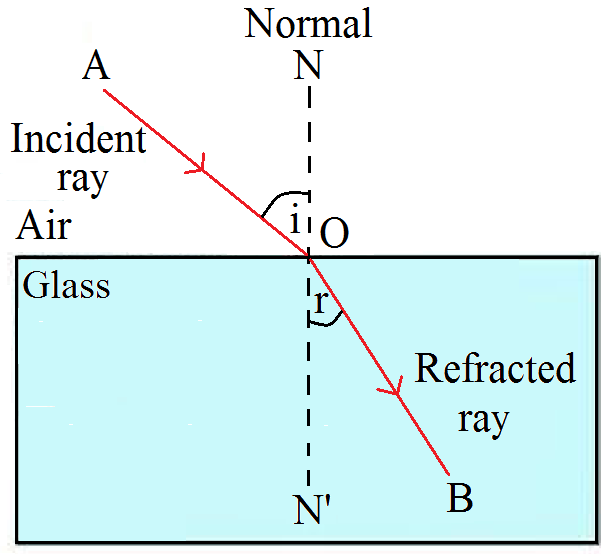
First law: According to the first law of refraction, the incident ray, the refracted ray and the normal at the point of incidence, all lie in the same.
Second law: According to the second law of refraction, the ratio of the angle of incidence to the point of incidence, all lie in the same plane.
First law: According to the first law of refraction, the incident ray, the refracted ray and the normal at the point of incidence, all lie in the same.
Second law: According to the second law of refraction, the ratio of the angle of incidence to the point of incidence, all lie in the same plane.

Download our appand get started for free
Experience the future of education. Simply download our apps or reach out to us for more information. Let's shape the future of learning together!No signup needed.*
Similar Questions
- 1View SolutionIdentify the device used as a spherical mirror or lens in following cases, when the image formed is virtual and erect in each case.Object is placed between infinity and device, image formed is diminished and between pole and focus, behind it.
- 2View SolutionWrite the word AMBULANCE as it would appear when reflected in a plane mirror. Why is it sometimes written in this way (as its mirror image) on the front of an ambulance?
- 3View SolutionHow could you find the focal length of a convex lens rapidly but approximately?
- 4View SolutionHow is the reflection of light ray from a plane mirror different from the refraction of light ray as it enters a block of glass?
- 5View SolutionDiscuss the case when a convex lens forms a virtual and enlarged image.
- 6View SolutionWhat is meant by power of a lens? What does its sign (+ve or -ve) indicate? State its S.I. unit. How is this unit related to focal length of a lens?
- 7View SolutionWrite down a formula for the magnification produced by a concave mirror.
- In terms of height of object and height of image.
- In terms of object distance and image distance.
- 8View SolutionA convex mirror used as a rear-view mirror in a car has a radius of curvature of 3m. If a bus is located at a distance of 5m from this mirror, find the position of image. What is the nature of the image?
- 9View SolutionState and define the S.I. unit of power of a lens.
- 10View SolutionList four properties of the image formed by a plane mirror.