Question
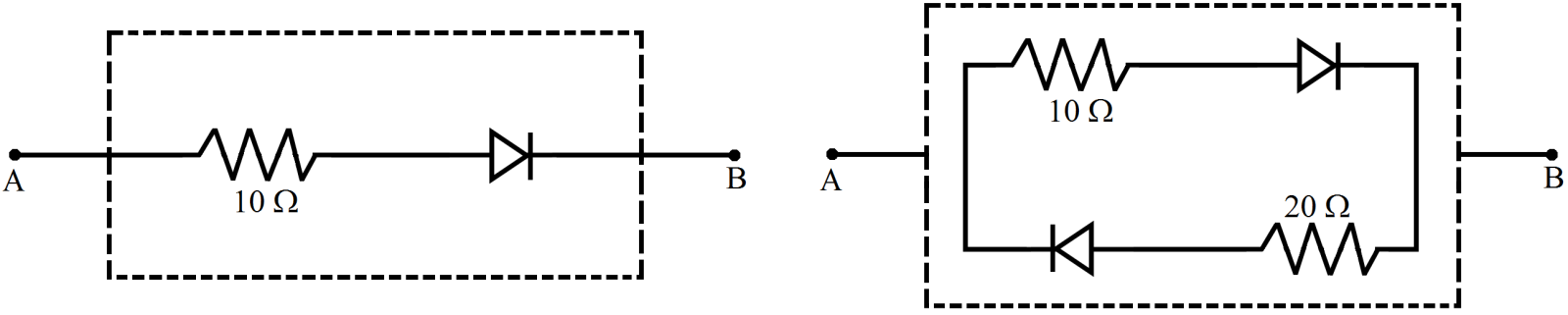
Draw the current-voltage characteristics for the device shown in figure. between the terminals A and B.

Answer

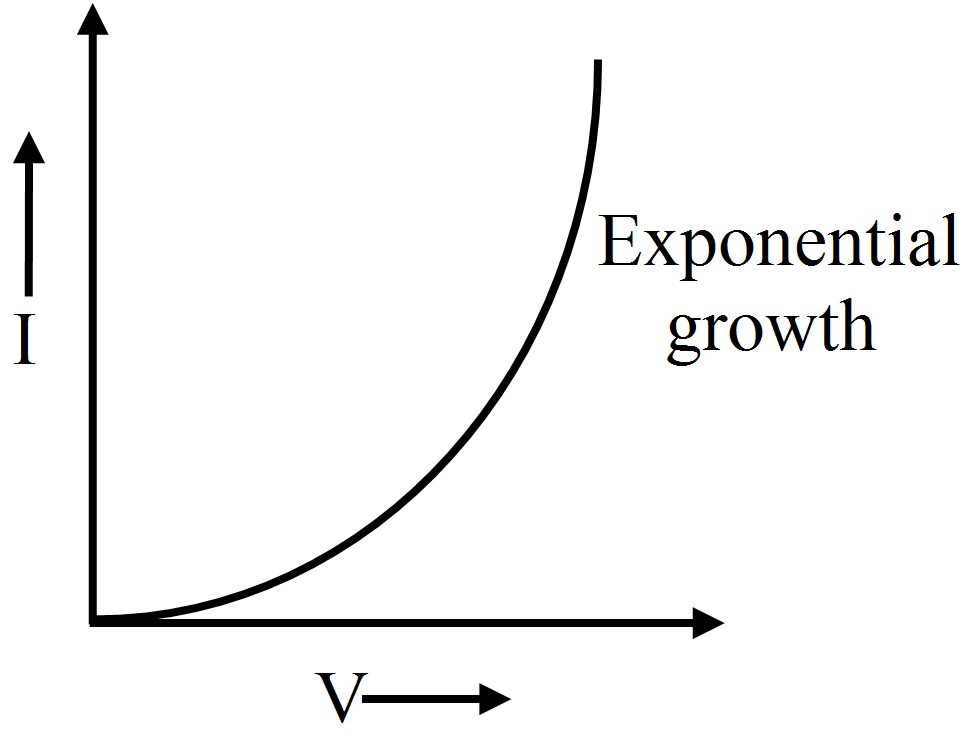
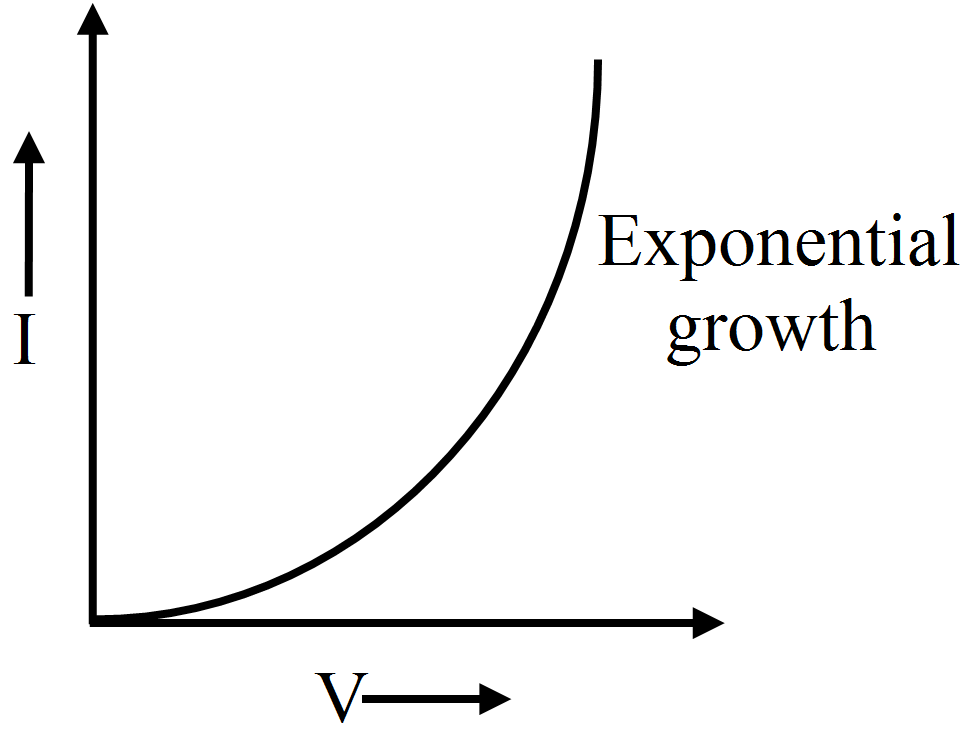
  1. If a battery is connected between terminals A and B, with positive terminal connected to point A and negative terminal connected to point B, then the diode will get forward biassed by the applied voltage. So, the current voltage graph for this circuit will be the same as that of the characteristic curves of a forward-biassed diode.
  1. If a battery is connected between terminals A and B, with positive terminal connected to point A and negative terminal connected to point B, then the upper diode will get forward biassed and the lower diode will get reverse biassed by the applied voltage. So, this lower branch can be replaced by an open circuit; hence, the current flow through this branch will be zero. The current flows only through the upper diode, so the circuit on simplification will become identical to the circuit in part (a). Hence, the current voltage graph for this circuit will be the same as that of the characteristic curves of a forward-biassed diode.

Need a full question paper?

Generate a complete, print-ready paper with questions like this in minutes — across 16+ boards, with answer keys.
Start Generating Free

Similar questions

Ajit had a high tension tower erected on his farm land. He kept complaining to the authorities to remove it as it was occupying a large portion of his land. His uncle, who was a teacher, explained to him the need for erecting these towers for efficient transmission of power. As Ajit realised its significance, he stopped complaining. 
Answer the following questions:
  1. Why is it necessary to transport power at high voltage?
  2. A low power factor implies large power loss. Explain.
  3. Write two values each displayed by Ajit and his uncle.
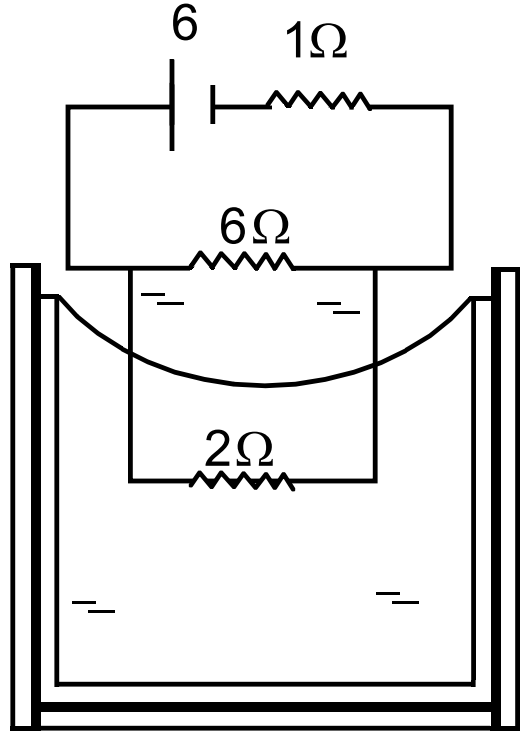
The $2.0\Omega$ resistor shown in the figure is dipped into a calorimeter containing water. The heat capacity of the calorimeter together with water is $2000JK^{-1}$.
  1. If the circuit is active for $15$ minutes, what would be the rise in the temperature of the water?
  2. Suppose the $6.0\Omega$ resistor gets burnt. What would be the rise in the temperature of the water in the next $15$ minutes?
A source of sound emitting a 1200Hz note travelg along a straight line at a speed of 170m/s. A detector is placed at a distance of 200m from the line of motion of the source.
  1. Find the frequency of sound received by the detector at the instant when the source gets closest to it.
  2. Find the distance between the source and the detector at the instant it detects the frequency 1200Hz. Velocity of sound in air = 340m/s.
A solid wire of radius $10\ cm$ carries a current $5.0A$ distributed uniformly over its cross$-$section. Find the magnetic field $B$ at a point at a distance $(a) 2\ cm\ (b) 10\ cm$ and $(c) 20\ cm$ away from the axis. Sketch a graph of $B$ versus $x$ for $0 < x < 20\ cm.$
Two samples $A$ and $B,$ of the same gas have equal volumes and pressures. The gas in sample $A$ is expanded isothermally to double its volume and the gas in $B$ is expanded adiabatically to double its volume. If the work done by the gas is the same for the two cases, show that $\gamma$ satisfies the equation $1-2^{1-\gamma}=(\gamma-1)\text{ln}2.$
The equation of motion of a particle started at t = 0 is given by $\text{x}=5\sin\big(20\text{t}+\frac{\pi}{3}\big)$ where x is in centimetre and t in second. When does the particle.
  1. First come to rest.
  2. First have zero acceleration.
  3. First have maximum speed?
A particle slides on the surface of a fixed smooth sphere starting from the topmost point. Find the angle rotated by the radius through the particle, when it leaves contact with the sphere.
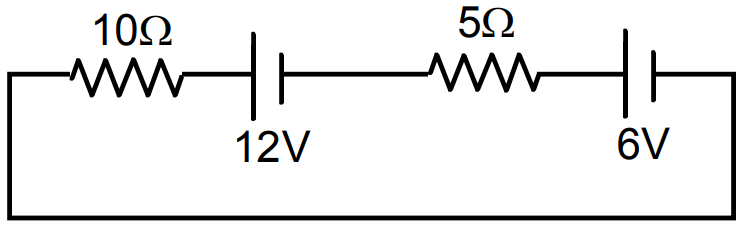
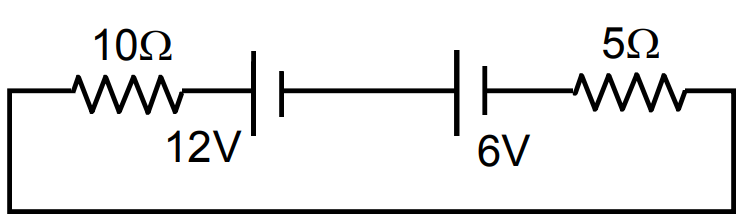
Consider the circuit shown in the figure. Find (a) the current in the circuit (b) the potential drop across the $5\Omega$ resistor (c) the potential drop across the $10\Omega$ resistor. (d) Answer the parts (a), (b) and (c) with reference to the figure.

Do permeability and relative permeability have the same dimensions?
A point object is placed at a distance of $15\ cm$ from a convex lens. The image is formed on the other side at a distance of $30\ cm$ from the lens. When a concave lens is placed in contact with the convex lens, the image shifts away further by $30\ cm.$ Calculate the focal lengths of the two lenses.