Question
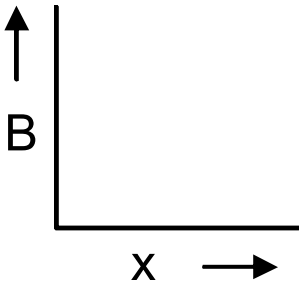
A solid wire of radius $10\ cm$ carries a current $5.0A$ distributed uniformly over its cross$-$section. Find the magnetic field $B$ at a point at a distance $(a) 2\ cm\ (b) 10\ cm$ and $(c) 20\ cm$ away from the axis. Sketch a graph of $B$ versus $x$ for $0 < x < 20\ cm.$
Answer

  1. $r = 10\ cm = 10 \times 10^{-2}m$
  2. $x = 2 \times 10^{-2}m,$$i = 5A$
  3. $i$ in the region of radius $2\ cm$
$\frac{5}{\pi(10\times\times10^{-2})^2}\times\pi(2\times10^{-2})^2=0.2\text{A}$
$\text{B}\times\pi(2\times10^{-2})^2=\mu_0(0-2)$
$\Rightarrow\text{B}=\frac{4\pi\times10^{-7}\times0.2}{\pi\times4\times10^{-4}}=\frac{0.2\times10^{-7}}{10^{-4}}=2\times10^{-4}$
  1. $10\ cm$ radius
$\text{B}\times\pi(10\times10^{-2})^2=\mu_0\times5$
$\Rightarrow\text{B}=\frac{4\pi\times10^{-7}\times5}{\pi\times10^{-2}}=20\times10^{-5}$
  1. $x = 20\ cm$
$\text{B}\times\pi(20\times10^{-2})^2=\mu_0\times5$
$\Rightarrow\text{B}=\frac{\mu_0\times5}{\pi\times(20\times10^{-2})^2}=\frac{4\pi10^{-7}\times5}{\pi\times400\times10^{-4}}=5\times10^{-5}$

Need a full question paper?

Generate a complete, print-ready paper with questions like this in minutes — across 16+ boards, with answer keys.

Start Generating Free

Similar questions

Two heaters are marked 200V, 300W and 200V, 600W. If the heaters are connected in series and the combination connected to a 200V dc supply, which heater will produce more heat?
Obtain the equivalent capacitance of the network in Fig. For a $300V$ supply, determine the charge and voltage across each capacitor.
A coil of resistance $40\Omega$ is connected across a 4.0V battery 0.10s after the battery is connected, the current in the coil is 63mA. Find the inductance of the coil.
Establish an expression for force on a current carrying conductor kept in a magnetic field. Explain right hand palm rule for the direction of force.
The convex surface of a thin concavo$-$convex lens of glass of refractive index $1.5$ has a radius of curvature $20\ cm.$ The concave surface has a radius of curvature $60\ cm.$ The convex side is silvered and placed on a horizontal surface as shown in figure.
  1. Where should a pin be placed on the axis so that its image is formed at the same place?
  2. If the concave part is filled with water $\Big(\mu=\frac{4}{3}\Big),$ find the distance through which the pin should be moved so that the image of the pin again coincides with the pin.
The mixture a pure liquid and a solution in a long vertical column (i.e, horizontal dimensions < < vertical dimensions) produces diffusion of solute particles and hence a refractive index gradient along the vertical dimension. A ray of light entering the column at right angles to the vertical is deviated from its original path. Find the deviation in travelling a horizontal distance d < < h, the height of the column.
It is desired to measure the magnitude of field between the poles of a powerful loud speaker magnet. $A$ small flat search coil of area $2\ cm^2$ with $25$ closely wound turns, is positioned normal to the field direction, and then quickly snatched out of the field region. Equivalently, one can give it a quick $90^\circ$ turn to bring its plane parallel to the field direction. The total charge flown in the coil $($measured by a ballistic galvanometer connected to coil$)$ is $7.5mC$. The combined resistance of the coil and the galvanometer is $0.50\Omega$ . Estimate the field strength of magnet.
One end of a $10\ cm$ long silk thread is fixed to a large vertical surface of a charged nonconducting plate and the other end is fastened to a small ball having a mass of $10\ g$ and a charge of $4.0 \times 10^{-5}C$. In equilibrium, the thread makes an angle of $60^\circ$ with the vertical. Find the surface charge density on the plate.
Three thin prisms are combined as shown in figure. The refractive indices of the crown glass for red, yellow and violet rays are $\mu_\text{r},\mu_\text{y}$ and $\mu_\text{v}$ respectively and those for the flint glass are $\mu'_\text{r},\mu'_\text{y}$ and $\mu'_\text{v}$ respectively. Find the ratio $\frac{\text{A}'}{\text{A}}$ for which.
  1. There is no net angular dispersion.
  2. There is no net deviation in the yellow ray.
Can $\text{L}_\alpha$ X-ray of one material have shorter wavelength than $\text{K}_\alpha$ X-ray of another?