Question
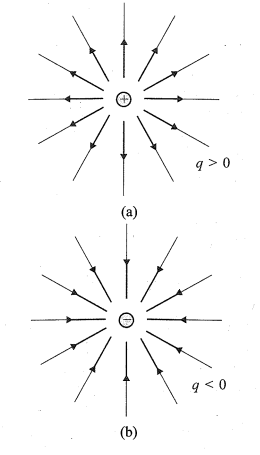
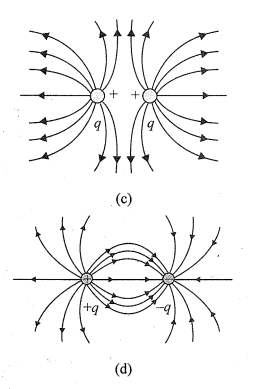
Draw the field lines of Simple electric charge distribution.

Answer

►Figure (a) shows the electric field lines for positive electric charge.
►Figure (b) shows the electric field lines for negative electric charge
►Figure (c) shows the electric field lines for two positive and equal value electric charge.
►Figure (d) shows the electric field lines for electric dipole.
Image
Image

Need a full question paper?

Generate a complete, print-ready paper with questions like this in minutes — across 16+ boards, with answer keys.
Start Generating Free

Similar questions

If two quantities have same dimensions, do they represent same physical content?
Explain polarisation of polar molecule in uniform electric field.
An immersion heater rated 1000W, 220V is used to heat 0.01m3 of water. Assuming that the power is supplied at 220V and 60% of the power supplied is used to heat the water, how long will it take to increase the temperature of the water from 15°C to 40°C?
Distinguish between an intrinsic semiconductor and P-type semiconductor. Give reason, why, a P-type semiconductor crystal is electrically neutral, although$\text{n}_{h}>>\text{n}_{e}$.
A Galilean telescope is 27cm long when focused to form an image at infinity. If the objective has a focal length of 30cm, what is the focal length of the eyepiece?
It is found experimentally that $13.6 eV$ energy is required to separate a hydrogen atom into a proton and an electron. Compute the orbital radius and the velocity of the electron in a hydrogen atom.
A compound microscope forms an inverted image of an object. In which of the following cases it is kely to create difficulties?
  1. Looking at small germs.
  2. Looking at circular spots.
  3. Looking at a vertical tube containing some water.
The force on a north pole,$\overrightarrow{\text{F}}=\text{m}\overrightarrow{\text{B}},$ is parallel to the field $\overrightarrow{\text{B}}.$ Does it contradict our earlier knowledge that a magnetic field can exert forces only perpendicular to itself?
Obtain Primary results from law of refraction.
The average kinetic energy of molecules in a gas at temperature T is 1.5kT. Find the temperature at which the average kinetic energy of the molecules of hydrogen equals the binding energy of its atoms. Will hydrogen remain in molecular from at this temperature? Take k = 8.62 × 10⁻⁵eVK-1.