Question
Draw the graph of deviation angle $(\delta)$ versus incidence angle $(i)$ and derive the formula for refractive index $n_{21}=\frac{\sin \left(\frac{A+D_m}{2}\right)}{\sin \left(\frac{A}{2}\right)}$ for the material of prism.
Answer

Image
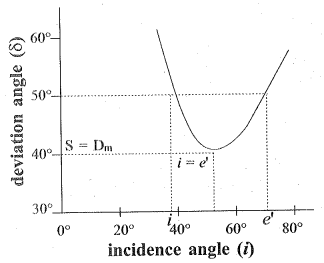
$\rightarrow$ The graph of deviation angle versus incidence angle is shown in figure.
$\rightarrow$ The graph shows that for a single value of deviation angle $(\delta)$ there are two values of incidence angle $i$ and hence also of $e$.
$\rightarrow$ From the symmetry it can be said that angle of deviation $\delta$ remains the same if angle of incidence $i$ and angle of emergent $e$ are interchanged.
Even if the path of ray can be traced back, resulting in the same angle of deviation.
$\rightarrow$ From the graph, for a particular value of $i=e$ the angle of incidence, a single value of deviation is obtained. At the minimum deviation, $D _m$, the refracted ray becomes parallel to its base.
$\rightarrow $ So when $\delta= D _m$ and $i=e,$ then $r_1=r_2$.
$\rightarrow$ For prism, $ A =r_1+r_2$
$\therefore A =2 r_1$
$\therefore r_1 =\frac{ A }{2}......(1)$
$\rightarrow$ and from $\delta=i+e- A$,
$ D _m=2 i- A$
$2 i= D _m+ A$
$i=\frac{ A + D _m}{2}......(2)$
$\rightarrow$ Applying Snell's law at incident point $Q ,$
$n_1 \sin i=n_2 \sin r_1$
$\rightarrow$ Substituting value of $r_1$ and $i$ from equation $(1)$ and $(2),$
$\therefore n_1 \sin \left(\frac{ A + D _m}{2}\right)=n_2 \sin \left(\frac{ A }{2}\right)$
$\therefore \frac{n_2}{n_1}=\frac{\sin \left(\frac{ A + D _m}{2}\right)}{\sin \frac{ A }{2}}$
$\therefore n_{21}=\frac{\sin \left(\frac{ A + D _m}{2}\right)}{\sin \frac{ A }{2}}$
$\rightarrow$ which is the formula to find the refractive index of the material of the prism.

Need a full question paper?

Generate a complete, print-ready paper with questions like this in minutes — across 16+ boards, with answer keys.
Start Generating Free

Similar questions

You are holding a cage containing a bird. Do you have to make less effort if the bird flies from its position in the cage and manages to stay in the middle without touching the walls of the cage? Does it make a difference whether the cage is completely closed or it has rods to let air pass?
Ampere's law gives a method to calculate the magnetic field due to given current distribution. According to it, the circulation $\oint\vec{\text{B}}.\text{d}\vec{\text{l}}$ di of the resultant magnetic field along a closed plane curve is equal to $\mu_0$ times the total current crossing the area bounded by the closed curve provided the electric field inside the loop remains constant. Ampere's law is more useful under certain synunetrical conditions. Consider one such case of a long Straight wire with circular cross-section (radius R) carrying current f uniformly distributed across this cross-section.
  1. The magnetic field at a radial distance r from the centre of the wire in the region r > R, is:
  1. $\frac{\mu_0\text{I}}{2\pi\text{r}}$
  2. $\frac{\mu_0\text{I}}{2\pi\text{R}}$
  3. $\frac{\mu_0\text{IR}^2}{2\pi\text{r}}$
  4. $\frac{\mu_0\text{Ir}^2}{2\pi\text{R}}$
  1. The magnetic field at a distance r in the region r < R is:
  1. $\frac{\mu_0\text{I}}{2\text{r}}$
  2. $\frac{\mu_0\text{Ir}^2}{2\pi\text{R}^2}$
  3. $\frac{\mu_0\text{I}}{2\pi\text{r}}$
  4. $\frac{\mu_0\text{Ir}}{2\pi\text{R}^2}$
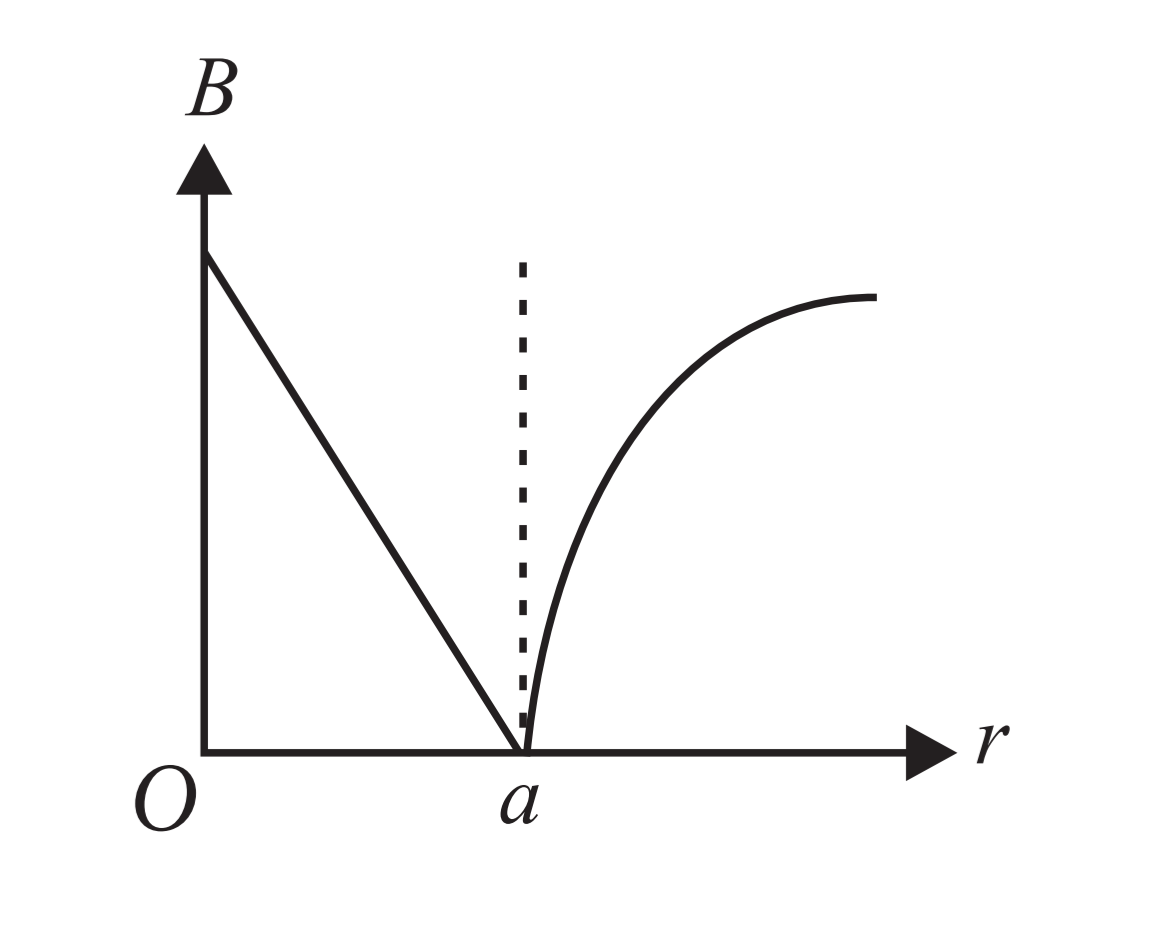
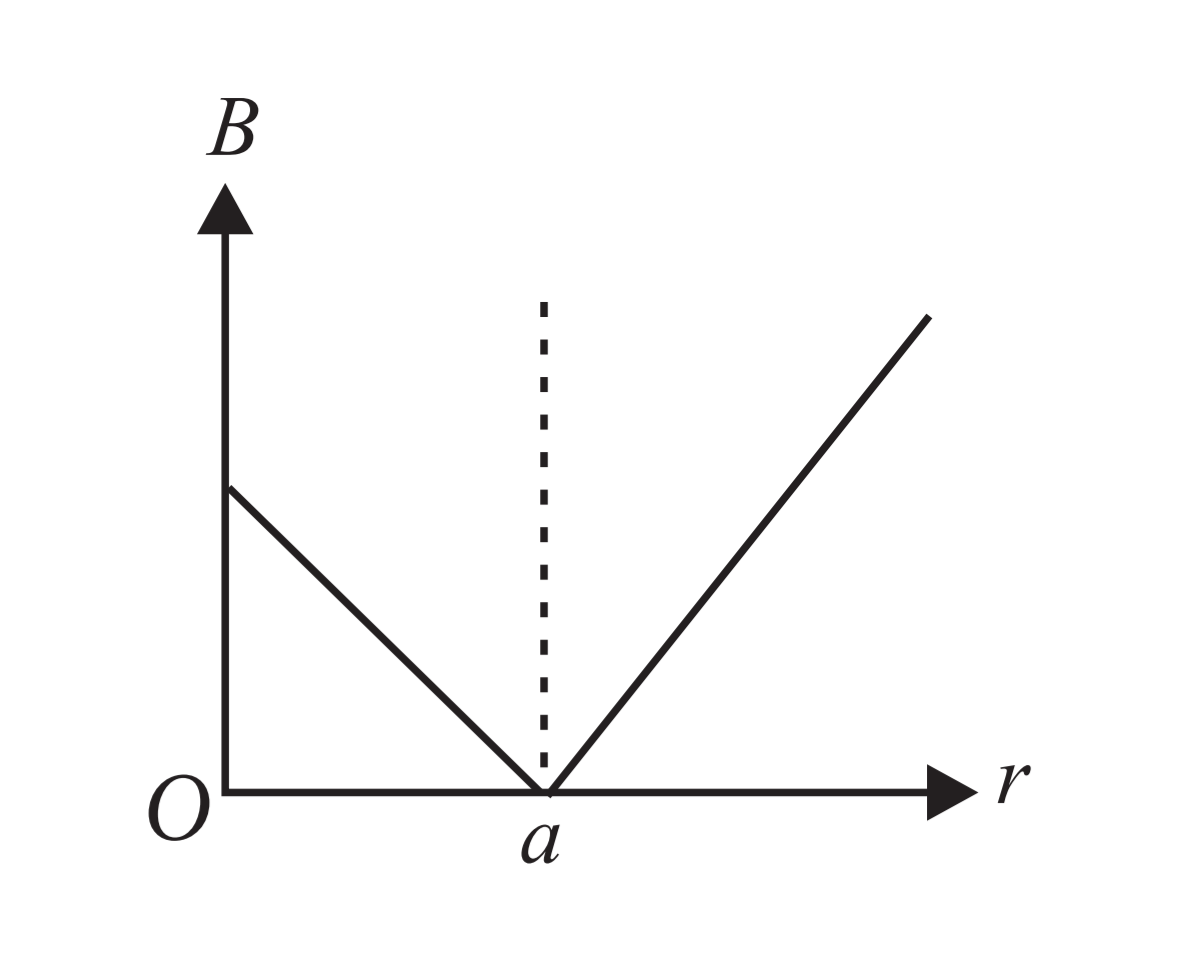
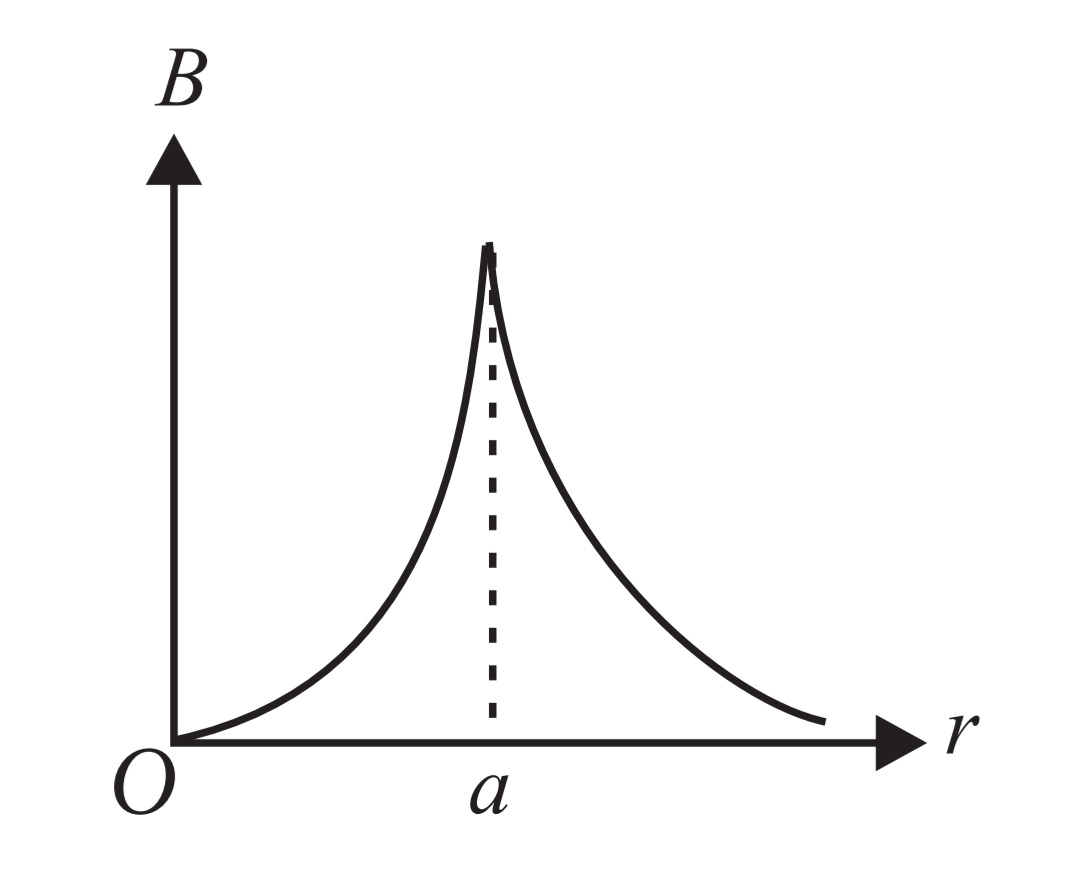
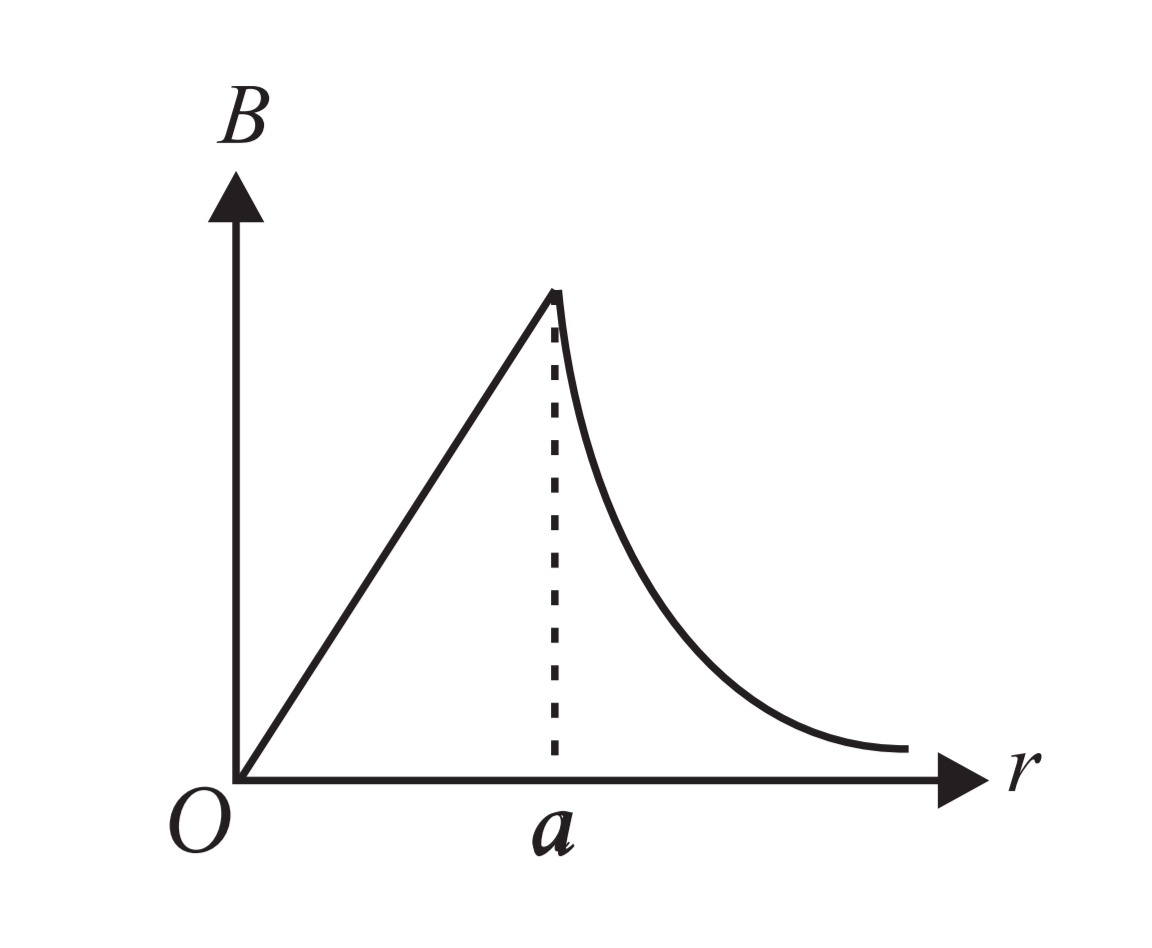
  1. A long straight wire of a circular cross section (radius a) carries a steady current I and the current I is uniformly distributed across this cross-section. Which of the following plots represents the variation of magnitude of magnetic field B with distance r from the centre of the wire?
  1.  
  1.  
  1.  
  1.  
  1. A long straight wire of radius R carries a steady current I. The current is uniformly distributed across its cross-section. The ratio of magnetic field at $\frac{\text{R}}{2}$ and 2R is:
  1. $\frac{\text{1}}{\text{2}}$
  2. $2$
  3. $\frac{\text{1}}{\text{4}}$
  4. $1$ 
  1. A direct current I flows along the length of an infinitely long straight thin walled pipe, then the magnetic field is:
  1. Uniform throughout the pipe but not zero.
  2. Zero only along the axis of the pipe.
  3. Zero at any point inside the pipe.
  4. Maximum at the centre and minimum at the edges. 
The electric field intensity at a point at a distance of 20 cm from the centre of a sphere is 10 Volt/meter. Find the intensity of the electric field at a point located at a distance 8 cm from the centre of that circle. The radius of the sphere is 5 cm.
 For the past some time, Aarti had been observing some erratic body movement, unsteadiness and lack of coordination in the activities of her sister Radha, who also used to complain of severe headache occasionally. Aarti suggested to her parents to get a medical check-up of Radha. The doctor thoroughly examined Radha and diagnosed that she has a brain tumour.
  1. What, according to you, are the values displayed by Aarti?
  2. How can radioisotopes help a doctor to diagnose brain tumour? 
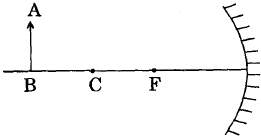
An object AB is kept in front of a concave mirror as shown in the figure.
  1. Complete the ray diagram showing the image formation of the object.
  2. How will the position and intensity of the image be affected if the lower half of the mirror's reflecting surface is painted black?
Two long bar magnets are placed with their axes coinciding in such a way that the north pole of the first magnet is 2·0cm from the south pole of the second. If both the magnets have a pole strength of 10A-m, find the force exerted by one magnet on the other.
When the electron orbiting in hydrogen atom in its ground state moves to the third excited state, show how the de Broglie wavelength associated with it would be affected.
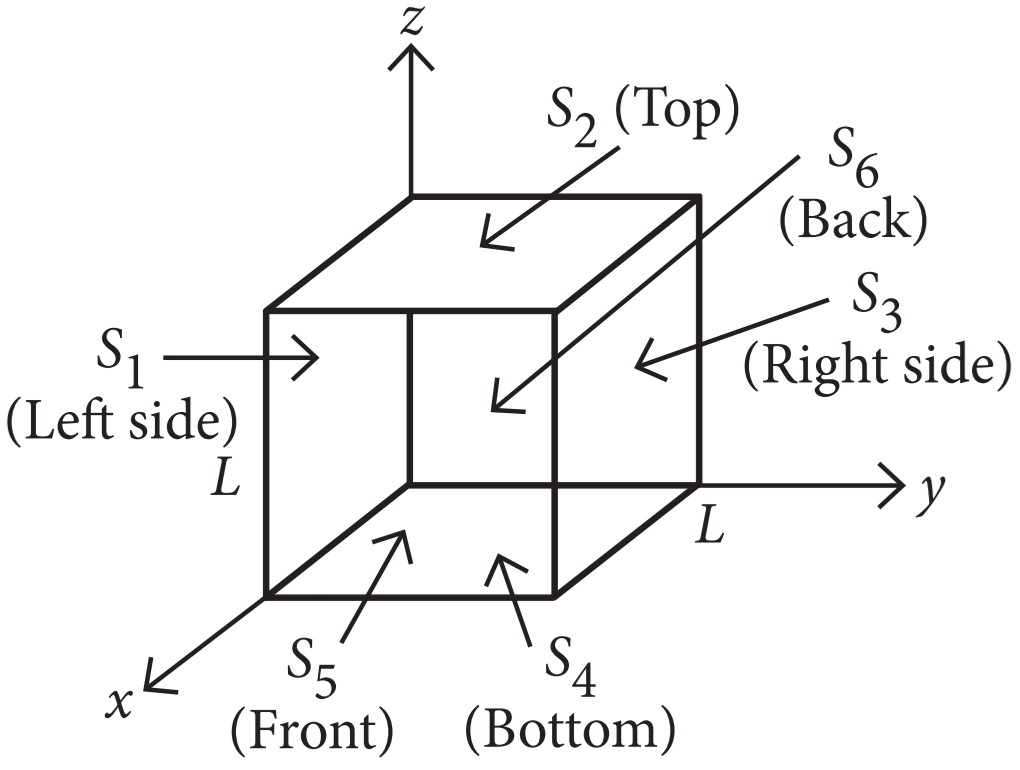
Net electric flux through a cube is the sum of fluxes through its six faces. Consider a cube as shown in figure, having sides of length $L = 10.0\ cm$. The electric field is uniform, has a magnitude $E = 4.00 \times 10^3N C^{-1}$ and is parallel to the xy plane at an angle of $37^\circ$ measured from the $+ x - $ axis towards the $+ y -$ axis.
  1. Electric flux passing through surface $S_6 $ is:
  1. The surfaces that have zero flux are:
  2. $-24N m^{2 }C^{-1}$
  3. $24N m^2 C^{-1}$
  4. $32N m^2 C^{-1}$
  5. $-32N m^2 C^{-1}$
  6. Electric flux passing through surface $S_1$ is:
  7. $-24N m^{2 }C^{-1}$
  8. $24N m^{2 }C^{-1}$
  9. $32N m^{2 }C^{-1}$
  10. $-32N m^{2 }C^{-1}$
  1. $S_1$ and $S_3$
  2. $S_5$ and $S_6$
  3. $S_2$ and $S_4$
  4. $S_1$ and $S_2$
  5. The total net electric flux through all faces of the cube is:
  6. $8N m^2 C^{-1}$
  7. $-8N m^2 C^{-1}$
  8. $24N m^2 C^{-1}$
  9. Zero.
  1. The dimensional formula of surface integral $\oint\vec{\text{E}}\cdot\text{d}\vec{\text{S}}$ of an electric field is:
  1. $[M L^{2 }T^{-2} A^{-1}]$
  2. $[M L^{3 }T^{-3} A^{-1}]$
  3. $[M L^{-1 }T^3 A^{-3}]$
  4. $[M L^{-3 }T^{-3} A^{-1}]$
In a chamber, a uniform magnetic field of 6.5 G (1 G = 10-4T ) is maintained. An electron is shot into the field with a speed of 4.8 X 10⁶ m s-1normal to the field. Explain why the path of the electron is a circle. Determine the radius of the circular orbit.
$\left( e =1.6 \times 10^{-19} C , m_e=9.1 \times 10^{-31} kg\right)$
A tungsten cathode and a thoriated-tungsten cathode have the same geometric dimensions and are operated at the same temperature. The thoriated-tungsten cathode gives 5000 times more current than the other cathode. Find the operating temperature. Take relevant data from the previous problem.