Question
A tungsten cathode and a thoriated-tungsten cathode have the same geometric dimensions and are operated at the same temperature. The thoriated-tungsten cathode gives 5000 times more current than the other cathode. Find the operating temperature. Take relevant data from the previous problem.
Answer

Pure tungsten:
$\phi=4.5\text{eV}$
$\text{A}=60\times10^{4}\text{A/m}^2-\text{k}^2$
$\text{i}=\text{AST}^2\text{e}^{\frac{\phi}{\text{KT}}}$
Thoriated tungsten:
$\phi=2.6\text{eV}$
$\text{A}=3\times10^{4}\text{A/m}^2-\text{k}^2$
$\text{i}_{\text{Thoriated Tungsten}}=5000\text{i}_{\text{Tungsten}}$
So, $5000\times\text{S}\times60\times10^{4}\times\text{T}_2\times\text{e}^{\frac{-4.5\times1.6\times10^{-19}}{1.38\times\text{t}\times10^{-23}}}$
$\Rightarrow\text{S}\times3\times10^{4}\times\text{T}^2\times\text{e}^{\frac{-2.56\times1.6\times10^{-19}}{1.38\times\text{T}\times10^{-23}}}$
$\Rightarrow3\times10^{8}\times\text{e}^{\frac{-4.5\times1.6\times10^{-19}}{1.38\times\text{t}\times10^{-23}}}=\text{e}^{\frac{-2.56\times1.6\times10^{-19}}{1.38\times\text{T}\times10^{-23}}}\times3\times10^4$
Taking 'in'
$\Rightarrow9.21\text{T}=220.29$
$\Rightarrow\text{T}=\frac{22029}{9.21}=2391.856\text{K}$

Need a full question paper?

Generate a complete, print-ready paper with questions like this in minutes — across 16+ boards, with answer keys.

Start Generating Free

Similar questions

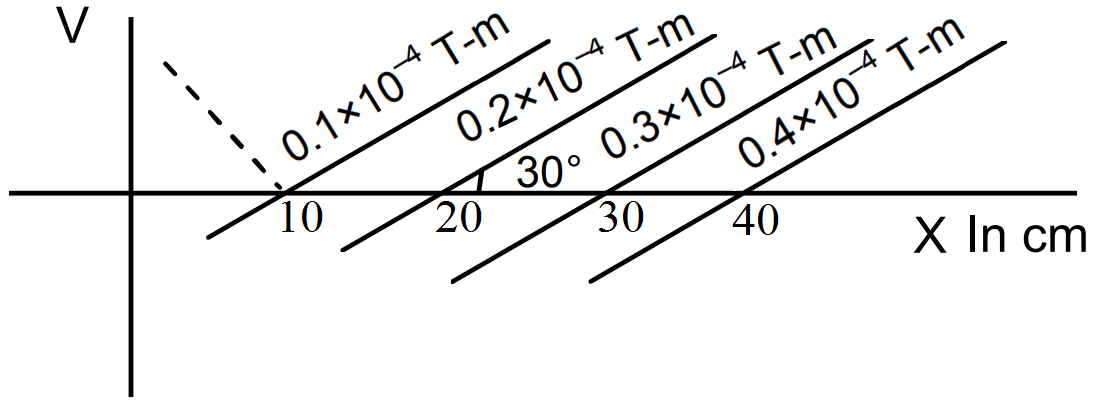
Figure shows some of the quipotential surfaces of the magnetic scalar potential. Fmd the magnetic field $B$ at a point in the region.
The magnetic moment of the assumed dipole at the earth's centre is $8.0 \times 10^{22}A-m^2.$ Calculate the magnetic field $B$ at the geomagnetic poles of the earth. Radius of the earth is $6400\ km.$
Distance between two successive bright or dark fringes is called fringe width.
$\beta=\text{Y}_\text{n+1}-\text{Y}_\text{n}=\frac{(\text{n}+1)\lambda\text{D}}{\text{d}}-\frac{\text{n}\lambda\text{D}}{\text{d}}=\frac{\lambda\text{D}}{\text{d}}$
Fringe width is independent of the order of the maxima. If whole apparatus is immersed in liquid of refractive index $\mu$ then $\beta=\frac{\lambda\text{D}}{\mu\text{d}} \ ($fringe width decreases$)$. Angular fringe width $(\theta)$ is the angular separation between two consecutive maxima or minima
$\theta=\frac{\beta}{\text{D}}=\frac{\lambda}{\text{d}}$
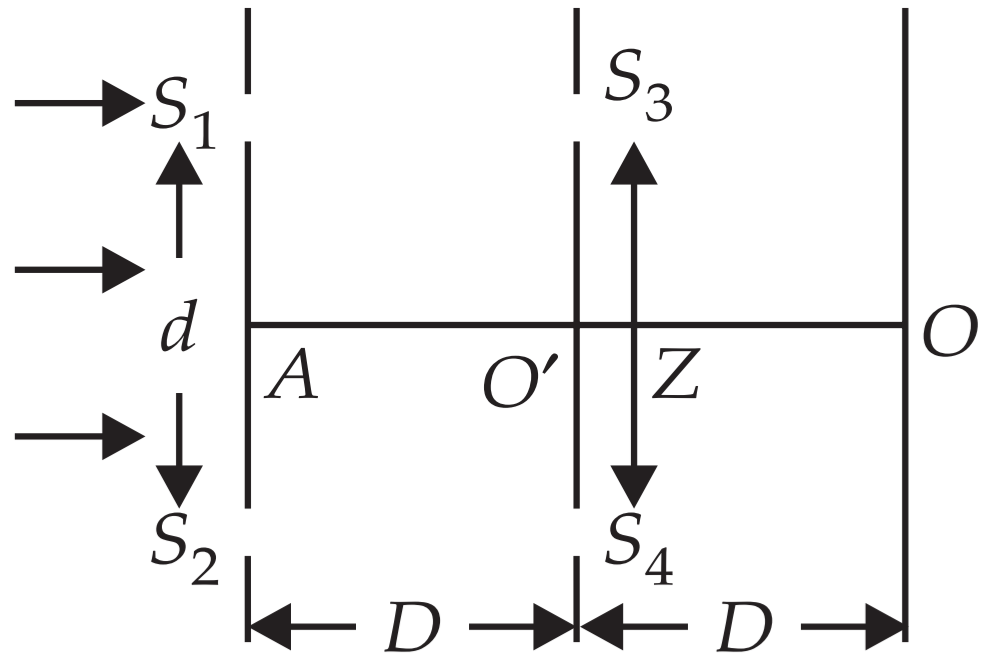
ln the arrangement shown in figure, slit $S_3$ and $S_4 $ are having a variable separation $Z$. Point $O$ on the screen is at the common perpendicular bisector of $S_1,S_2$ and $S_3,S_4.$
  1. The maximum number of possible interference maxima for slit separation equal to twice the wavelength in Young's double $-$ slit experiment, is:
  1. Does not move at all.
  2. Gets displaced from its earlier position.
  3. Becomes coloured.
  4. Disappears.
  5. ln a two slit experiment with white light, a white fringe is observed on a screen kept behind the slits. When the screen is moved away by $0.05m,$ this white fringe.
  6. Remain unaltered.
  7. Become wider.
  8. Become narrower.
  9. Disappear.
  10. When the complete Young's double slit experiment is immersed in water, the fringes.
  11. Unchanged
  12. Halved
  13. Doubled
  14. Quadrupled
  15. ln Young's double slit experiment, if the separation between the slits is halved and the distance between the slits and the screen is doubled, then the fringe width compared to the unchanged one will be.
  16. Wider
  17. Brighter
  18. Narrower
  19. Darker
  20. ln Young's double $- $ slit experiment if yellow light is replaced by blue light, the interference fringes become.
  21. Infinite
  22. Five
  23. Three
  24. Zero
What are different kinds of modulation ? Explain.
If an automobile engine is overheated, it is cooled by putting water on it. It is advised that the water should be put slowly with engine running. Explain the reason.
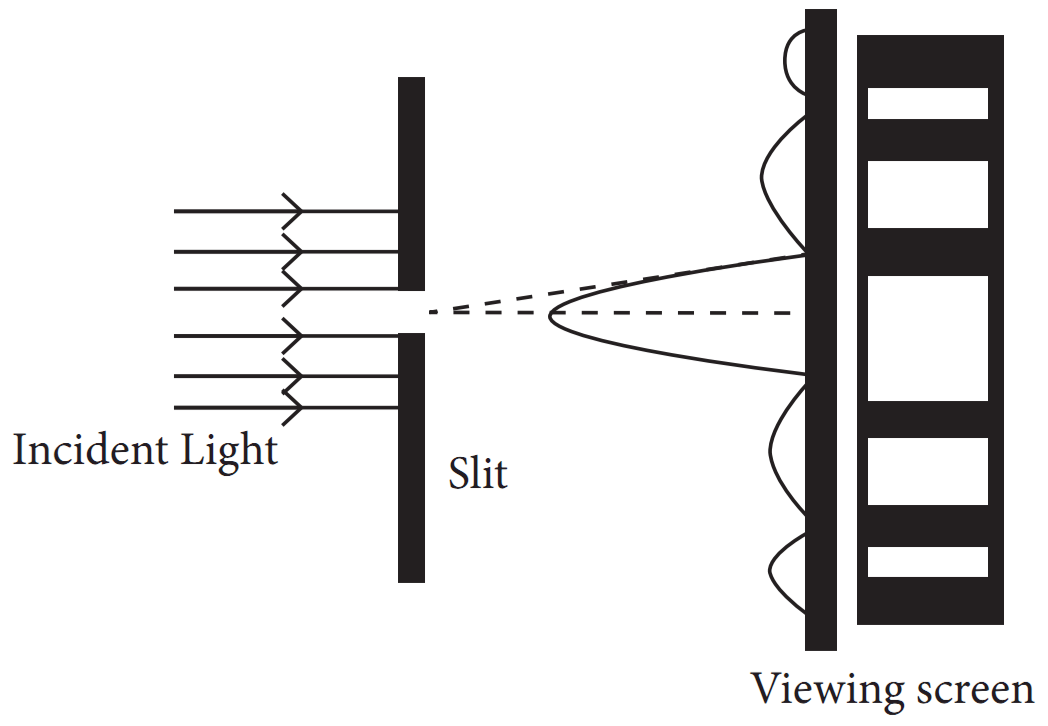
When light from a monochromatic source is incident on a single narrow slit, it gets diffracted and a pattern of ahem ate bright and dark fringes is obtained on screen, called "Diffraction Pattern" of single slit. ln diffraction pattern of single slit, it is found that.
  1. Central bright fringe is of maximum intensity and the intensity of any secondary bright fringe decreases with increase in its order.
  2. Central bright fringe is twice as wide as any other secondary bright or dark fringe.
  1. A single slit of width $0.1\ mm$ is illuminated by a parallel beam oftight of wavelength $6000\mathring{\text{A}}$ and diffraction bands are observed on a screen $0.5\ m$ from the slit. The distance of the third dark band from the central bright band is:
  1. Should be $\frac{\lambda}{2}$, where $\lambda$, is the wavelength.
  2. Should be of the order of wavelength.
  3. Has no relation to wavelength.
  4. Should be much larger than the wavelength.
  5. To observe diffraction, the size of the obstacle.
  6. Bands disappear
  7. Bands become broader and farther apart
  8. No change will take place
  9. Diffraction bands become narrower and crowded together.
  10. A diffraction pattem is obtained by using a beam of red light. What will happen, if the red light is replaced by the blue light?
  11. $6 \times 10^{-3}$ rad
  12. $4 \times 10^{-3}$ rad
  13. $2.4 \times 10^{-3}$ rad
  14. $4.5 \times 10^{-3}$ rad
  15. Light of wavelength $600\ nm$ is incident normally on a slit of width $0.2mm$. The angular width of central maxima in the diffraction pattern is $($measured from minimum to minimum$).$
  16. $10^{-1}m$
  17. $10^{-2}m$
  18. $2 \times 10^{-2}m$
  19. $2 \times 10^{-1}m$
  20. ln Fraunhofer diffraction pattern, slit width is $0.2\ mm$ and screen is at $2\ m$ away from the lens. If wavelength of tight used is $5000\mathring{\text{A}}$ then the distance between the first minimum on either side the central maximum is:
  21. $3\ mm$
  22. $1.5\ mm$
  23. $9\ mm$
  24. $4.5\ mm$
What can be said about the centre of mass of a uniform hemisphere without making any calculation? Will its distance from the centre be more than $\frac{\text{r}}{2}$ or less than $\frac{\text{r}}{2}?$
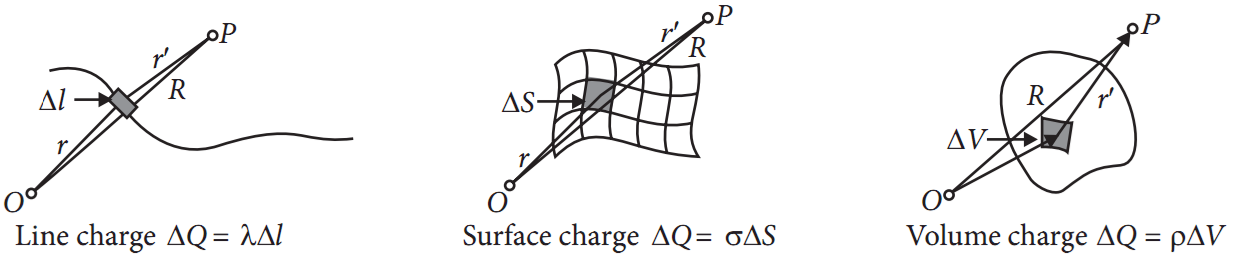
ln practice, we deal with charges much greater in magnitude than the charge on an electron, so we can ignore the quantum nature of charges and imagine that the charge is spread in a region in a continuous manner. Such a charge distribution is known as continuous charge distribution. There are three types of continuous charge distribution : $(i)$ Line charge distribution $(ii)$ Surface charge distribution $(iii)$ Volume charge distribution as shown in figure.
  1. Statement $1$ : Gauss's law can't be used to calculate an electric field near an electric dipole.
Statement $2$ : Electric dipole don't have symmetrical charge distribution.
  1. Statement $1$ and statement $2$ are true.
  2. Statement $1$ is false but statement $2$ is true.
  3. Statement $1$ is true but statement $2$ is false.
  4. Both statements are false.
  1. An electric charge of $8.85 \times 10^{-13}C$ is placed at the centre of a sphere of radius $1m$. The electric flux through the sphere is:
  1. $0.2NC^{-1} m^2$
  2. $0.1NC^{-1} m^2$
  3. $0.3NC^{-1} m^2$
  4. $0.01NC^{-1} m^2$
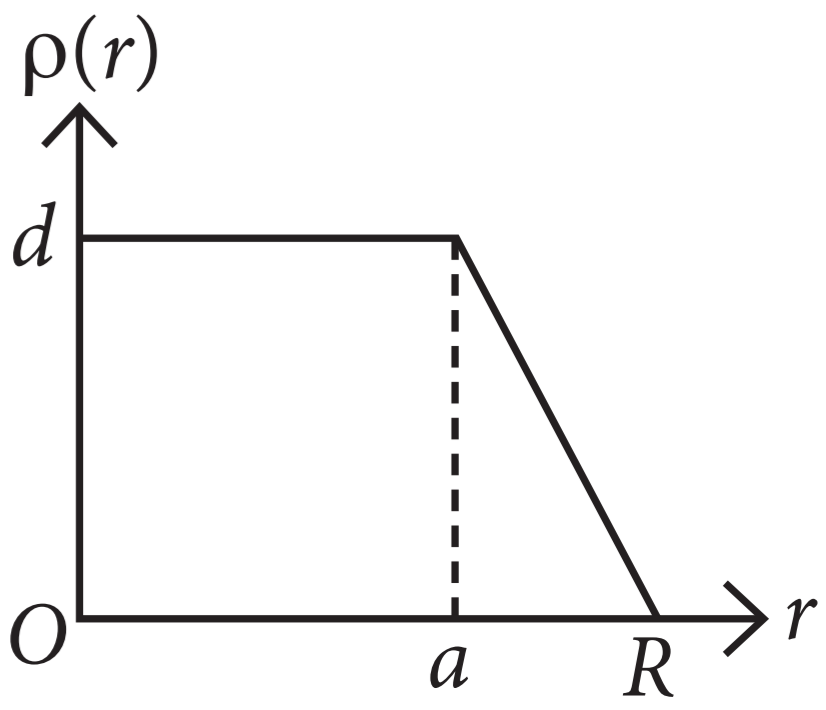
  1. The electric field within the nucleus is generally observed to be linearly dependent on $r$. So,
  1. $a = 0$
  2. $\text{a}=\frac{\text{R}}{2}$
  3. $a = R$
  4. $\text{a}=\frac{\text{2R}}{3}$
  1. What charge would be required to electrify a sphere of radius $25\ cm$ so as to get a surface charge density of $\frac{3}{\pi}\text{Cm}^{-2}?$
  1. $0.75C$
  2. $7.5C$
  3. $75C$
  4. Zero
  1. The $\text{SI}$ unit of linear charge density is :
  1. $Cm$
  2. $Cm^{-1}$
  3. $Cm^{-2}$
  4. $Cm^{-3}$
Currents can be induced not only in conducting coils, but also in conducting sheets or blocks. Current is induced in solid metallic masses when the magnetic flux threading through them changes. Such currents flow in the from of irregularly shaped loops throughout the body of the metal. These currents look like eddies or whirlpools in water so they are known as eddy currents. Eddy currents have both undesirable effects and practically useful applications. For example it causes unnecessary heating and wastage of power in electric motors, dynamos and in the cores of transformers.
  1. The working of speedometers of trains is based on:
  1. Wattless currents.
  2. Eddy currents.
  3. alternating currents.
  4. pulsating currents.
  1. Identify the wrong statement.
  1. Eddy currents are produced in a steady magnetic field.
  2. Induction furnace uses eddy currents to produce heat.
  3. Eddy currents can be used to produce braking force in moving trains.
  4. Power meters work on the principle of eddy currents.
  1. Which of the following is the best method to reduce eddy currents?
  1. Laminating core.
  2. Using thick wires.
  3. By reducing hysteresis loss.
  4. None of these.
  1. The direction of eddy currents is given by:
  1. Fleming's left hand rule.
  2. Biot-Savart law.
  3. Lenz's law
  4. Ampere-circuital law.
  1. Eddy currents can be used to heat localised tissues of the human body. This branch of medical therapy is called:
  1. Hyperthermia.
  2. Diathermy.
  3. Inductothermy.
  4. None of these.
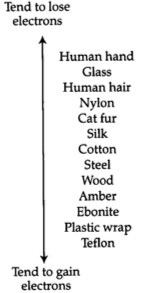
The triboelectric series is a list that ranks materials according to their tendency to gain or lose electrons. The process of electron transfer as a result of two objects coming into contact with one another and then separating is called triboelectric charging. During such an interaction, one of the two objects will always gain electrons (becoming negatively charged) and the other object will lose electrons (becoming positively charged). The relative position of the two objects on the triboelectric series will define which object gains electrons and which object loses electrons.
In triboelectric series, materials are ranked from high to low in terms of the tendency for the material to lose electron. If an object high up on this list (Glass, for example) is rubbed with an object low down on the list (Teflon, for example), the glass will lose electrons to the teflon. The glass will, in this case, become positively charged and the teflon will become negatively charged. Materials in the middle of the list (steel and wood, for example) are items those do not have a strong tendency to give up or accept electrons.
Image
(i) Materials in the upper position have ________ tendency to become positively charged
(a) no (b) medium (c) high (d) low
(ii) Name two materials which do not have a strong tendency to give up or accept electrons.
(a) Steel, wood (b) Plastic wrap, Teflon (c) Ebonite, Nylon (d) Nylon, cat fur
(iii) if human hair is rubbed with amber, how those will be charged?
(a) Hair will be negatively charged, Amber will be positively charged.
(b) Both positive
(c) Hair will be positively charged, Amber will be negatively charged.
(d) Both negative
(iv) Triboelectric charging is the process of electron transfer between two objects
(a) By contact (b) Without contact (c) By anyone of these (d) By none of these

OR

The object which loses electron becomes ________ charged and the object gains electron becomes ________ charged.
(a) positively, positively
(b) negatively, positively
(c) negatively, negatively
(d) positively, negatively