Question
Draw the graph of the following linear equations in two variables:
x + y = 4

Answer

We have,
x + y = 4
⇒ x = 4 - y ...(i)
Putting y = 0, we get x = 4 - 0 = 4
Putting y = 3, we get x = 4 - 3 = 1
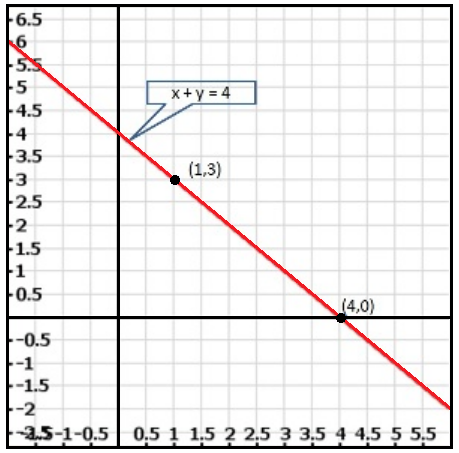
Thus, we have the following table giving two points on the line represented by the equation x + y = 4:
Graph of the equation x + y = 4:

Need a full question paper?

Generate a complete, print-ready paper with questions like this in minutes — across 16+ boards, with answer keys.
Start Generating Free

Similar questions

The perimeter of a triangular field is 420m and its sides are in the ratio 6 : 7 : 8. Find the area of the triangular field.
 In the following, using the remainder theorem, find the remainder when f(x) is divided by g(x) and verify the by actual division:
$\text{f(x)}=3\text{x}^4+2\text{x}^3-\frac{\text{x}^3}{3}-\frac{\text{x}}{9}+\frac{2}{27},$ $\text{g(x)}=\text{x}+\frac{2}{3}$
In a $\triangle\text{ABC},$ P and Q are respectively the mid points of AB and BC and R is the midpoint of AP. Prove that:
  1. $\text{ar}(\triangle\text{PBQ})=\text{ar}(\triangle\text{ARC}).$
  2. $\text{ar}(\triangle\text{PRQ})=\frac{1}{2}\text{ar}(\triangle\text{ARC}).$
  3. $\text{ar}(\triangle\text{EQC})=\frac{3}{8}\text{ar}(\triangle\text{ABC}).$
O is the circumference of the triangle ABC and OD is perpendicular on BC. Prove that $\angle\text{BOD}=\angle\text{A}.$
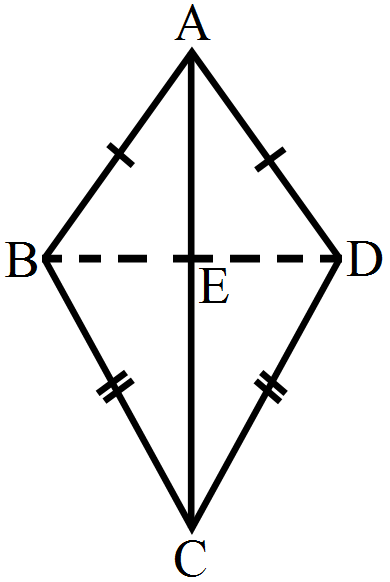
In the given figure, ABCD is a quadrilateral in which AB = AD and BC = DC. Prove that
  1. AC bisects $\angle\text{A}$ and $\angle\text{C},$
  2. BE = DE,
  3. $\angle\text{ABC}=\angle\text{ADC}.$
Find the value of p for the following distribution whose mean is 16.6
x:
8
12
15
p
20
25
30
f:
12
16
20
24
16
8
4
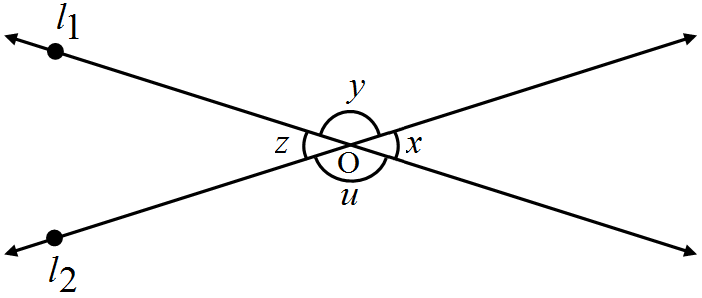
In figure, Line $l_1$ and $l_2$ intersect at $O,$ forming angles as shown in the figure. $If x = 45,$ find the value of $y, z$ and $u$.
Why do we group data?
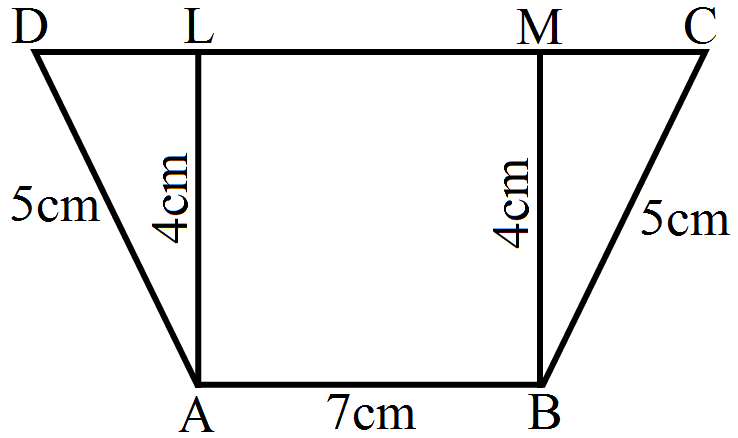
In the adjoining figure, ABCD is a trapezium in which AB || DC; AB = 7cm; AD = BC = 5cm and the distance between AB and DC is 4cm. Find the length of DC and hence, find the area of trap. ABCD.
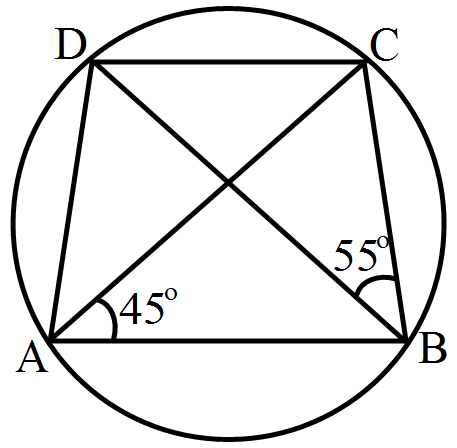
In the given figure, ABCD is a cyclic quadrilateral in which AC and BD are its diagonals. If $\angle\text{DBC}=55^\circ$ and $\angle\text{BAC}=45^\circ,$ find $\angle\text{BCD}.$