Question
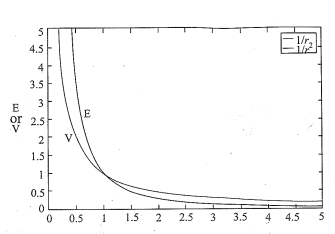
Draw the graph of variation in potential difference and electric field with distance ' $r$ ' for a point electric charge $Q$.
Answer

Image

Electric potential of a point charge,
$V =\frac{k Q }{r} \text { and }$

electric field $E =\frac{k Q }{r^2}$
$\therefore V \propto \frac{1}{r}$ and
$\text { E } \alpha \frac{1}{r^2}$

In the figure(graph), how electric potential and electric field changes with distance $r$ is shown.

Need a full question paper?

Generate a complete, print-ready paper with questions like this in minutes — across 16+ boards, with answer keys.

Start Generating Free

Similar questions

What is the radius of the path of an electron $($mass $9 \times 10^{-31} \ kg$ and charge $1.6 \times 10^{-19} C )$ moving at a speed of $3 \times 10^7 m / s$ in a magnetic field of $6 \times 10^{-4} T$ perpendicular to it? What is its frequency? Calculate its energy in $keV .\left(1 eV =1.6 \times 10^{-19} J \right)$.
A photographic plate records sufficiently intense lines when it is exposed for 12s to a source of 10W. How long should it be exposed to a 12W source radiating the light of same colour to get equally intense lines?
Light is incident from glass $(\mu=1.5)$ to air. Sketch the variation of the angle of deviation $\delta$ with the angle of incident i for 0 < i < 90°.
Write the law of conservation of electric charge
Answer the following question:
Every metal has a definite work function. Why do all photoelectrons not come out with the same energy if incident radiation is monochromatic? Why is there an energy distribution of photoelectrons?
Two identical metal spheres of exactly equal mass have been taken. One is charged with negative charge say q and the other with the same amount of positive charge. Will there be any difference in the mass of the two spheres? If yes then why?
Write a short note on Infrared waves.
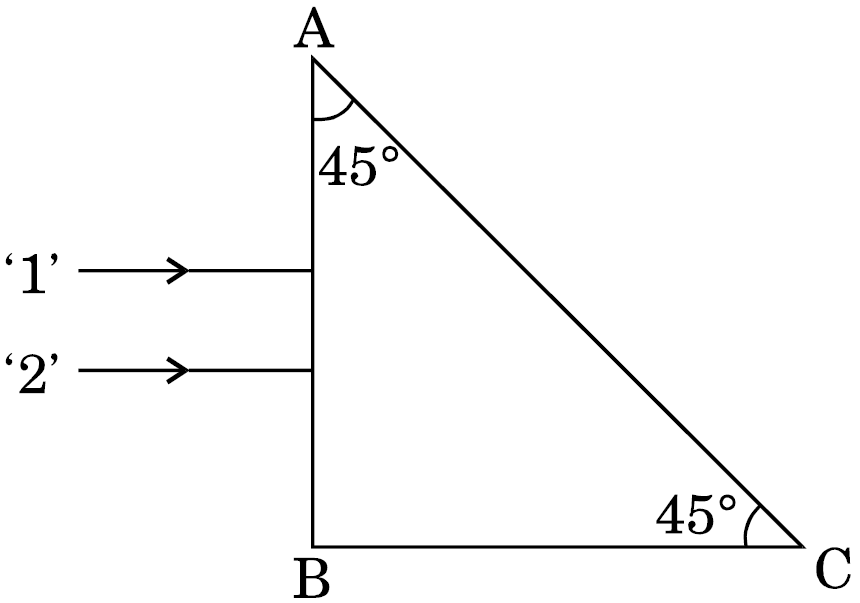
Two monochromatic rays of light are incident normally on the face AB of an isosceles right-angled prism ABC. The refractive indices of the glass prism for the two rays ‘1’ and ‘2’ are respectively 1.38 and 1.52. Trace the path of these rays after entering through the prism.
Light from Balmer series of hydrogen is able to eject photoelectrons from a metal. What can be the maximum work function of the metal?
The three stable isotopes of neon: $^{20}_{10}\text{Ne},\ ^{21}_{10}\text{Ne }\text{ and }\ ^{22}_{10}\text{Ne}$ have respective abundances of 90.51%, 0.27% and 9.22%. The atomic masses of the three isotopes are 19.99 u, 20.99 u and 21.99 u, respectively. Obtain the average atomic mass of neon.