Question 12 Marks
Drive the equation of Energy stored in capacitor $\left( U =\frac{ Q ^2}{2 C }\right)$
Answer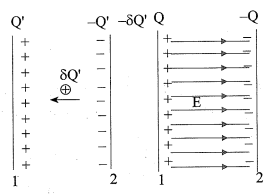
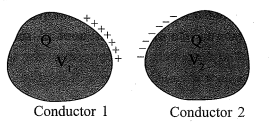
→To find the energy stored in capacitor, suppose the charge on the conductor is zero, initially. →Suppose the positive charge is taken from conductor-2 to conductor 1 , bit by bit. At the end of the process, suppose the conductor 1 gets charge Q and conductor 2 has charge - Q .
→To transfer the positive charge from conductor 2 to conductor 1 , work needs to be done and the energy equivalent to this work is stored in the capacitor, which is known as the energy stored in the capacitor.
→Consider the intermediate situation when the conductors 1 and 2 have charges $Q^{\prime}$ and $-Q^{\prime}$ respectively. At this stage, the p.d. $V ^{\prime}$ between the conductors 1 and 2 is $\frac{Q^{\prime}}{C}$ where C is the capacitance of the system.
→Now, work done to transfer a small charge $\delta Q^{\prime}$ from conductor 2 to conductor 1 ,
$\delta W = V ^{\prime} \delta Q ^{\prime}=\frac{ Q ^{\prime}}{ C } \delta Q ^{\prime}$
→Total work required to be done in building (/ establishing) + Q charge on conductor 1 ,
$\begin{aligned}
W & =\int_0^{ Q } \frac{ Q ^{\prime}}{ C } \delta Q ^{\prime} \\
\therefore W & =\frac{1}{ C }\left(\frac{ Q ^{\prime 2}}{2}\right)_0^{ Q }\left[\because \int x^n d x=\frac{x^{n+1}}{n+1}\right] \\
\therefore W & =\frac{1}{ C }\left(\frac{ Q ^2}{2}-0\right) \\
\therefore W & =\frac{ Q ^2}{2 C }
\end{aligned}$
→Because this work is stored in capacitor in the form of energy which is called energy stored in capacitor.
$\therefore U =\frac{ Q ^2}{2 C }$
→Using $Q = CV$ in above equation, we can easily get other alternate forms of above equation.
→$U =\frac{ Q ^2}{2 C }=\frac{1}{2} CV ^2=\frac{1}{2} VQ$
View full question & answer→→To find the energy stored in capacitor, suppose the charge on the conductor is zero, initially. →Suppose the positive charge is taken from conductor-2 to conductor 1 , bit by bit. At the end of the process, suppose the conductor 1 gets charge Q and conductor 2 has charge - Q .
→To transfer the positive charge from conductor 2 to conductor 1 , work needs to be done and the energy equivalent to this work is stored in the capacitor, which is known as the energy stored in the capacitor.
→Consider the intermediate situation when the conductors 1 and 2 have charges $Q^{\prime}$ and $-Q^{\prime}$ respectively. At this stage, the p.d. $V ^{\prime}$ between the conductors 1 and 2 is $\frac{Q^{\prime}}{C}$ where C is the capacitance of the system.
→Now, work done to transfer a small charge $\delta Q^{\prime}$ from conductor 2 to conductor 1 ,
$\delta W = V ^{\prime} \delta Q ^{\prime}=\frac{ Q ^{\prime}}{ C } \delta Q ^{\prime}$
→Total work required to be done in building (/ establishing) + Q charge on conductor 1 ,
$\begin{aligned}
W & =\int_0^{ Q } \frac{ Q ^{\prime}}{ C } \delta Q ^{\prime} \\
\therefore W & =\frac{1}{ C }\left(\frac{ Q ^{\prime 2}}{2}\right)_0^{ Q }\left[\because \int x^n d x=\frac{x^{n+1}}{n+1}\right] \\
\therefore W & =\frac{1}{ C }\left(\frac{ Q ^2}{2}-0\right) \\
\therefore W & =\frac{ Q ^2}{2 C }
\end{aligned}$
→Because this work is stored in capacitor in the form of energy which is called energy stored in capacitor.
$\therefore U =\frac{ Q ^2}{2 C }$
→Using $Q = CV$ in above equation, we can easily get other alternate forms of above equation.
→$U =\frac{ Q ^2}{2 C }=\frac{1}{2} CV ^2=\frac{1}{2} VQ$