Question
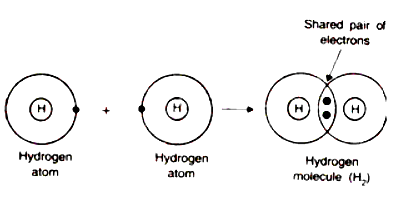
Draw the orbit structure of the following:
$H_2$

Answer

Orbit structure of $H_2$:

Need a full question paper?

Generate a complete, print-ready paper with questions like this in minutes — across 16+ boards, with answer keys.
Start Generating Free

Similar questions

Separate the following compounds into three categories - ionic, polar and covalent compounds; $N_2, NH_4Cl, NH_3, NO, NH_4NO_3, NCl_3.$
Write a balanced equation for the following:
(i) C2H5Br + alcoholic KOH → ? (ii) CH3CH2COONa + soda lime? (iii) C2H4 + Br2 → ?
Explain the following briefly.
Pure water does not conduct electricity, but on adding sodium chloride to it, it starts conducting electricity.
What is the purpose of Habers process? Name the gaseous inputs in the Habers process and state the ratio by volume in which the gases are mixed. What is done to increase the rate of the reaction in Habers process? Give two different ways by which the product can be separated from the reactants.
Give the chemical names and formulae of the main ores of (i) aluminium, (ii) iron and (iii) zinc.
What is meant by the term "electrovalency"? State why sodium (at. no. 11] has electrovalency +1 and chlorine (at. no. 17) has electrovalency of -1.
Explain the following :
(a) Why are the wooden shelves on which concentrated sulphuric acid bottles kept, stained black?
(b) Why is concentrated sulphuric acid always added to water and not water to concentrated sulphuric acid? Why does the mixture get hot?
Write the observation, and balanced equation for the following reaction:
Moist starch iodide paper is placed at the mouth of a test tube containing chlorine gas.
A metal whose alloy finds use in the construction of aircrafts in the powdered form is added to sodium hydroxide solution. A colourless gas was evolved and after reaction was over, the solution was colourless.
(a) Name the powdered metal added to sodium hydroxide solution.
(b) Name the gas evolved.
(c) Name the salt present in the colorless solution.
Barium chloride crystals contain $14.8\%$ water of crystallization. Find the number of molecules of water of crystallization per molecule.