Questions

[3 Mark Question Answer]

🎯

Test yourself on this topic

27 questions · timed · auto-graded

Question 13 Marks
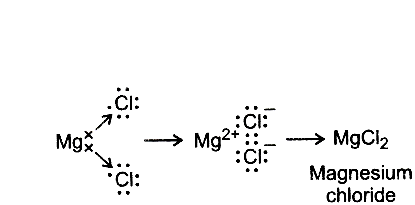
Draw an electron dot diagram to show the formation of the following compound.
Magnesium chloride [ H=1, C=6, Mg=12, Cl=17].
Answer
Electron dot structure of magnesium chloride:
View full question & answer
Question 23 Marks
Draw an electron dot diagram to show the formation of the following compound.
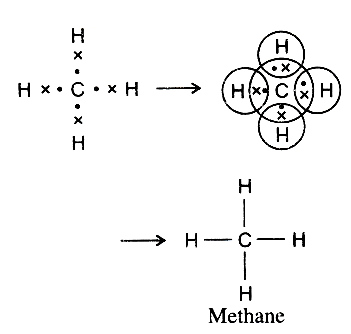
Methane
Answer
Formation of Methane :
View full question & answer
Question 43 Marks
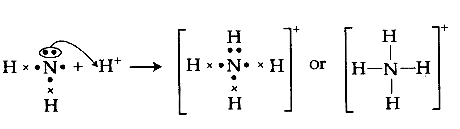
By drawing an electron dot diagram, show the lone pair effect leading to the formation of ammonium ion from ammonia gas and hydrogen ion.
Answer

$NH_3$ has one lone pair of electrons which is donates to hydrogen atom forming a co-ordinate bond. The arrow represents a co-ordinate bond. The arrow points from donor to acceptor atom.
View full question & answer
Question 53 Marks
Give reason as to why hydrogen chloride can be termed as a polar covalent compound.
Answer
HCl is a covalent compound formed by sharing one electron between chlorine and hydrogen. Because chlorine is more electronegative than hydrogen, the shared pair of electrons shifts towards the chlorine atom. So, a partial negative charge (δ-) develops on chlorine and a partial positive charge (δ+) develops on hydrogen. Hence, the covalent bond is polar in nature.
View full question & answer
Question 63 Marks
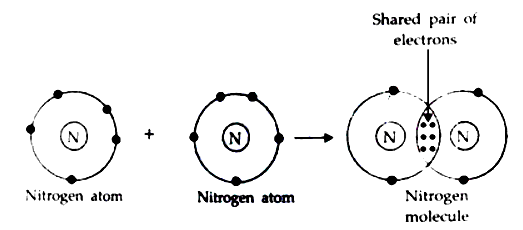
The electronic configuration of $N_2$ is $2, 5$. How many electrons in the outer shell of a $N$ atom are not involved in the formation of a nitrogen molecule?
Answer
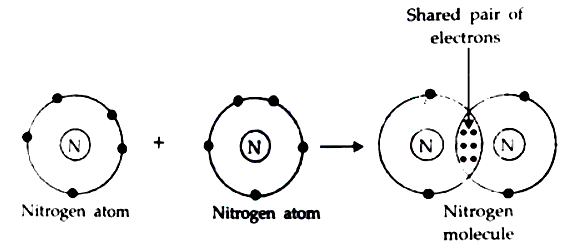
Two electrons of a nitrogen atom are not involved in the formation of a nitrogen molecule since $N_2$ contains triple bond formed by sharing of three electrons from each nitrogen atom.
View full question & answer
Question 83 Marks
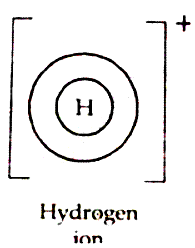
Acids dissolve in water to produce positively charged ions. Draw the structure of these positive ions.
Answer
Acids dissolve in water to form positively charged ions which are generally hydrogen ions (H+). Structure of Hydrogen ion : As hydrogen element has only one electron in its valence shell which is lost during formation of hydrogen ions so its structure is:
View full question & answer
Question 93 Marks
Element $X$ is a metal with a valency $2$. Element $Y$ is a non metal with a valency $3.$
(a) Write equations to show how $X$ and $Y$ form ions.
(b) If $Y$ is a diatomic gas, write the equation for the direct combination of $X$ and $Y$ to form a compound.
Answer
(a) For element X :
$X \rightarrow X^2 + 2e^-$​​​​​​​
For element Y :
$Y + 3e^- \rightarrow Y^{3-}​​​​​​​$​​​​​​​
(b) Since Y is a diatomic gas hence it combines with X as :
$3X + Y_2\rightarrow X_3Y_2​​​​​​​$​​​​​​​
View full question & answer
Question 103 Marks
Copy and complete the following table
  Sodium Phosphorous
Formula of chloride    
Physical state of chloride at room temperature(i.e., Solid,Liquid or gas)    
Nature of bonding in chloride    
Answer
  Sodium Phosphorous
Formula of chloride Nacl $PCI_{3,}PCI_5$
Physical state of chloride at room temperature(i.e., Solid,Liquid or gas) Solid $PCI_3$ - gas
$PCI_5$ - solid
Nature of bonding in chloride Ionic Ionic
View full question & answer
Question 113 Marks
What do you understand by lone pair and shared pair?
Answer
Lone pair: A pair of electrons which is not shared with any other atom is known as the lone pair of electrons.
For example in $NH_3$, Nitrogen has a lone pair of electrons which is not shared with any hydrogen atom.
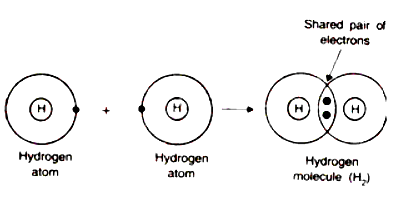
Shared pair: A pair of electrons which is shared with other atoms to form a bond is known as shared pair of electrons.
For example in HCl the pair of electrons responsible for bond formation between H and Cl is called shared pair.
View full question & answer
Question 123 Marks
Define a coordinate bond and give the conditions for its formation.
Answer
Coordinate bond: The bond formed between two atoms by a pair of electrons, provided entirely by one of the combining atoms, is called a coordinate bond or dative bond.
Conditions for the formation of coordinate bond:
One of the two atoms must have at least one lone pair of electrons.
Another atom should be short of at least a lone pair of electrons.
View full question & answer
Question 133 Marks
Elements X and Y have the following configurations:
$X (2, 8, 7), Y (2, 8, 8, 2)$
Answer the following questions:
(a) What will be the nature of bond between X and Y?
(b) Draw the diagram to show the bond formation between X and Y?
(c) Sate three main properties of this compound.
Answer
Electronic Configuration of X shows that X is a metal.
Electronic Configuration of Y shows that y is a non metal.
a) Since Y is a metal and thus electropositive :
$Y → Y^+ + 2e^-$
B) Since X is a non metal and thus electro-negative :
$X + 1e^-→ X^-$
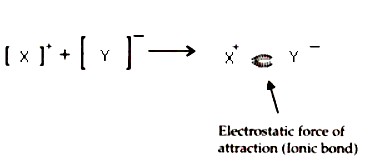
Hence two X atoms can combine with one Y atom to form $YX_2$ molecule and since the formation of $YX_2$ involves complete transfer of electrons between them so the bond between them is ionic.
(b)


(c) The three main properties of this compound are:
  • It is an ionic compound.
  • It is soluble in water but insoluble in organic solvents.
  • It is a good conductor of electricity in the molten state and in aqueous solution.
View full question & answer
Question 143 Marks
Separate the following compounds into three categories - ionic, polar and covalent compounds; $N_2, NH_4Cl, NH_3, NO, NH_4NO_3, NCl_3.$
Answer
Ionic compounds $= NO, NH_4Cl, NH_4NO_3$​​​​​​​
Covalent compounds $= N_2, NH_3, NO$
Polar compounds $= NCl_3​​​​​​​$​​​​​​​
Concept Insight : Electro negativity difference between the bonded atoms determines the ease of transfer of electrons between the atoms. On the basis of extent of transfer of electrons between the two atoms the bond will be ionic, covalent or polar.
View full question & answer
Question 153 Marks
Explain the following briefly:
Metals are electropositive.
Answer
Metals have low ionization energy due to which they can lose their outermost electrons easily to form positive metallic ions hence metals are electropositive.
For example:
Sodium metal always form $\mathrm{Na}^{+}$ions, Potassium forms $\mathrm{K}^{+}$ions etc.
View full question & answer
Question 163 Marks
Explain the following briefly:
$Cl_2$ is a non polar molecule, while $HCl$ is a polar molecule.
Answer
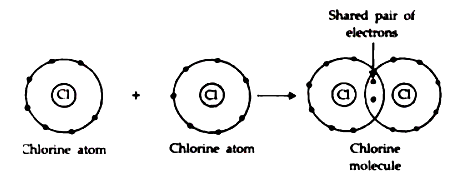
$Cl_2$ is a non polar molecule because the bond is between same atoms that is chlorine with zero electronegativity difference among them. So the shared electron pair is attracted equally by the two chlorine atoms hence there is no separation of charges in the bond formed so the chlorine molecule is non polar.
In case of HCl the bond is formed between two different atoms that is hydrogen and chlorine with enough electro negativity difference so that the shared electron pair is attracted towards more electronegative chlorine atom which acquires partial negative charge while the hydrogen atom acquires partial positive charge hence HCl is a polar molecule.
View full question & answer
Question 173 Marks
Explain the following briefly.
Pure water does not conduct electricity, but on adding sodium chloride to it, it starts conducting electricity.
Answer
Pure water does not conduct electricity because it has a polar covalent molecule hence does not have ions in it which can conduct electricity.
On adding sodium chloride to pure water, sodium chloride breaks apart into sodium and chloride ions because water being polar decreases the strong forces of attraction among sodium and chloride ions. Now, pure water has ions present in it which can conduct electricity.
View full question & answer
Question 183 Marks
Explain the following briefly:
Helium does not form $He_2$​​​​​​​ molecule
Answer
Helium does not form $He _2$ molecule as it has its outermost shell complete i.e. two electrons in its valence shell. Due to this complete valence shell helium atom is very stable hence does not participate in chemical bonding to form He2 molecule.
View full question & answer
Question 193 Marks
Explain the following briefly:
Sodium chloride dissolves in water but carbon tetra chloride is insoluble in water.
Answer
Sodium chloride dissolves in water because it is an ionic compound and water is also a polar covalent compound. Water decreases the electrostatic forces of attraction among the sodium and chloride ions due to which these ions become free in water, hence sodium chloride dissolves. On the other hand, carbon tetra chloride has non polar covalent bond and water has polar covalent bond. Hence, water is unable to break the non polar covalent bond of carbon tetra chloride. So it is insoluble in water.
View full question & answer
Question 263 Marks
Explain the following:
Polar covalent compounds are good conductors of electricity.
Answer
Polar covalent compounds are good conductors of electricity because when these are dissolved in water, they ionize and act as electrolyte to produce ions which are responsible for conduction of electricity.
For example polar covalent compound $HCl$ in water behaves as:
$HCl + H _2 O \rightarrow H _3 O ^{+}+ Cl ^{-}$
These hydronium and chloride ions produced on dissolution of $HCl$ in water are responsible for conduction of electricity.
View full question & answer
Question 273 Marks
What are the conditions for the formation of an electrovalent bond?
Answer
The conditions for the formation of an electrovalent bond are:
1) Low ionization energy of electropositive atom
2) High electron affinity of the electronegative atom.
3) Large electronegativity difference.
4) High lattice energy.
Concept Insight:
1) Lower is the ionization energy of atom, higher is its tendency to lose electron to form a cation and form ionic bond.
2) Higher the value of electron affinity of an atom, greater will be its tendency to form anion and form ionic bond.
3) If the electronegativity difference of two elements is higher, more easy will be the transfer of electrons and hence more chances of ionic bond formation.
4) Lattice energy is the energy released when positive and negatively charged atoms called ions come closer to form a crystal because the attractive forces among the oppositely charged ions tend to decrease the energy of the system. Higher is the lattice energy, greater will be the ease of formation of the compound.
View full question & answer
[3 Mark Question Answer] - Chemistry STD 10 Questions - Vidyadip