Question
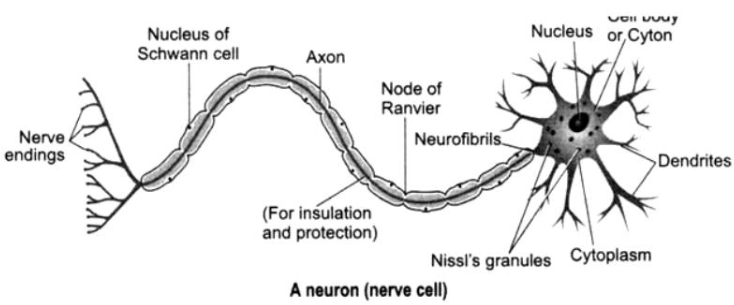
Draw the structure of a neuron and describe its function.
Answer

Neuron or nerve cell is a structural and functional unit of the nervous system that is specialised to receive, conduct and transmit nerve impulses. A neuron (nerve cell) has three components:
i. Cell body (cyton)
ii. Dendrites
iii. Axon
Image
Functions: The information acquired at the end of the dendritic tip of a neuron sets off a chemical reaction which creates an electrical impulse. This impulse travels from die dendrite to the cyton along the axon of its end. At the end of axon, the electrical impulse sets off the release of some chemicals, which cross the synapse and start a similar electrical impulse in a dendrite of the next neuron. In this way nerve impulses travel in the body, from one neuron to another till it reaches the brain or the target organ. Thus, a nervous tissue is made up of an organised network of nerve cells or neurons which are specialised in conducting information via electrical impulse from one part of the body to another.

Need a full question paper?

Generate a complete, print-ready paper with questions like this in minutes — across 16+ boards, with answer keys.

Start Generating Free

Similar questions

Analyse the following observation table showing variation of image distance (v) with object distance (u) in case of a convex lens and answer the questions that follow, without doing any calculations:
S. No.
Object distance u (cm)
Image distance v (cm)
1
-90
+18
2
-60
+20
3
-30
+30
4
-20
+60
5
-18
+90
6
-10
+100
  1. What is the focal length of the convex lens? Give reason in support of your answer.
  2. Write the serial number of that observation which is not correct. How did you arrive at this conclusion?
  3. Take an appropriate scale to draw ray diagram for the observation at S. No. 4 and find the approximate value of magnification.
  1. Name the following:
  1. Metal that can be cut by knife.
  2. Lustrous non-metal.
  3. Metal that exists in liquid state at room temperature.
  4. Most malleable and ductile metal.
  5. Metal that is best conductor of electricity.
  6. Non-metal that can exist in different forms.
  1. How are alloys better than metals? Give composition of solder and amalgam.
Explain "industrialization is one of the main causes of deterioration of the environment."
Describe the parts of our tooth with the help of a labelled diagram.
An organic compound having the molecular formula $C _3 H _6 O$ can exist in the form of two isomers $A$ and $B$ having different functional groups. The isomer $A$ is a liquid which is used as a solvent for nail polish. The isomer $B$ is also a liquid. An aqueous solution of one of the lower homologues of $B$ is used for preserving biological specimens in the laboratory.
  1. What is compound A?
  2. Write the electron-dot structure of A.
  3. What is compound B?
  4. Write the electron-dot structure of B.
  5. Name the lower homologue of compound B which is used in preserving biological specimens.
A food chain occurring in the sea which provides food for many people can be written as:
phytoplankton → zooplankton → X → Y
  1. Name one phytoplankton.
  2. Name two zooplanktons.
  3. What could be X?
  4. Name the organism which Y could be.
  5. Which organism in the above food chain is a (i) primary consumer, and (ii) tertiary consumer?
Excretion is different in multi-cellular organisms as compared to unicellular organisms. How?
Three incandescent bulbs of 100W each are connected in series in an electric circuit. In another circuit another set of three bulbs of the same wattage are connected in parallel to the same source.
  1. Will the bulb in the two circuits glow with the same brightness? Justify your answer.
  2. Now let one bulb in both the circuits get fused. Will the rest of the bulbs continue to glow in each circuit? Give reason.
 A red-brown metal X forms a salt $XSO _4$. When hydrogen sulphide gas is passed through an aqueous solution of $XSO _4$, then a black precipitate of XS is formed alongwith sulphuric acid solution.
a. What could the salt $XSO _4$ be?
b. What is the colour of salt $XSO _4$ ?
c. Name the black precipitate XS.
d. By using the formula of the salt obtained in (a) above, write an equation of the reaction which takes place when hydrogen sulphide gas is passed through its aqueous solution.
e. What type of chemical reaction takes place in this case?
A compound C (molecular formula, $C _2 H _4 O _2$ ) reacts with Na -metal to form a compound $R$ and evolves a gas which burns with a pop sound. Compound C on treatment with an alcohol A in presence of an acid forms a sweet smelling compound S (molecular formula, $C _3 H _6 O _2$ ). On addition of NaOH to C , it also gives R and water. S on treatment with NaOH solution gives back R and A .Identify $C , R , A , S$ and write down the reactions involved.