Question
A compound C (molecular formula, $C _2 H _4 O _2$ ) reacts with Na -metal to form a compound $R$ and evolves a gas which burns with a pop sound. Compound C on treatment with an alcohol A in presence of an acid forms a sweet smelling compound S (molecular formula, $C _3 H _6 O _2$ ). On addition of NaOH to C , it also gives R and water. S on treatment with NaOH solution gives back R and A .Identify $C , R , A , S$ and write down the reactions involved.
Answer

Compound C with molecular formula $C _2 H _4 O _2$ contains two oxygen atoms so it can be either ester or carboxylic acid. Since it reacts with sodium metal to form compound R and evolves a gas which burns with pop sound, therefore it should be a carboxylic acid which forms sodium alkanoate and hydrogen gas with sodium metal.
$2 CH_3 COOH+2 Na \longrightarrow 2 CH_3 COONa+H_2 \uparrow$
The gas which burns with pop sound is hydrogen gas.
Reaction of ethanoic acid with alcohol in the presence of an acid (Conc. $H _2 SO _4$ ) forms sweet smelling ester. So compound S that is formed due to reaction of ethanoic acid and methanol $(A)$ is methyl ethanoate with molecular formula $C _3 H _6 O _2$ and structural formula $CH _3 COOCH _3$.
$CH_3 COOH+CH_3 OH \xrightarrow{\text { Conc. } H_2 So_4} CH_3 COOCH_3+H_2 O$
Hence compound $C =$ Ethanoic acid $\left( CH _3 COOH \right), R =$ Sodium ethanoate $\left( CH _3 COONa \right), A =$ Methanol $\left( CH _3 OH \right)$ and $S =$ Methyl merhanoate $\left( CH _3 COOCH _3\right)$

Need a full question paper?

Generate a complete, print-ready paper with questions like this in minutes — across 16+ boards, with answer keys.

Start Generating Free

Similar questions

What is biomass? Explain the principle and working of a biogas plant using a labelled schematic diagram.
The gland A is attached to the wind pipe in the human body. The gland A makes and secretes a hormone B which controls the metabolism of carbohydrates, fats and proteins in the body. The non-metal element C is necessary for the formation of hormone B. The deficiency of C in the diet can cause a deficiency of hormone B in the body leading to a disease D in which the neck of a person appears to be swollen. People are advised to use salt E in cooking food so as to avoid disease D.
  1. Name (i) gland A, and (ii) hormone B.
  2. What is the element C?
  3. Name one type of food which can provide sufficient C in the diet of a person.
  4. Name (i) disease D, and (ii) salt E.
An object 3cm high is placed at a distance of 8cm from a concave mirror which produces a virtual image 4.5cm high:
  1. What is the focal length of the mirror?
  2. What is the position of image?
  3. Draw a ray-diagram to show the formation of image.
i. Explain by giving one example each:
a. Unisexual flowers
b. Bisexual flowers
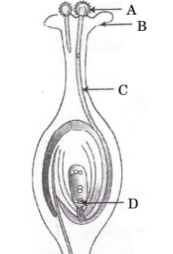
ii. Name the labelled parts A, B, C and D in the diagram given below.
Image
iii. Pollination may occur without fertilisation but fertilisation will not take place without pollination. Give reason to justify this statement.
A part of the early classification of elements has been given below:$\text{H}\ \ \ \ \ \ \ \text{Li} \ \ \ \ \ \ \ \text{Be} \ \ \ \ \ \ \ \ \ \text{B}\ \ \ \ \ \ \ \text{C}\ \ \ \ \ \ \ \text{N}\ \ \ \ \ \ \ \text{O}\\\text{F}\ \ \ \ \ \ \ \text{Na}\ \ \ \ \ \ \text{Mg}\ \ \ \ \ \ \ \text{Al}\ \ \ \ \ \ \text{Si}\ \ \ \ \ \ \ \text{P}\ \ \ \ \ \ \ \ \text{S}$
  1. Which law of classification of element is illustrated by the above arrangement of elements?
  2. Name the scientist who proposed such a classification of elements.
  3. Why is such a classification of elements compared with a characteristics of musical scale?
  4. State one limitation of this classification of elements.
Explain with a schematic representation the exchange of gases in tissues.
What is biomass? Explain the principle and working of a biogas plant using a labelled schematic diagram.
  1. Define focal length of a divergent lens.
  2. A divergent lens of focal length 30 cm forms the image of an object of size 6 cm on the same side as the object at a distance of 15 cm from its optical centre. Use lens formula to determine the distance of the object from the lens and the size of the image formed.
  3. Draw a ray diagram to show the formation of image in the above situation.
Describe the mechanism of urine formation in human excretory system. Draw a labelled diagram to illustrate your answer.
How would you bring about the following conversions? Name the process and write the reaction involved.
  1. Ethanol to ethene.
  2. Propanol to propanoic acid. Write the reactions.