Question
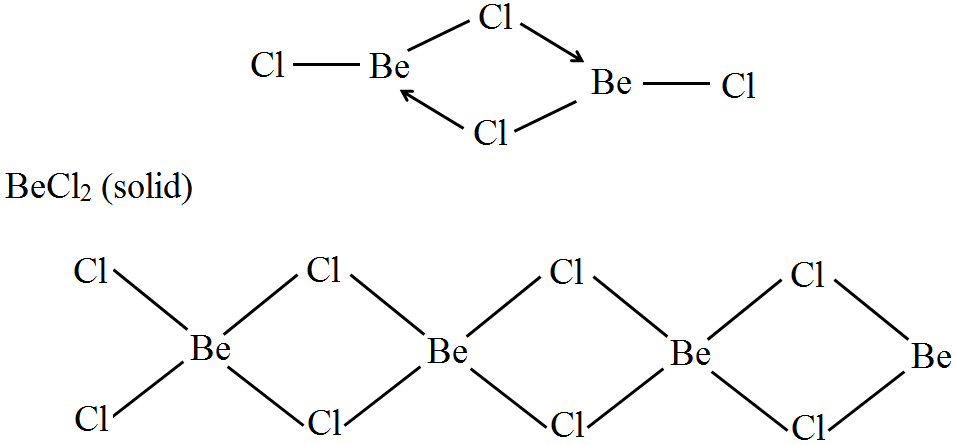
Draw the structure of
(i) $\mathrm{BeCl}_2$​​​​​​​ (vapour)
(ii) $\mathrm{BeCl}_2$ (solid).
Answer

$\mathrm{BeCl}_2$ (vapour)
In the vapour state, it exists as a chlorobridged dimer.

Need a full question paper?

Generate a complete, print-ready paper with questions like this in minutes — across 16+ boards, with answer keys.

Start Generating Free

Similar questions

State the law of thermodynamics that was first formulated by Nernst in 1906. What is the utility of this law? The equilibrium constant for the reaction $A \rightleftharpoons B$ is $1.8 \times 10^{-7}$ at 298 K . Calculate the value of $\Delta G ^{\circ}$ for the reaction $\left( R =8.314 JK ^{-1} mol^{-1}\right)$. Predict the feasibility of the reaction under standard states.
The pH of a sample of vinegar is 3.76. Calculate the concentration of hydrogen ion in it.
With help of following values calculate energy of $> C = C <$ bond :
$
\begin{array}{l}
2 C(s)+2 H_2(g)=C_2 H_4(g) ; \Delta H=52.6 kJ \\
C(s) \rightarrow C(g) ; \Delta H=716.68 kJ \\
H_2(g)=2 H(g) ; \Delta H=435.84 kJ \\
\text { and } C-H \text { bond energy }=+413 kJ
\end{array}
$
Explain:
  1. Boron is unable to form $\text{BF}^{3-}_6$ ion.
  2. $[\text{SiF}_6]^{2-}$ is known whereas $[\text{SiCl}_6]^{2-}$ is not known.
  3. Conc. $\mathrm{HNO}_3$ can be stored in aluminium container.
Write chemical reactions of:
  1. Wurtz-Fittig reaction.
  2. Kolbe's electrolytic method.
  3. B-Elimination reaction.
Which of the following substances exhibit H-bonding? Draw the H-bonds between two molecules of the substance where appropriate.
  1. $\text{CH}_3\text{CH}_2\text{OH}$
  2. $\ \ \ \ \ \ \ \ \ \ \ \ \text{O}\\\ \ \ \ \ \ \ \ \ \ \ \ \ \|\\\text{CH}_3-\text{C}-\text{OH}$
  3. $\ \ \ \ \ \ \ \ \ \ \ \ \text{O}\\\ \ \ \ \ \ \ \ \ \ \ \ \ \|\\\text{CH}_3-\text{C}-\text{CH}_3$
  4. $\ \ \ \ \ \ \ \ \ \ \ \ \text{O}\\\ \ \ \ \ \ \ \ \ \ \ \ \ \|\\\text{}\text{CH}_3-\text{C}-\text{NH}_2$
Is demineralised or distilled water useful for drinking purposes? If not, how can it be made useful?
Give the name and an atomic number of the inert gas atom in which the total number of d-electrons is equal to the difference in numbers of total p and s electrons.
What transition in the hydrogen spectrum would have the same wavelength as the Balmer transition $n = 4 to n = 2 of He^+$ spectrum?
A certain particle carries $2.5 \times 10^{–16}C$ of static electric charge. Calculate the number of electrons present in it.