Question
Give the name and an atomic number of the inert gas atom in which the total number of d-electrons is equal to the difference in numbers of total p and s electrons.

Answer

The Kr is the first Noble gas with atomic number 36 that contains electrons in d-orbit. The electronic configuration of Kr is:
$1 s^2,2 s^2, 2 p^6, 3 s^2, 3 p^6, 3 d^{10}, 4 s^2, 4 p^6$
Total number of d-electrons $=10$
Total number of p-electrons $=18$
Total number of s-electrons $=8$
$\therefore$ Difference in total number of p and s electrons $=18-8=10$
Thus, the inert gas is krypton.

Need a full question paper?

Generate a complete, print-ready paper with questions like this in minutes — across 16+ boards, with answer keys.
Start Generating Free

Similar questions

Calculate the amount of $KCIO _3$ needed to supply sufficient oxygen for burning 112 L of CO gas at NTP.
Give the relationship between $\Delta U$ and $\Delta H$ for gases.
The molar solubility of lead iodate, $Pb(I0_3)_2$ is $4.0 \times 10^{-5} mol/ L at 25^\circ C$. Calculate its $K_{sp}$.
$\text{Pb}(\text{IO}_3)_2\rightleftharpoons\text{Pb}^{2+}+\text{2IO}_3$
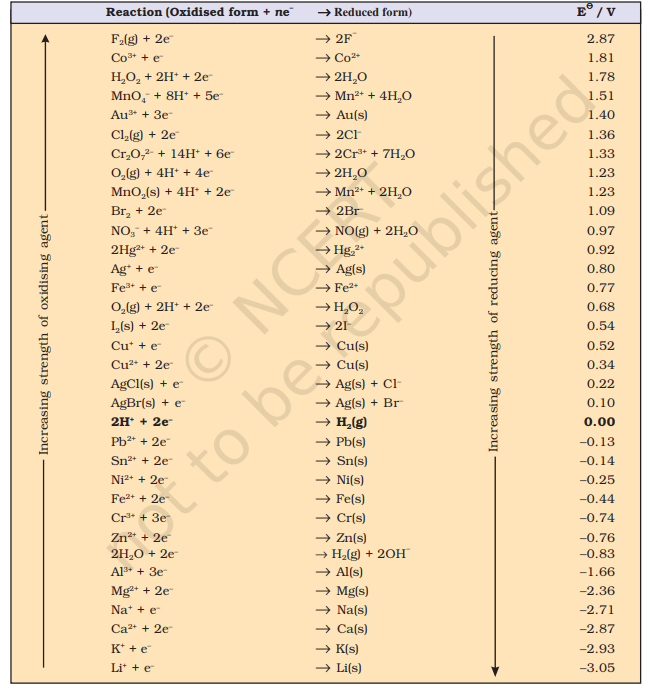
Using the standard electrode potentials given in the Table, predict if the reaction between the following is feasible:
$\mathrm{Ag}^{+}(\mathrm{aq})$ and $\mathrm{Cu}(\mathrm{s})$.
Explain the following:
  1. Boyle's law.
  2. Avogadro's law.
  3. Critical temperature.
Assuming the water vapor to be a perfect gas, calculate the internal energy change when 1 mol of water at $100^{\circ} C$ and 1 bar pressure is converted to the ice at $0^{\circ} C$. Given the enthalpy of fusion of ice is 6.00 kJ mol1 heat capacity of water is $4.2 J / g ^{\circ} C$.
A certain buffer is made by mixing sodium formate and formic acid in water. With the help of equations explain how this buffer neutralizes addition of a small amount of an acid or a base?
QUESTION "Stability of carbocations depends upon the electron releasing inductive effect of groups adjacent to positively charged carbon atom involvement of neighbouring groups in hyperconjugation and resonance."
Write structures of various carbocations that can be obtained from 2-methylbutane. Arrange these carbocations in order of increasing stability.
Explain the following terms:
  1. Photochemical smog.
  2. Acid rain.
  3. Eutrophication.
Balance the following equations by the oxidation number method.
$\text{MnO}_2+\text{C}_2\text{O}^{2-}_4\xrightarrow{ \ \ \ \ \ \ \ }\text{Mn}^{2+}+\text{CO}_2$