Question
Draw the structures of the following :
(a) $H_2S_2O_8$
(b) $ClF_3$
(a) $H_2S_2O_8$
(b) $ClF_3$
Get the step-by-step solution for this question inside the Vidyadip app.
Get the answer in the appGenerate a complete, print-ready paper with questions like this in minutes — across 16+ boards, with answer keys.
| Column I | Column II | ||
| (i) | 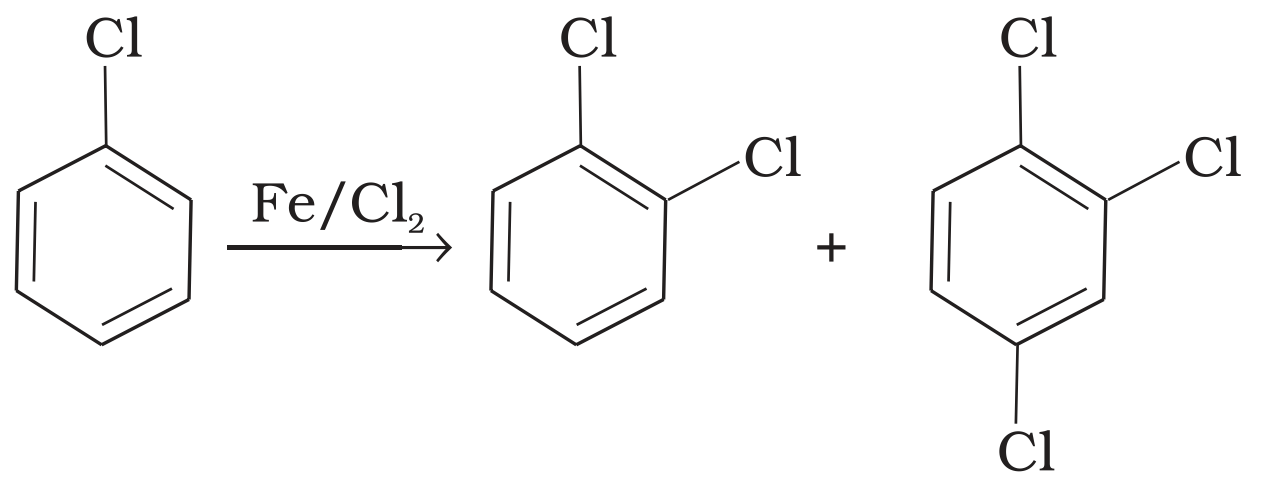 |
(a) | Nucleophilic aromatic substitution |
| (ii) | $\text{CH}_3-\text{CH}==\text{CH}_2+\text{HBr}\xrightarrow{ \ \ \ \ \ }\text{CH}_3-\text{CH}-\text{CH}_3\ \ \ \ \ \ \ \ \ \ \ \ \ \ \ \ \ \ \ \ \ \ \ \ \ \ \ \ \ \ \ \ \ \ \ \ | \ \ \ \ \ \ \ \ \ \ \ \text{Br}$ | (b) | Electrophilic aromatic substitution |
| (iii) | 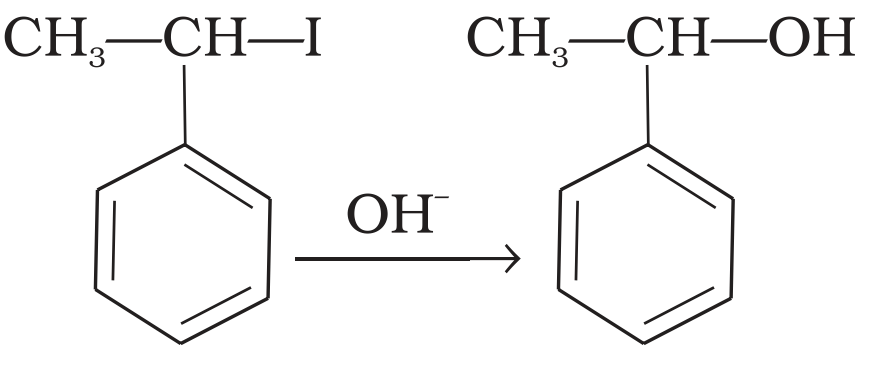 |
(c) | Saytzeff elimination |
| (iv) | 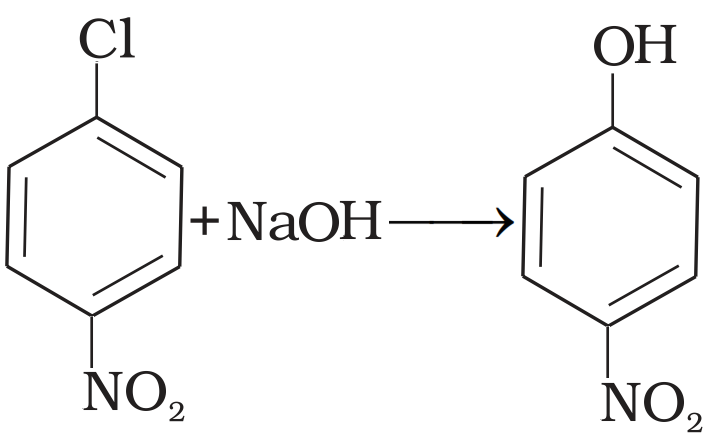 |
(d) | Electrophilic addition |
| (v) | $\text{CH}_3\text{CH}_2\text{CH}\text{CH}_3\xrightarrow{\text{alc.KOH}}\text{CH}_3\text{CH}==\text{CH}\text{CH}_3\ \ \ \ \ \ \ |\ \ \ \ \ \ \ \ \ \ \ \ \ \ \ \ \text{Br}$ | (e) | Nucleophilic substitution $(S_N1)$ |
| Column I | Column II | ||
| $(i)$ | Chloramphenicol | $(a)$ | Malaria |
| $(ii)$ | Thyroxine | $(b)$ | Anaesthetic |
| $(iii)$ | Chloroquine | $(c)$ | Typhoid fever |
| $(iv)$ | Chloroform | $(d)$ | Goiter |
| $(e)$ | Blood substituent |
|
$A^+$
|
$B^-$
|
$A^+$
|
$B^-$
|
$A^+$
|
|
$B^-$
|
$0$
|
$B^-$
|
$A^+$
|
$B^-$
|
|
$A^+$
|
$B^-$
|
$A^+$
|
$0$
|
$A^+$
|
|
$B^-$
|
$A^+$
|
$B^-$
|
$A^+$
|
$B^-$
|