Question
Draw velocity-time graph for an object, starting from rest. Acceleration is constant and remains positive.

Answer

Get the step-by-step solution for this question inside the Vidyadip app.

Get the answer in the app

Need a full question paper?

Generate a complete, print-ready paper with questions like this in minutes — across 16+ boards, with answer keys.
Start Generating Free

Similar questions

Why should the difference between the frequencies be less than 10 to produce beats?
5.74 g of a substance occupies $1.2 cm ^3$. Express its density by keeping the significant figures in view.
It is easier to catch a table tennis ball than a cricket ball even when both are moving with same velocity. Why?
What is the orbital velocity for a satellite orbiting close to the surface of earth?
At what angle should a ball be thrown so that its horizontal range is maximum?
Name the gas commonly used in refrigerators.
Express an acceleration of $10m/ s^2$ in $km/ h^2$.
A physical quantity $\text{X}=\frac{\text{a}^2\text{b}^{\frac{-3}{2}}}{\text{c}^4}$ A student says that the relative error in $2\frac{\Delta\text{a}}{\text{a}}-\frac{3}{2}\frac{\Delta\text{b}}{\text{b}}-4\frac{\Delta\text{c}}{\text{c}}.$ Do you agree with the student? If not, what is the relative error in X?
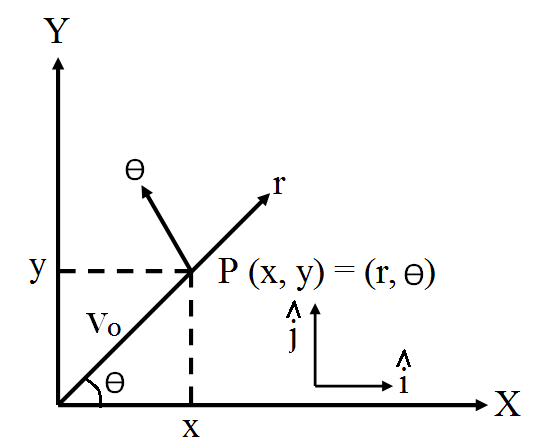
Motion in two dimensions, in a plane can be studied by expressing position, velocity and acceleration as vectors in Cartesian co-ordinates $\text{A}=\text{A}_\text{x}\hat{\text{i}}+\text{A}_\text{y}\hat{\text{j}}$ where $\hat{\text{i}}$ and $\hat{\text{j}}$ are unit vector along x and y directions, respectively and $A_x$ and $A_y$ are corresponding components of A Fig. Motion can also be studied by expressing vectors in circular polar co-ordinates as $\text{A}=\text{A}_\text{r}\hat{\text{r}}+\text{A}_\theta\hat{\theta}$ where $\hat{\text{r}}=\frac{\text{r}}{\text{r}}=\cos\theta\hat{\text{i}}+\sin\theta\hat{\text{j}}$ and $\hat{\theta}=-\sin\theta\hat{\text{i}}+\cos\theta\hat{\text{j}}$ are unit vectors along direction in which ‘r’ and ‘$\theta$’ are increasing.
  1. Express $\hat{\text{i}}$ and $\hat{\text{j}}$ in terms of $\hat{\text{r}}$ and $\hat{\theta}$.
  2. Show that both $\hat{\text{r}}$ and $\hat{\theta}$ are unit vectors and are perpendicular to each other.
  3. Show that $\frac{\text{d}}{\text{dt}}(\hat{\text{r}})=\omega\hat{\theta}$ where $\omega=\frac{\text{d}\theta}{\text{dt}}$ and $\frac{\text{d}}{\text{dt}}(\hat{\text{r}})=-\omega\hat{\text{r}}$
  4. For a particle moving along a spiral given by $\text{r}=\text{a}\theta\hat{\text{r}}$ , where a = 1 (unit), find dimensions of ‘a’.
  5. Find velocity and acceleration in polar vector represention for particle moving along spiral described in (d) above.
What is the frequency of oscillation of a simple pendulum mounted in a cabin that is freely falling under gravity?