MCQ
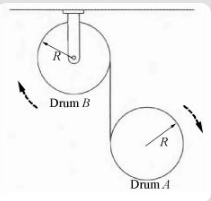
Drum A undergoes:
  • A
    Rotational motion.
  • B
    Translational motion.
  • C
    Rotational as well as translational motion.
  • D
    None of these.

Answer

  1. Rotational as well as translational motion.

Explanation:

The $\omega$ of drum B provides enough length of connecting wire for translational motion.

Need a full question paper?

Generate a complete, print-ready paper with questions like this in minutes — across 16+ boards, with answer keys.

Start Generating Free

Similar questions

Nitrogen gas is filled in an insulated container. If $\alpha$ fraction of moles dissociates without exchange of any energy, then the fractional change in its temperature is ..............
If $R =$ universal gas constant, the amount of heat needed to raise the temperature of $2$ mole of an ideal monoatomic gas from $273K$ to $373K$ when no work is done ...... $R$
Both earth and moon are subject to the gravitational force of the sun. As observed from the sun, the orbit of the moon.
Consider a sample of oxygen behaving like an ideal gas. At $300 \,K ,$ the ratio of root mean square (rms) velocity to the average velocity of gas molecule would be :

(Molecular weight of oxygen is $32 \,g / mol$ $\left. R =8.3 \,J K ^{-1} mol ^{-1}\right)$

In an elastic collision:
  1. The kinetic energy remains constant.
  2. The linear momentum remains constant.
  3. The final kinetic energy is equal to the initial kinetic energy.
  4. The final linear momentum is equal to the initial linear momentum.
A man balances himself in a horizontal position by pushing his hands and feet against two parallel walls. His centre of mass lies midway between the walls. The coefficients of friction at the walls are equal. Which of the following is not correct?
A room temperature the r.m.s. velocity of the molecules of a certain diatomic gas is found to be 1930m/ sec. the gas is:
The Bernoulli's theorem is based on the conservation of:
A body having its centre of mass at the origin has three of its particles at (a, 0, 0), (0, a, 0), (0, 0, a). The moments of inertia of the body about the X and Y axes are 0.20kg-m2 each. The moment of inertia about the Z-axis:
  1. Is 0.20kg-m2
  2. Is 0.40kg-m2
  3. Is $0.20\sqrt2\text{kg-m}^2$
  4. Cannot be deduced with this information.
Motion of a particle in $x - y$ plane is described by a set of following equations $x=4 \sin \left(\frac{\pi}{2}-\omega t\right) m$ and $y=4 \sin (\omega t) m$. The path of particle will be