MCQ
Dry ice is
  • A
    lce cube
  • B
    Sodium chloride
  • C
    Liquid nitrogen
  • Solid carbon dioxide

Answer

Correct option: D.
Solid carbon dioxide
(d) We know that when solid carbondioxide is heated, it becomes vapour directly without passing through its liquid phase. Therefore it is called dry ice.

Need a full question paper?

Generate a complete, print-ready paper with questions like this in minutes — across 16+ boards, with answer keys.
Start Generating Free

Similar questions

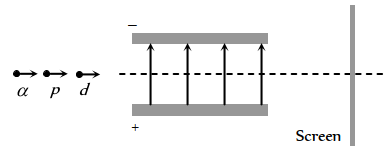
A proton, a deutron and an $\alpha$-particle having the same momentum, enters a region of uniform electric field between the parallel plates of a capacitor. The electric field is perpendicular to the initial path of the particles. Then the ratio of deflections suffered by them is
Image
A Container having $1$ mole of a gas at a temperature $27^{\circ} \mathrm{C}$ has a movable piston which maintains at constant pressure in container of $1 \mathrm{~atm}$. The gas is compressed until temperature becomes $127^{\circ} \mathrm{C}$. The work done is ( $C$ for gas is $7.03 \mathrm{cal} / \mathrm{mol} / \mathrm{K}$ )
If the ratio of coefficient of thermal conductivity of silver and copper is $10: 9$, then the ratio of the lengths upto which wax will melt in Ingen Hausz experiment will be
The energy which an $e^{-}$acquires when accelerated through a potential difference of 1 volt is called
Cathode rays enter into a uniform magnetic field perpendicular to the direction of the field. In the magnetic field their path will be
$5000\  kg$ rocket is set for vertical firing. The exhaust speed is $800\  ms ^{-1}$. To give an initial upward acceleration of $20\  ms ^{-2}$, the amount of gas ejected per second to supply the needed thrust will be $\left(g=10\  m s^{-2}\right)$
According to Bernoulli's equation$\frac{P}{\rho g}+h+\frac{1}{2} \frac{v^2}{g}=\text { constant }$ The terms $A, B$ and $C$ are generally called respectively:
If the density of the material increases, the value of Young's modulus
Find the change in internal energy of the system when a system absorbs $2$ kilocalorie of heat and at the same time does $500$ joule of work
The unit of the coefficient of viscosity in S.l. system is