- An atomic electron is ejected.
- An electron which is already present within the nucleus is ejected.
- A neutron in the nucleus decays emitting an electron.
- A proton in the nucleus decays emitting an electron.
Explanation:
Negative beta decay is given as
$\text{n}\rightarrow\text{p + e}^-+\bar{\text{v}}$
Neutron decays to produce proton, electron and anti-neutrino.
Generate a complete, print-ready paper with questions like this in minutes — across 16+ boards, with answer keys.
State which of the following is correct
|
(a) Joule = coulomb × volt |
(b) Joule = coulomb/volt |
|
(c) Joule = volt × ampere |
(d) Joule = volt/ampere |
At any instant the ratio of the amount of radioactive substances is 2 : 1. If their half lives be respectively 12 and 16 hours, then after two days, what will be the ratio of the substances
|
(a) 1 : 1 |
(b) 2 : 1 |
(c) 1 : 2 |
(d) 1 : 4 |

Solid targets of different elements are bombarded by highly energetic electron beams. The frequency (f) of the characteristic X-rays emitted from different targets varies with atomic number Z as
|
(a) f ∝ |
(b) f ∝ |
(c) f ∝ Z |
(d) f ∝ |
For the production of X-rays, the target should be made of
|
(a) Steel |
(b) Copper |
(c) Aluminum |
(d) Tungsten |
For the sustained interference of light, the necessary condition is that the two sources should
|
(a) Have constant phase difference |
(b) Be narrow |
|
(c) Be close to each other |
(d) Of same amplitude |
Two lines of force due to a bar magnet
|
(a) Intersect at the neutral point |
|
(b) Intersect near the poles of the magnet |
|
(c) Intersect on the equatorial axis of the magnet |
|
(d) Do not intersect at all |
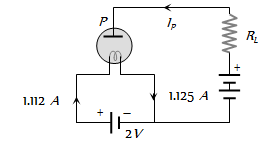
The value of plate current in the given circuit diagram will be

|
(a) 3 mA |
(b) 8 mA |
(c) 13 mA |
(d) 18 mA |