MCQ
During superposition of two waves of nearly equal frequencies, beats frequency is defined as the
  • A
    Sum of frequencies of interfering waves
  • Number of times the resultant intensity becomes maximum or minimum in one second
  • C
    Average of frequencies of interfering waves
  • D
    Number of times the resultant amplitude becomes maximum or minimum in one second
Answer

Correct option: B.
Number of times the resultant intensity becomes maximum or minimum in one second
b
(b)

Beats is the difference in the frequencies of two superimposing waves. Beats are noticed when the resultant wave acquire its higher amplitudes, due to both waves, sounding higher than the regular sound.

The beats would occur $f_1-f_2=\Delta f$ times per second. Hence answer is $(b)$.

Need a full question paper?

Generate a complete, print-ready paper with questions like this in minutes — across 16+ boards, with answer keys.

Start Generating Free

Similar questions

A projectile of mass $M$ is fired so that the horizontal range is $4\, km$. At the highest point the projectile explodes in two parts of masses $M/4$ and $3M/4$ respectively and the heavier part starts falling down vertically with zero initial speed. The horizontal range (distance from point of firing) of the lighter part is .................. $\mathrm{km}$
A trolley is carrying a box on its surface having coefficient of static friction equal to $0.3.$ Now the trolley starts moving with increasing acceleration. Find the maximum acceleration of the trolley so that the box does not slide back on the trolley.
A vertical wire carries a current in upward direction. An electron beam sent horizontally towards the wire will be deflected:
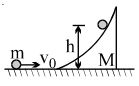
A particle of mass $m$ moving horizontally with $v_0$ strikes $a$ smooth wedge of mass $M$, as shown in figure. After collision, the ball starts moving up the inclined face of the wedge and rises to $a$ height $h$. When the particle has risen to $a$ height $h$ on the wedge, then choose the correct alternative $(s)$
A ball is projected from the ground with a speed $15 \,ms ^{-1}$ at an angle $\theta$ with horizontal so that its range and maximum height are equal, then $tan\,\theta$ will be equal to 
A cricketer can throw a ball to a maximum horizontal distance of $100\, m .$ The speed with which he throws the ball is (to the nearest integer)  (in $ms ^{-1}$)
A missile is launched with a velocity less than the escape velocity. The sum of its kinetic and potential energy is
A solid cylinder $(i)$ rolls down $(ii)$ slides down an inclined plane. The ratio of the accelerations in these conditions 
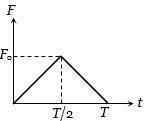
A particle of mass $m$ moving with velocity $u$ makes an elastic one dimensional collision with a stationary particle of mass $m$. They are in contact for a very short time $T$. Their force of interaction increases from zero to $F_0$ linearly in time $T/2$, and decreases linearly to zero in further time $T/2$. The magnitude of $F_0$ is
The ends of a rope are held by two men who pulls on it with equal and opposite forces of  magnitude $F$ each. Then the tension in the rope is