MCQ
During the nuclear fusion reaction
  • A
    A heavy nucleus breaks into two fragments by itself
  • B
    A light nucleus bombarded by thermal neutrons breaks up
  • C
    A heavy nucleus bombarded by thermal neutrons breaks up
  • Two light nuclei combine to give a heavier nucleus and possibly other products
Answer

Correct option: D.
Two light nuclei combine to give a heavier nucleus and possibly other products
d
A nuclear reaction in which atomic nuclei of low atomic number fuse to form a heavier nucleus with the release of energy is called nuclear fusion.

Need a full question paper?

Generate a complete, print-ready paper with questions like this in minutes — across 16+ boards, with answer keys.

Start Generating Free

Similar questions

Electroscope is used:
A number of capacitors each of capacitance $1\,\mu F$ and each one of which get punctured if a potential difference just exceeding $500\,volt$ is applied, are provide, then an arrangement suitable for givin  a capacitance of $2\,\mu F$ across which $3000\,volt$ may be applied requires at least
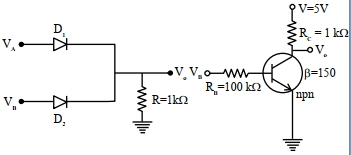
If ${V}_{{A}}$ and ${V}_{{B}}$ are the input voltages (either $5\, {V}$ or $0\, {V}$ ) and ${V}_{0}$ is the output voltage then the two gates represented in the following circuit $(A)$ and $(B)$ are:-

$(A)\quad\quad\quad\quad(B)$

A ray of light is incident on the plane mirror at rest. The mirror starts turning at a uniform acceleration of $4\pi \, rad/s^2$.The reflected ray at the end of $\frac{1}{4}\, s$ must have turned through......$^o$
A photo cell is receiving light from a source placed at a distance of 1 m. If the same source is to be placed at a distance of 2 m, then the ejected electron
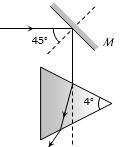
A ray of light strikes a plane mirror $M$ at an angle of $45^o $ as shown in the figure. After reflection, the ray passes through a prism of refractive index $1.5$ whose apex angle is $4^o $. The total angle through which the ray is deviated is....$^o$
Magnetic field does not cause deflection in:
Two lenses are placed in contact with each other and the focal length of combination is $80 cm$. If the focal length of one is $20 cm,$ then the power of the other will be
The force with which a magnet attracts objects like iron is called $............$
A girl brings a positively charged rod near a thin neutral stream of water flowing from a tap. She observes, that the water stream, bends towards her. Instead, if she is to bring a negativity charged rod near to the stream, it will: