MCQ
Magnetic field does not cause deflection in:
  • A
    $\alpha-\text{rays}$
  • B
    $\beta^+-\text{rays}$
  • C
    $\beta^--\text{rays}$
  • $\gamma-\text{rays}$

Answer

Correct option: D.
$\gamma-\text{rays}$

Magnetic force acts on a charged particle, due to which it deflects from its path. The magnitude of this force is measured as $\Big|\overrightarrow{\text{F}}\Big|=\Big|\text{q}\Big(\overrightarrow{\text{v}}\times\overrightarrow{\text{B}}\Big)\Big|.$
Here, $q$ is the charge on the particle that is moving with speed v in a uniform magnetic field $B$.
Since alpha, beta$-$plus and beta$-$minus are charged particles, they suffer deflection due to the field applied. On the other hand, gamma rays are photons and due to zero charge, they do not suffer any deflection.

Need a full question paper?

Generate a complete, print-ready paper with questions like this in minutes — across 16+ boards, with answer keys.
Start Generating Free

Similar questions

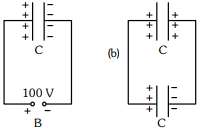
A capacitor of capacitance $C =900\,pF$ is charged fully by $100\,V$ battery $B$ as shown in figure $(a)$. Then it is disconnected from the battery and connected to another uncharged capacitor of capacitance $C =900\,pF$ as shown in figure $(b)$. The electrostatic energy stored by the system $(b)$ is $\dots\dots\times 10^{-6}\,J$
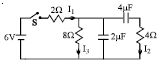
In the circuit shown in the figure, the switch $S$ is initially open and the capacitor is initially uncharged. $ I_1, I_2$ and $I_3$ represent the current in the resistance $2\,\Omega , 4\,\Omega $ and $8\,\Omega$ respectively.
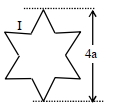
A symmetric star conducting wire loop is carrying a steady state current $\mathrm{I}$ as shown in figure. The distance between the diametrically opposite vertices of the star is $4 a$. The magnitude of the magnetic field at the center of the loop is
Which of the following helps us in the determination of the temperature of sun
Which of the following waves have a maximum frequency?
A conducting rod is moved with a constant velocity v in a magnetic field. A potential difference appears across the two ends:
Wavelength of light of frequency 100Hz
A man is looking at a small object placed at his near point. Without altering the position of his eye or the object, he puts a simple microscope of magnifying power $5X$ before his eyes. The angular magnification achieved is:
A square card of side length $1\, mm$ is being seen through a magnifying lens of focal length $10\, cm$. The card is placed at a distance of $9\, cm$ from the lens. Axis is perpendicular to the plane of card. The apparent area of the card through the lens is......$cm^2$
When a proton moves in a uniform magnetic field, the momentum change but its kinetic energy does not change because: