$E$ denotes electric field in a uniform conductor, $I$ corresponding current through it, ${v_d}$ drift velocity of electrons and $P$ denotes thermal power produced in the conductor, then which of the following graph is incorrect
- A
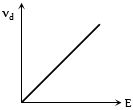
- B
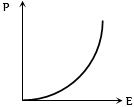
- C
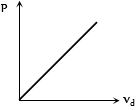
- D
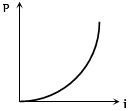
Easy


Download our appand get started for free
Experience the future of education. Simply download our apps or reach out to us for more information. Let's shape the future of learning together!No signup needed.*
Similar Questions
- 1A wire of length $10 \mathrm{~cm}$ and radius $\sqrt{7} \times 10^{-4} \mathrm{~m}$ connected across the right gap of a meter bridge. When a resistance of $4.5 \ \Omega$ is connected on the left gap by using a resistance box, the balance length is found to be at $60 \mathrm{~cm}$ from the left end. If the resistivity of the wire is $\mathrm{R} \times 10^{-7} \Omega \mathrm{m}$, then value of $\mathrm{R}$ is :View Solution
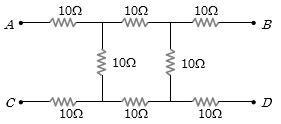
- 2What will be the equivalent resistance between the two points $A$ and $D$ ............. $\Omega$View Solution
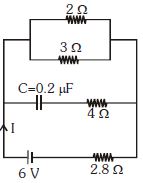
- 3In the given figure the steady state current $I$ is ................. $\mathrm{A}$View Solution
- 4The internal resistance of a $2.1\, V$ cell which gives a current of $0.2\, A$ through a resistance of $10\,\Omega$ is ............. $\Omega$View Solution
- 5View SolutionIn the given circuit, the terminal potential difference of the cell is:
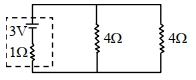
- 6A thermocouple of negligible resistance produces an $e.m.f.$ of $40\,\mu V{/^o}C$ in the linear range of temperature. A galvanometer of resistance $10\; ohm$ whose sensitivity is $1\;\mu A/div$, is employed with the thermocouple. The smallest value of temperature difference that can be detected by the system will beView Solution
- 7$A$. The drift velocity of electrons decreases with the increase in the temperature of conductor.View Solution
$B$. The drift velocity is inversely proportional to the area of cross-section of given conductor.
$C$. The drift velocity does not depend on the applied potential difference to the conductor.
$D$. The drift velocity of electron is inversely proportional to the length of the conductor.
$E$. The drift velocity increases with the increase in the temperature of conductor.
Choose the correct answer from the options given below:
- 8A potentiometer having the potential gradient of $2\, mV/cm$ is used to measure the difference of potential across a resistance of $10 \,\Omega$. If a length of $50\, cm$ of the potentiometer wire is required to get the null point, the current passing through the $10 \,\Omega$ resistor is (in $mA$)View Solution
- 9With a potentiometer null point were obtained at $140\, cm$ and $180\, cm$ with cells of $emf$ $1.1 \,V$ and one unknown $X\, volts$. Unknown $emf$ is .............. $V$View Solution
- 10Two identical batteries, each of $e.m.f.$ $2\, volt$ and internal resistance $1.0\, ohm$ are available to produce heat in an external resistance $R = 0.5\,ohm$ by passing a current through it. The maximum Joulean power that can be developed across $R$ using these batteries is ............. $watt$View Solution