MCQ
Each capacitor in the circuit shown is a 1F capacitor. What would be the equivalent capacitance between A and B?
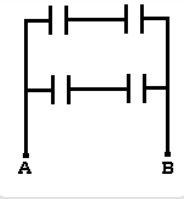
- A0.5F
- BF
- C2F
- D4F
Explanation:
Equivalent capacitance of each pair of capacitance in series$=\frac{1\times1}{1+1}\text{F}=0.5\text{F}$
The two series combination are connected in parallel. Hence the net capacitance becomes 0.5F + 0.5F = 1F
Generate a complete, print-ready paper with questions like this in minutes — across 16+ boards, with answer keys.
Magnetic effect of current was discovered by
|
(a) Faraday |
(b) Oersted |
(c) Ampere |
(d) Bohr |
The e.m.f. of a cell is E volts and internal resistance is r ohm. The resistance in external circuit is also r ohm. The p.d. across the cell will be
|
(a) E/2 |
(b) 2E |
(c) 4E |
(d) E/4 |
An electron of mass m when accelerated through a potential difference V has de-Broglie wavelength λ. The de-Broglie wavelength associated with a proton of mass M accelerated through the same potential difference will be
|
(a) λ |
(b) λ |
(c) λ |
(d) λ |
The resistance of a conductor is 5 ohm at 50 oC and 6 ohm at 100 oC. Its resistance at 0 oC is
|
(a) 1 ohm |
(b) 2 ohm |
(c) 3 ohm |
(d) 4 ohm |
In a double slit arrangement fringes are produced using light of wavelength 4800 Å. One slit is covered by a thin plate of glass of refractive index 1.4 and the other with another glass plate of same thickness but of refractive index 1.7. By doing so the central bright shifts to original fifth bright fringe from centre. Thickness of glass plate is
|
(a) 8 mm |
(b) 6 mm |
(c) 4 mm |
(d) 10 mm |
Positive rays consists of
|
(a) Electrons |
(b) Neutrons |
|
(c) Positive ions |
(d) Electro magnetic waves |
A calcite crystal is placed over a dot on a piece of paper and rotated, on seeing through the calcite one will be see
|
(a) One dot |
(b) Two stationary dots |
|
(c) Two rotating dots |
(d) One dot rotating about the other |


