MCQ
Of the following properties, the photon does not process:
- ARest mass
- BMomentum
- CEnergy
- DFrequency
Explanation:
A particle representing a quantum of light or other electromagnetic radiation.
A photon carries energy proportional to the radiation frequency but has zero rest mass.
Generate a complete, print-ready paper with questions like this in minutes — across 16+ boards, with answer keys.
The radioactive decay of uranium into thorium is expressed by the equation 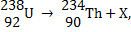 where ‘X’ is
|
(a) An electron |
(b) A proton |
(c) A deuteron |
(d) An alpha particle |
$\text{I}_0$
$\frac{\text{I}_0}{4}$
$\frac{\text{I}_0}{2}$
$4\text{I}_0$
Indicate which one of the following system is digital
|
(a) Pulse position modulation |
(b) Pulse code modulation |
|
(c) Pulse width modulation |
(d) Pulse amplitude modulation |
The velocity of light in a medium is half its velocity in air. If ray of light emerges from such a medium into air, the angle of incidence, at which it will be totally internally reflected, is
|
(a) 15o |
(b) 30 o |
(c) 45 o |
(d) 60 o |
If in the experiment of Wheatstone's bridge, the positions of cells and galvanometer are interchanged, then balance points will
|
(a) Change |
|
(b) Remain unchanged |
|
(c) Depend on the internal resistance of cell and resistance of galvanometer |
|
(d) None of these |
In Young's double slit experiment using sodium light (λ = 5898 Å), 92 fringes are seen. If given colour (λ = 5461 Å) is used, how many fringes will be seen
|
(a) 62 |
(b) 67 |
(c) 85 |
(d) 99 |