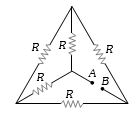
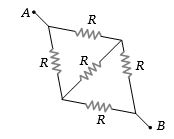
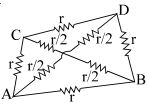
Each of the resistance in the network shown in fig. is equal to $R$. The resistance between the terminals $A$ and $B$ is
AIIMS 2017, Easy


Download our appand get started for free
Experience the future of education. Simply download our apps or reach out to us for more information. Let's shape the future of learning together!No signup needed.*
Similar Questions
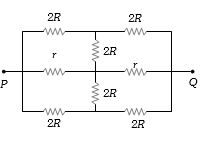
- 1The effective resistance between points $P$ and $Q$ of the electrical circuit shown in the figure isView Solution
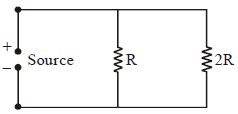
- 2The charge supplied by source varies with time $'t'$ as $Q = at -bt^2$. The total heat produced in the resistor $2R$ before current reduces to zeroView Solution
- 3A wire of radius $r$ has resistance $R$. If it is stretched to a radius of $\frac{{3r}}{4}$, its resistance becomesView Solution
- 4The figure shows a tetrahedron, each side of which has a resistance $r$ If a battery is connected between any two points of the tetrahedron, then identify the correct statement $(s)$.View Solution
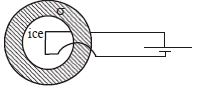
- 5Figure shows a thick shell made of electrical conductivity $\sigma$ and has inner & outer radii of $10\ cm$ & $20\ cm$ respectively and is filled with ice inside it. Its inside and outside surface are kept at different potentials by a battery of internal resistance $\frac{2}{\pi} \Omega \ \&\ \epsilon = 5V$. Find value of $\sigma$ for which ice melts at maximum possible rate if $25\%$ of heat generated by shell due to joule heating is used to melt ice.View Solution
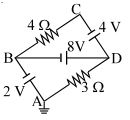
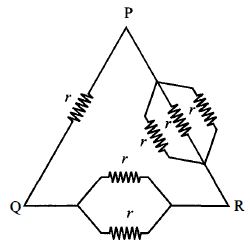
- 6Six equal resistances are connected between points $P, Q$ and $R$ as shown in figure. Then net resistance will be maximum betweenView Solution
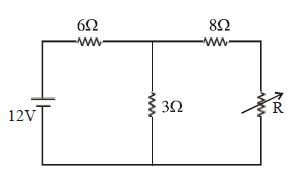
- 7The maximum power delivered to resistance $R$ is ............... $W$View Solution
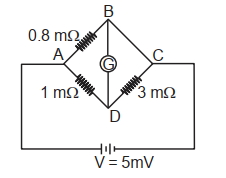
- 8To measure the temperature coefficient of resistivity $\alpha$ of a semiconductor, an electrical arrangement shown in the figure is prepared. The arm BC is made up of the semiconductor. The experiment is being conducted at $25^{\circ} \mathrm{C}$ and resistance of the semiconductor arm is $3 \mathrm{~m} \Omega$. Arm BC is cooled at a constant rate of $2^{\circ} \mathrm{C} / \mathrm{s}$. If the galvanometer $\mathrm{G}$ shows no deflection after $10 \mathrm{~s}$, then $\alpha$ is :View Solution
- 9Two wires have resistance of $2$ $\Omega$ and $4$ $\Omega$ connected to same voltage, ratio of heat dissipated at resistance isView Solution
- 10The figure shows a network of resistances in which the point $A$ is earthed. The current through the $4\,\Omega$ resistor isView Solution